
Trump says the US now controls 65 billion barrels of Venezuelan oil. US forces struck Iran in Hormuz Sunday. Software earnings broke the sector's rally open.
Thirty-five percent.
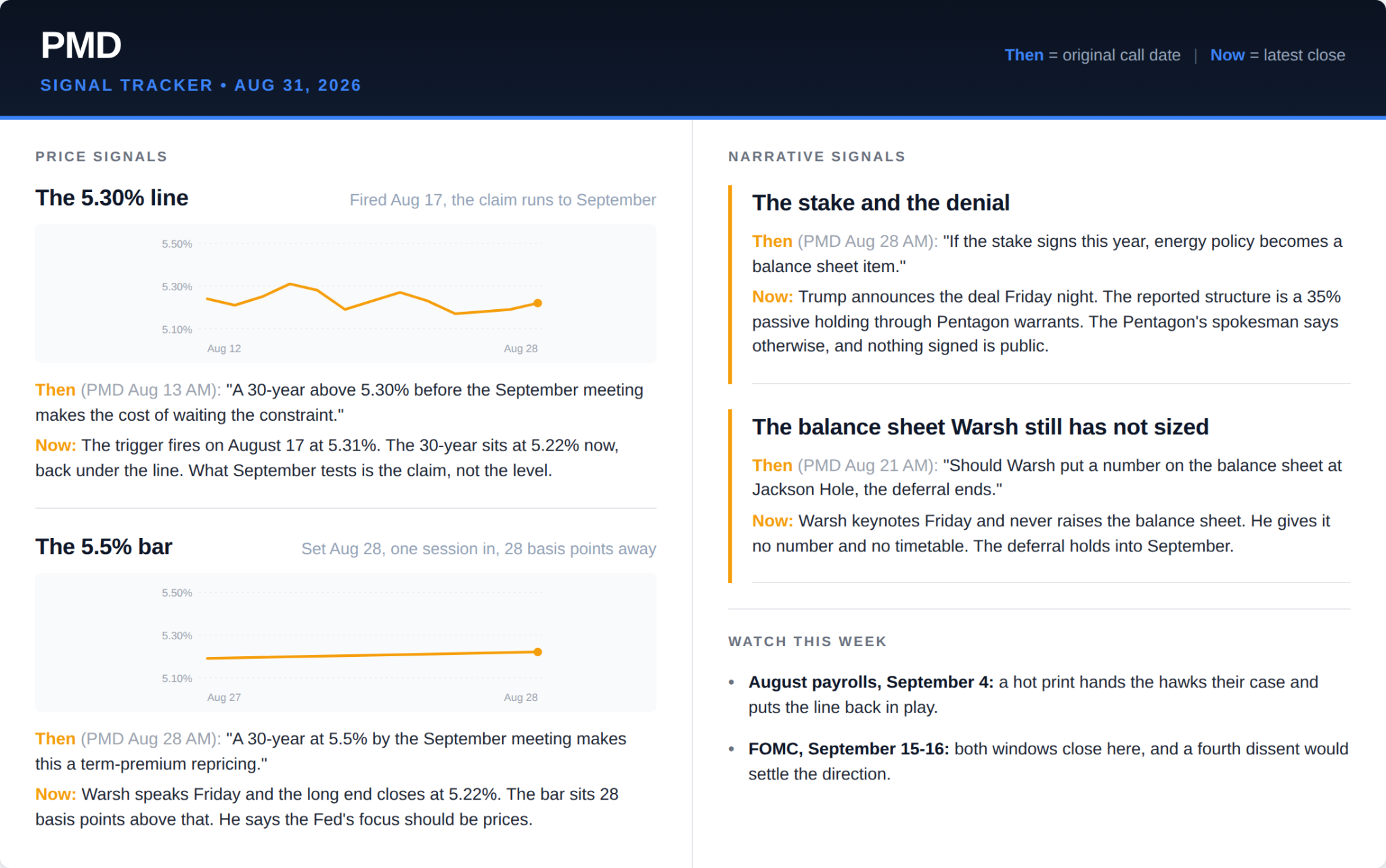
That is the stake in a Venezuelan oil venture the Journal says Washington is taking. The Pentagon denies its capital office takes equity at all. Both cannot be right.
Trump said Friday night the US has taken control of 65 billion barrels of Venezuelan oil. The Journal reports a 35% passive stake, held by the Pentagon.
US forces struck two Iranian rocket launchers in Hormuz Sunday. Iran vowed severe repercussions.
Software earnings broke the sector open. Salesforce (CRM) jumped 22.6% and the software ETF turned positive for the year.
Aon (AON) is near a $17 billion deal for KKR's (KKR) USI Insurance, one of private equity's biggest exits in a stuck market.
Bessent is at the G20 pressing allies on Iran.
PMD LENS
Friday's PMD tracked the advanced talks. Friday afternoon had Chevron (CVX) nearing deals. Hours later the US government was the investor itself. This is the endpoint of the interventionist industrial policy that ran through Intel (INTC) and MP Materials (MP): the Pentagon taking direct equity in foreign oil reserves. Two days on, the US struck Iran in Hormuz. That is the chokepoint the stake goes around, and Sunday showed why.
Wall Street Owns 88% — Yet Most Investors Don’t Know the Name

Institutions already control 88% of this little-known company.
BlackRock owns roughly 32 million shares. Vanguard owns about 48 million.
And management authorized a 40-million-share buyback.
One man believes Wall Street may see something Main Street has missed.
- The Pentagon structures its stake through penny warrants, giving the US equity with almost no capital outlay.
- The deal conflicts with Venezuela's 1999 constitution, which says the country's reserves cannot be sold.
- A single Panama Canal slot just sold for a record $5.3 million, on rerouting around Hormuz.
- Gold is up 10% in August, its best month since January. Bitcoin briefly broke $80,000 on a short squeeze.
- OpenAI is cutting off model access to Cursor after SpaceX (SPCX) bought it, escalating the Musk-Altman feud.
The US Government Just Became an Oil Investor in Venezuela. The Pentagon Holds the Stake.
Washington Stopped Opening Doors
For years Washington opened doors abroad for oil companies. Friday night it walked through one itself. The US takes 35% of North American Blue Energy Partners. That company holds century-long rights to 17 Venezuelan fields. Washington also gets first call on a fifth of future output, at cost.
The Warrant Trick
The Journal puts the holding at the Pentagon's Office of Strategic Capital. It arrives as penny warrants. The Pentagon says otherwise. Its spokesman says that office does not take equity stakes at all. So one of two things is true. Washington owns a third of an oil venture, or an option nobody will confirm.
The Counterparty Is a Constitution
The administration wanted a Western Hemisphere source while the Iran war runs. Venezuela pumps 1.1 million barrels a day, about what North Dakota does. Rebuilding those fields takes years. Article 12 of the charter makes those reserves inalienable. The question is not whether the deal breaks it. It is who enforces it.
The Sovereign Ahead of You
The market read a 35% stake and priced a policy shift. What exists on paper is a warrant nobody will confirm. Either way a government now sits inside an oil producer's capital structure. A written Pentagon confirmation before year end turns the option into a position.
The Closest Thing to a Virtual AI Monopoly Wall Street Is Ignoring
A little-known company is building what may be the closest thing to a virtual monopoly the AI era has ever seen.
Only 3...
Yet it beat Apple, Amazon, and the S&P 500 combined...
While paying out $146,000 in total dividends on a 1,000-share stake.
Kevin O'Leary calls what it controls a "unicorn."
Right now, it's trading at a rare discount.
>>>Whitney Tilson reveals the name, completely free.<<<
This ad is sent on behalf of Stansberry Research, 1125 N Charles St, Baltimore, MD 21201. If you would like to optout from receiving offers from Stansberry Research please click here.
SIGNAL 1: The Hedge and the Chokepoint Landed the Same Weekend
The US hit two Iranian rocket launchers on Larak Island Sunday. Central Command said they were about to fire rockets carrying sea mines.
Crude jumped more than 2%. Iran fired at US forces in Jordan hours later. The IRGC called the strike a fatal error.
Washington has run sanctions, not a ground war. Another bank gets designated this week. Sunday was the other instrument.
The Second Instrument
Crude trades a strait at a twentieth of prewar traffic. Sanctions and strikes rest on opposite theories of how Iran answers. Only one is right and the tape has picked neither. Nobody can size that trade until Tehran picks for them.
SIGNAL 2: Software Answered Back With Earnings
The trade that said AI would eat software met a quarter that disagreed.
Salesforce's contracted sales rose 14%. Benioff: "Our seats were supposed to decline." They grew instead. Workday (WDAY) now runs nearly $600 million of AI subscriptions. That was $500 million a quarter ago. CrowdStrike (CRWD) and ServiceNow (NOW) ran too.
Mizuho's Jordan Klein points at the other engine. Funds were underweight and short. The sector rose on two things.
The Two Engines
Marks moved on a thesis that just failed. No one has split conviction from short covering. Private marks follow the answer, not the move. One engine has a quarter left.
SIGNAL 3: Private Equity Found a Buyer That Isn't Another Fund
Aon is close to paying about $17 billion for USI Insurance. KKR and a Canadian pension fund bought it for $4.3 billion in 2017.
KKR posted a record quarter of asset sales in July. That was one manager selling. What differs here is the buyer.
Secondaries clear fund stakes at a discount. The natural buyer is another fund. Aon is an operator.
The Operator Bid
A thaw is what the market took. The buyer is the part it skipped. An operator buys one company it can absorb and nothing else. Another operator taking a $10 billion fund asset by October 31 makes the bid a market.
Landmark Executive Order 14241 Unleashes
TRUMP’S NEW DOLLAR
Republican or Democrat – whether you support or oppose Trump’s New Dollar – every American could soon be forced to use it
Discover three critical moves to help you prepare, before it’s too late
- Watch today's G20 for cover on Iranian oil buyers.
- Huang takes the G20 stage September 2, on chip orders.
- Watch September 4 payrolls for the hawks' excuse.
- Canadian counter-tariffs reach shelf prices September 8.
- September 9 lifts the long-end buyback floor. Watch the 30-year.
- September 15-16 settles whether three dissents become four.
Capital Discipline
A government that buys into your sector is not the referee. It is a shareholder in a competitor that can price below cost for reasons unrelated to profit. Your model assumes a rival that must earn.
Worth an hour before September's IC. Take your largest position in a market a state-backed rival could serve. Count the revenue it could win at a price you cannot match. Strip it out and rerun the return. If the position still clears your hurdle, the moat is commercial. If it clears only with that revenue, the moat is a regulator.
Venezuela named the energy hedge. Iran named the conflict it hedges against. Software named the AI-thesis correction. Aon and KKR named the exit thaw. The week opens on a government that just became an oil investor and a Fed that may tighten into the inflation oil is feeding.
The open question is whether 65 billion barrels a century out does anything for a gas price now. The barrels are years away. The strait is still contested. And the Fed watches prices the fiscal side cannot lower fast enough. The September 4 jobs print is the first answer.