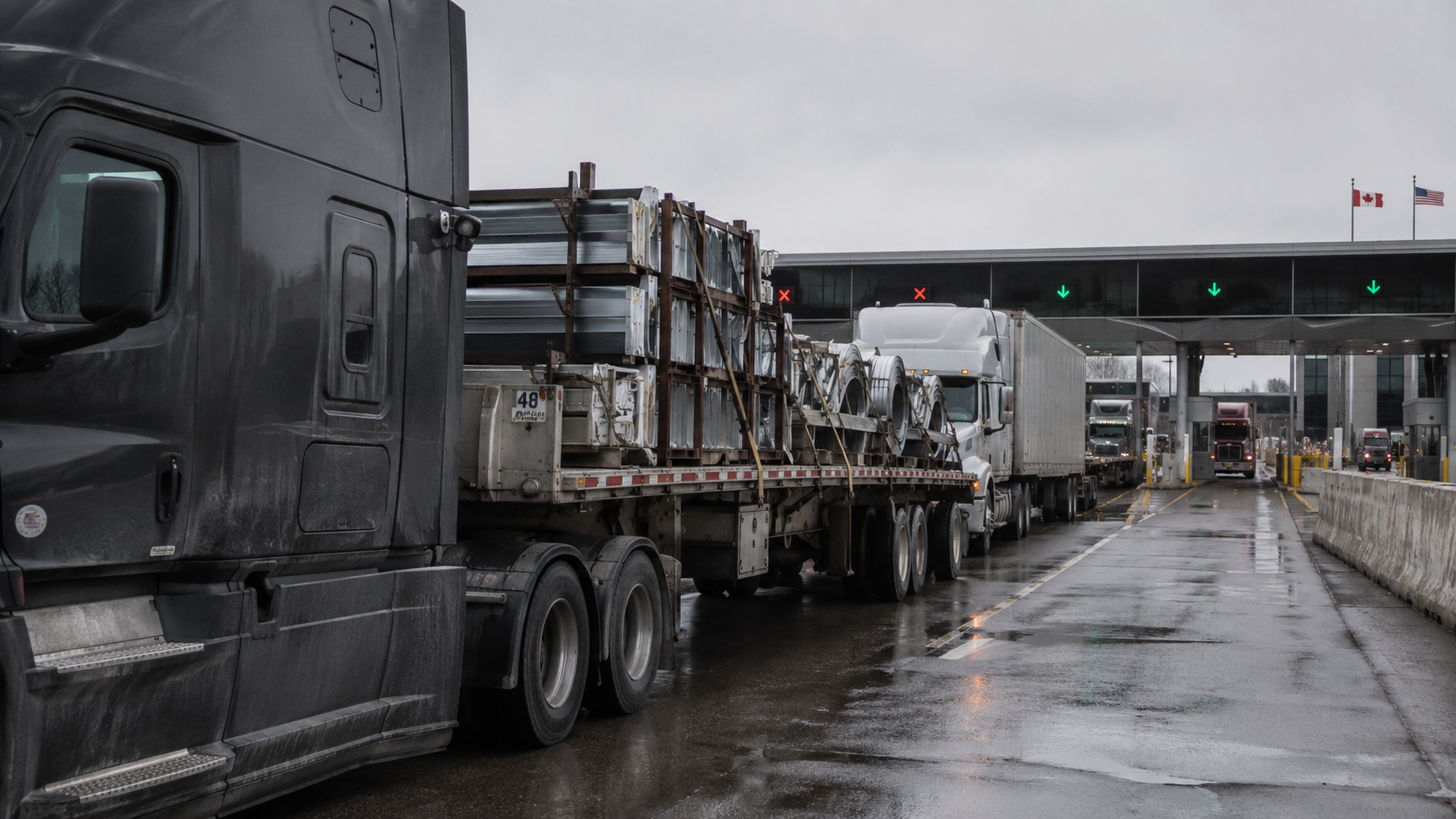
At 12:01 a.m. ET on Saturday, the United States began collecting 50% tariffs on roughly $20 billion of Canadian goods, about 5% of Canada's total exports to the US, after weekend trade talks between the two countries collapsed. The list covers electronics, industrial machinery, dairy products, steel, lumber and autos. Canada has not sat still: Prime Minister Mark Carney announced dollar-for-dollar retaliatory tariffs on US steel, dairy, appliances, agricultural machinery, paper and electronics, set to take effect September 8.
The overlap in those two lists is the story. Autos, steel and dairy appear on both countries' tariff and retaliation sheets. That means the same cross-border supply chains, parts crossing into Canada for assembly, steel crossing back the other way, dairy inputs moving in both directions, now absorb cost shocks from two directions simultaneously. A one-way tariff raises costs for importers on one side of a border. This structure raises costs for producers and importers on both sides of the same integrated chain, a materially different problem for the companies caught inside it, including automakers such as GM, Ford and Stellantis, and steelmakers such as Nucor, Steel Dynamics and U.S. Steel.
Why this isn't a quick fix
Around August 19, President Trump had described the framework under discussion as a "very fair trade agreement." By the weekend, US Trade Representative Jamieson Greer said Canada "declined to finalise the trade deal under the terms agreed earlier this week." Carney called the US tariffs "uneconomic, unfair" and said "we got attacked." Those are competing framings of the same breakdown, and each side has now staked out a public position that makes climbing down harder without looking like it lost the exchange.
A two-week window, not a dead end
Carney's retaliation doesn't take effect until September 8, more than two weeks after the US tariffs started. That gap is either a courtesy to importers who need time to adjust or a window left open for a negotiated fix; the record does not say which, and neither government has indicated whether talks will resume before then. Canada chose delay over immediate mirroring, which keeps a door open that same-day retaliation would have closed.
Markets aren't pricing this as a shock, yet
The Canadian dollar moved, but not dramatically: USD/CAD traded at 1.38259, up 0.46% on the session, inside a 1.37826-1.38507 range. That's a modest, directionally consistent softening in the loonie, not a currency crisis.
US equity-index futures were mixed rather than sharply risk-off as of roughly 4:03 a.m. ET Monday: S&P 500 futures down 0.22% to 7,674.25, Nasdaq futures down 0.72% to 29,175.50, and Dow futures down 0.09% to 53,306.00. That softness shouldn't be read as a verdict on the tariff news specifically. The same session carried a pending Iran-sanctions announcement and positioning ahead of both the Jackson Hole conference and Nvidia's earnings, any of which could be moving futures independent of, or alongside, the trade story. Separating which catalyst is doing the work isn't possible from this data alone.
What decides the outcome
If Washington and Ottawa reach an understanding before September 8, the retaliatory list never takes effect and this reads as a hardball negotiating tactic that briefly escalated before resolving. If it arrives without a deal, both governments will have converted a rhetorical standoff into a live, two-directional cost shock running through the same auto, steel and dairy supply chains. September 8 is the date that decides which story this becomes.