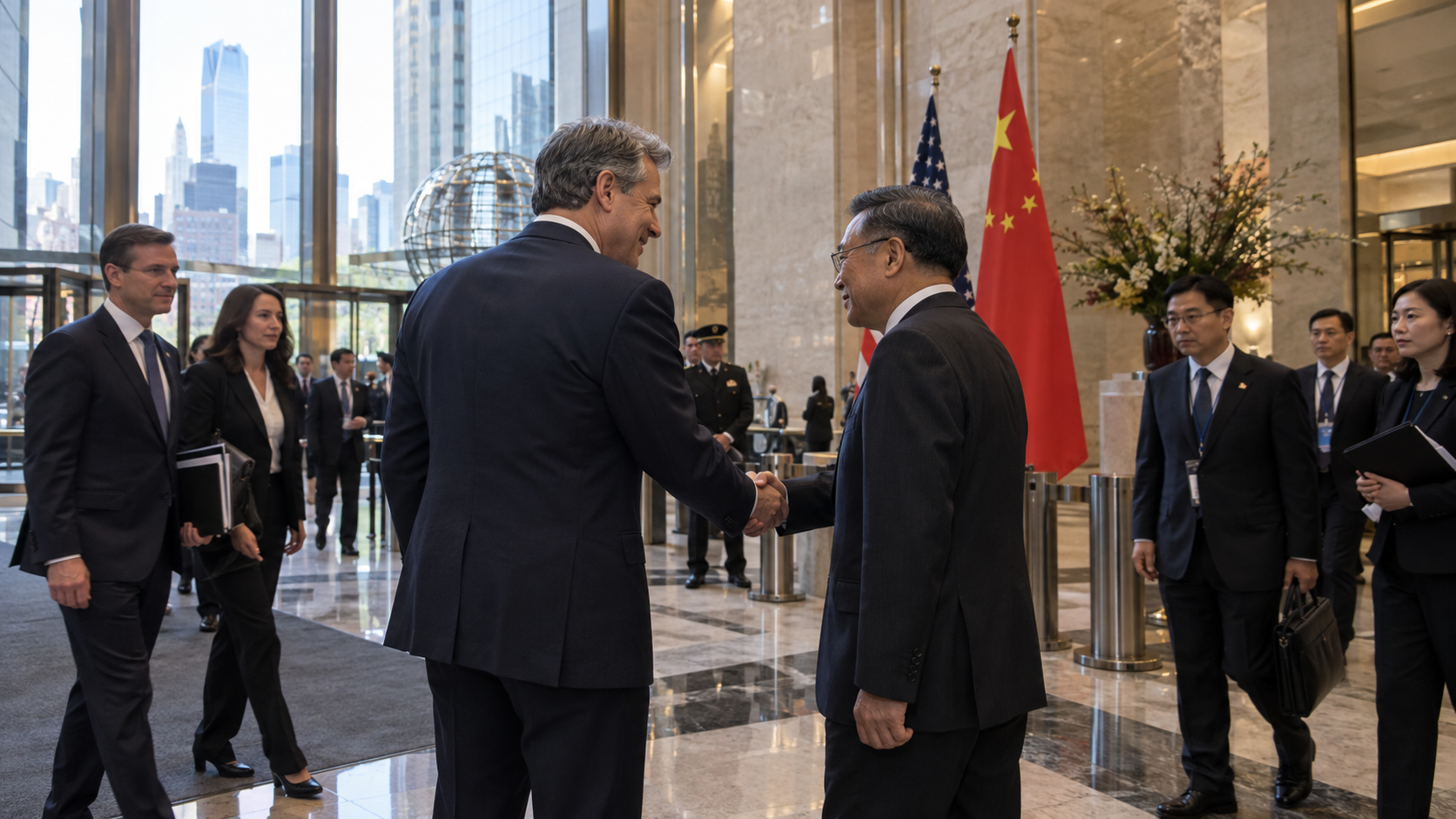
Treasury Secretary Scott Bessent and Chinese Vice Premier He Lifeng met in New York to lay groundwork for a presidential summit this week, with a trade truce set to expire in November and Washington saying Beijing's promised flow of critical minerals still falls short.
Treasury Secretary Scott Bessent and Chinese Vice Premier He Lifeng met in New York on September 20 to prepare potential agreements on artificial intelligence, tariffs and critical minerals ahead of a high-stakes summit this week between President Trump and Chinese President Xi Jinping. The talks, held at JPMorgan Chase's Manhattan headquarters and also involving U.S. Trade Representative Jamieson Greer, were expected to run the full day. Bessent told reporters beforehand that he looked forward to "focused, fulsome and constructive talks" ahead of the presidential meeting.
The most immediate deadline hanging over the talks is a U.S.-China trade truce set to expire on November 10. The two sides also discussed the flow of Chinese rare-earth magnets and other critical minerals, which U.S. officials say has not met the commitments China made under the truce, with a senior U.S. official saying Beijing's performance on that front "has not been up to par." Rare earths remain central to the relationship because they are essential to manufacturing the advanced semiconductors that power artificial-intelligence systems, giving China leverage it has used before in trade disputes with Washington.
Artificial intelligence itself has become a formal agenda item in a way it was not during earlier rounds of talks. Bessent said he expects the discussion to cover both open-weight and closed-weight AI models, and he called for the two countries to agree on AI "guard rails" aimed at keeping powerful models out of the hands of malign non-state actors. "The United States remains the leader in AI," Bessent said. "And we are open to discussions on avoiding shared risks and avoiding bifurcation of our two systems." Representative Ro Khanna, the ranking Democrat on the House Select Committee on Strategic Competition with China, said any agreement between Trump and Xi on AI should include a ban on recursive self-improving AI systems and safeguards against the technology being misused to develop biological or nuclear weapons.
Most analysts expect the talks to produce incremental progress rather than a breakthrough. Anna Ashton, a China trade analyst and founder of Ashton Intelligence, said she does not expect a major shift, calling "status quo" the most likely outcome both governments are working toward, even as both sides look for enough deliverables to justify the optics of a presidential summit. The talks build on commitments made at a May meeting between Bessent, He and Greer in Beijing, including an effort to cut tariffs on non-strategic goods and Chinese pledges to increase agricultural purchases by $17 billion a year and to buy more than 200 Boeing aircraft, commitments that remain works in progress rather than completed transactions.
The broader tariff backdrop remains unsettled on its own. A November 2025 truce reached in Busan, South Korea, had capped Trump-era tariffs on Chinese goods at about 20% after they had briefly reached triple digits on both sides, but the U.S. Supreme Court later struck down the national-emergency legal authority the administration had used to impose them. The administration has since been rebuilding tariff measures under different legal authorities, including a 12.5% tariff on Chinese goods tied to forced-labor allegations, and is finalizing a separate investigation aimed at curbing what it describes as excess industrial capacity in China. Separately, a coalition of U.S. auto industry groups sent Trump a letter this week urging him to maintain an effective ban on Chinese vehicle sales in the United States on national security grounds, even as Trump has signaled openness to allowing Chinese automakers to build factories domestically, a tension that will likely surface again once Trump and Xi sit down directly.