

The last time a major central bank raised interest rates into a raging oil shock was July 3, 2008. Jean-Claude Trichet's ECB hiked by 25 basis points to fight inflation that was being driven almost entirely by energy prices, not runaway demand. Within 90 days, Lehman Brothers was gone.
Today, Kevin Warsh's Fed is expected to do the same thing. The parallels are uncomfortable. The question is whether Warsh knows something Trichet didn't, or whether he's making the same mistake with better PR.
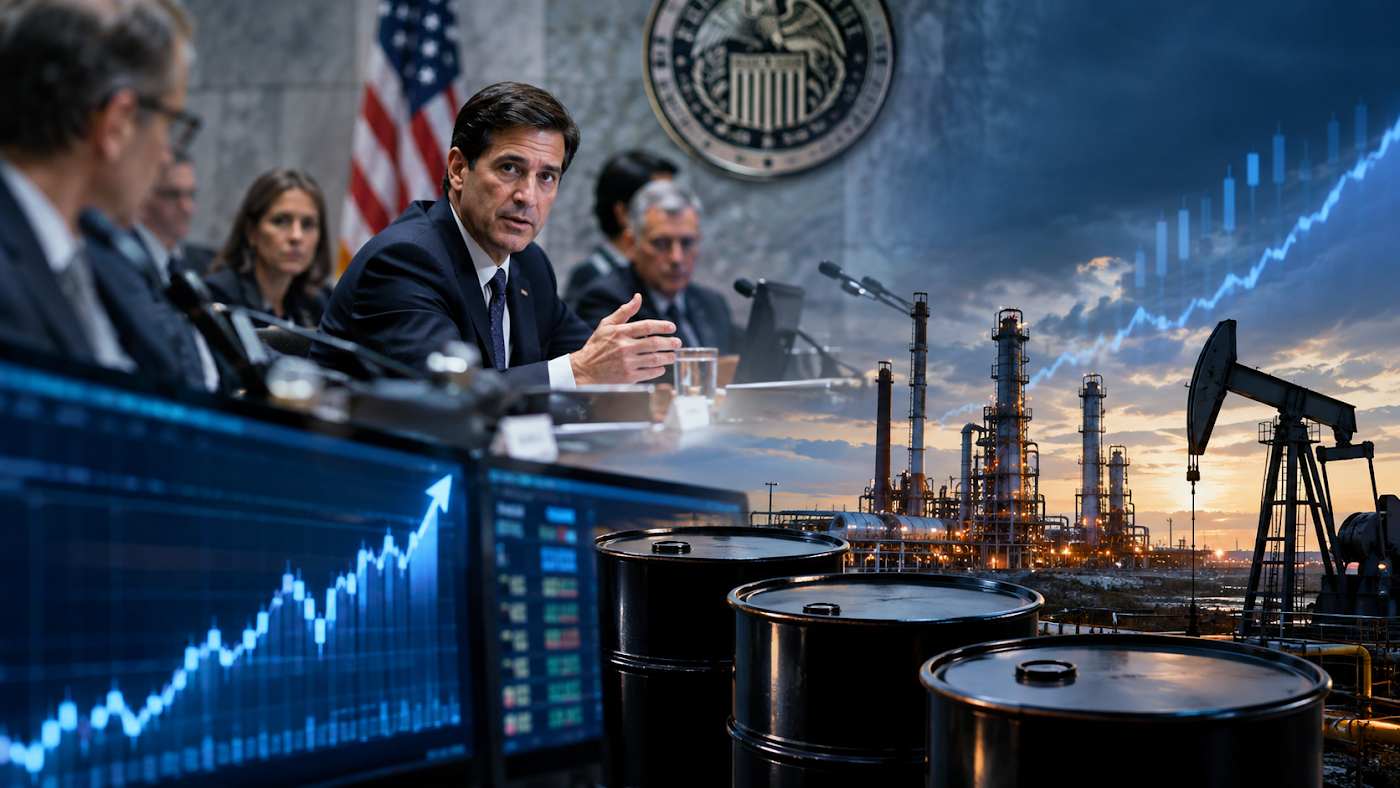
But before we get to that, let's take a quick look at the markets and what matters today...
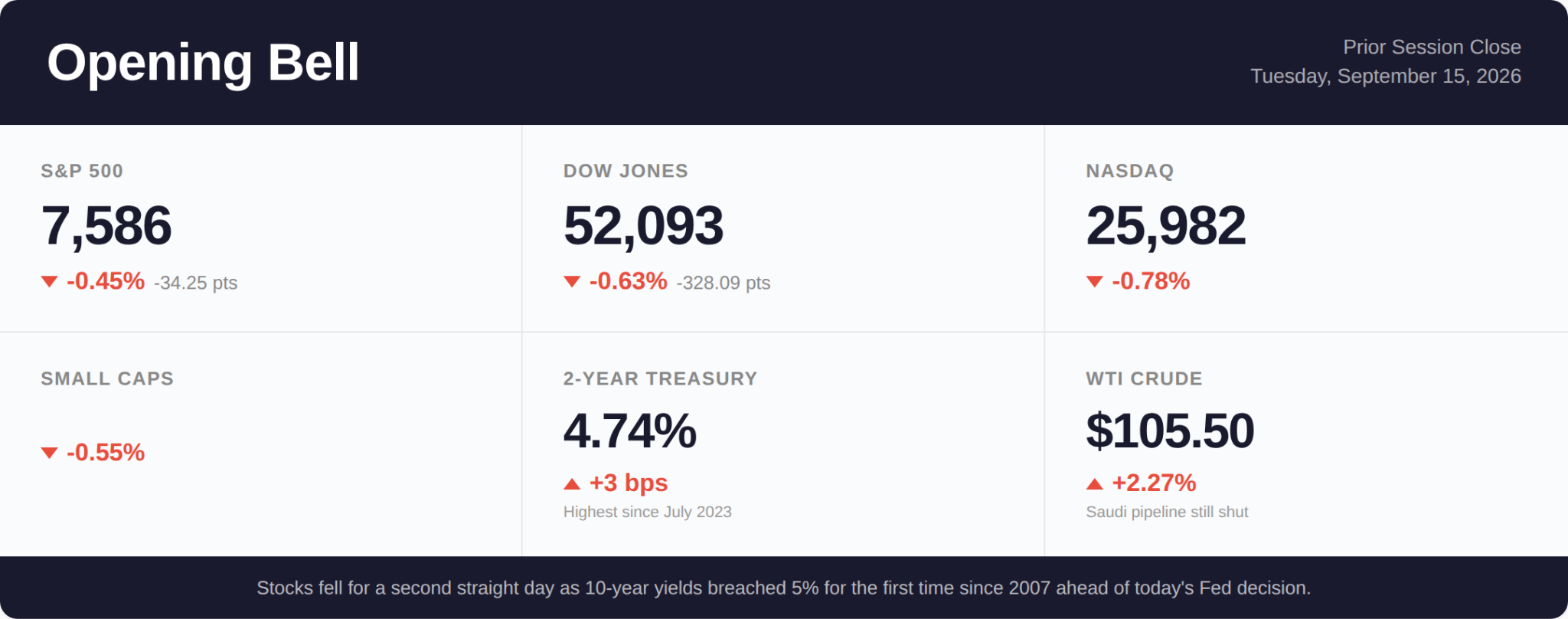
3 Movers in 3 Minutes
- 10-Year Yields Breached 5% for the First Time Since 2007. The benchmark Treasury yield climbed as high as 5.04% on Tuesday before settling at 5.01%, a level last seen before the global financial crisis. A weak $13 billion 20-year bond auction that cleared at 5.42%, up sharply from the prior 5.20%, added fuel to the selloff. Bond markets are no longer whispering about inflation risk. They are shouting.
- AI Chip Stocks Bucked the Selloff. Qualcomm (QCOM) rose more than 4% and Advanced Micro Devices (AMD) gained 2% even as the broader market fell. Both names continue to ride the wave from Qualcomm's $60 billion Amazon Web Services data center deal announced on September 8 and AMD's updated $3 trillion semiconductor TAM forecast. The AI trade is quietly decoupling from the rate trade.
- Oil Hit a Four-Month High Above $105. WTI crude rose past $105.50 on Tuesday after Saudi Arabia reportedly cancelled some European September deliveries following the pipeline shutdown and fresh Houthi strikes. Brent traded around $107.50. The correlation between crude and the 10-year yield has hit 0.96, the tightest positive relationship since 2019, meaning every further leg up in oil is dragging borrowing costs higher across the entire economy.
3 Signals for Today
FOMC Rate Decision (2:00 PM ET): The Fed is widely expected to raise rates by 25 basis points to 3.75%-4.00%, its first hike since July 2023. The dot plot and press conference will matter more than the hike itself.
August Retail Sales (8:30 AM ET): Advance monthly retail figures land five and a half hours before the Fed decision. July's print fell 0.6%. A weak number could complicate the case for hiking; a strong one reinforces it.
Chair Warsh Press Conference (2:30 PM ET): Markets will parse every sentence for guidance on whether today is a one-and-done hike or the start of a new tightening cycle. Warsh has refused to offer forward guidance all year, so the language will be unusually high-stakes.
7 Income Machines Built to Make You Rich
The 7 Stocks to Buy and Hold Forever aren’t just plays for the next quarter - they’re built to deliver for decades.
These are blue-chip companies with fortress balance sheets, elite dividend track records, and the staying power to outperform in bull and bear markets alike.
Some are Dividend Kings, others are on the path there, and all are proven wealth compounding machines.
Download the full list now - before it disappears behind the paywall.
And with that out of the way, let's get to today's big story: why the last time a central bank hiked rates into an oil shock, the global financial system collapsed within 90 days.
The Sip
On July 3, 2008, Jean-Claude Trichet stood at a podium in Frankfurt and announced that the European Central Bank would raise its benchmark interest rate by 25 basis points, to 4.25%.
Oil was above $140 a barrel. Eurozone headline inflation had climbed past 4%. And the subprime tremors in the United States, while visible, had not yet become what they would become. Trichet's logic was textbook: inflation was above target, wage pressures were building, and the mandate said act.
Seventy-seven days later, Lehman Brothers filed for bankruptcy. Within four months, the ECB had cut rates by 325 basis points. The July hike is now widely considered one of the worst monetary policy decisions of the 21st century. A demand-side tool was deployed against a supply-side problem. The inflation it was designed to fight was coming from oil fields, not overheated factories.
That context matters today because, at 2:00 PM Eastern, Kevin Warsh's Federal Reserve is expected to do the same thing.
The Setup Rhymes
The raw parallels are hard to ignore. In July 2008, Brent crude was above $140. Today, it is above $107, with WTI past $105. In 2008, headline CPI was running above 4%. Today, U.S. headline inflation sits at 3.4%, with core at 2.4%. In 2008, the 10-year Treasury yield was pressing multi-year highs. Today, it breached 5% for the first time since 2007.
And in both cases, the inflation the central bank was responding to was driven overwhelmingly by energy, not demand. Saudi Arabia's East-West pipeline remains shut after Houthi drone strikes. Libya has suspended production at multiple oil fields. Russia and Ukraine continue to attack each other's energy infrastructure despite claimed truces. The supply shock is real. And supply shocks do not respond to interest rates.
That is the crux of what makes today's decision so fraught. When oil prices rise because of a war, raising rates does not bring oil prices down. It does not reopen pipelines. It does not stabilize shipping lanes. What it does is tighten financial conditions for everyone else: the homebuyer, the small business, the levered corporate balance sheet. The inflation stays. The growth goes.
The Fed's own dissent patterns signal how narrow this call has been. At the July meeting, the FOMC held rates at 3.50%-3.75% by a 9-3 vote. Three members, Beth Hammack, Neel Kashkari, and Lorie Logan, already wanted to hike. Just four more votes needed to flip the decision. The August jobs report, which showed 162,000 nonfarm payrolls added versus 53,000 expected, tilted the math. Markets now price in a 93% chance of a 25 basis point hike today.
The Trichet Trap
The term has floated around academic and macro circles for years. It describes a specific pattern: a central bank responding to a supply-driven inflation spike with a rate hike, not because the hike will solve the inflation, but because the mandate demands action and doing nothing feels politically untenable.
Free Stock Pick: The Company First in Line
for America’s New Super Fuel
The U.S. Army and Department of Energy are about to flip the switch on a revolutionary new fuel — and one obscure defense contractor has a five-year head start on every competitor.
This joint, high-priority initiative — ordered by President Trump — is called Project Janus.
And the first powerplant to run this new fuel is expected to go live beforeDecember 18, 2026…
When it does, this company’s name will be everywhere.
Full details — including the name and ticker symbol — are being revealed for free.
Click HERE to get the stock name, ticker, and the full Project Janus story for free.
Trichet did it in 2008 and again in 2011. Both times, the ECB was forced to reverse within months. The 2011 version was arguably worse: Trichet hiked twice while Greece was in its first bailout program and Spanish sovereign spreads had blown out past 500 basis points. A former ECB analysis described the motivation simply: Trichet wanted to leave office with his inflation-fighting reputation intact. He sacrificed financial stability for a decimal point.
Warsh's incentives are different, but the structural trap is the same. He was nominated by President Trump, who has publicly and repeatedly called for lower rates. Hiking would demonstrate independence. It would silence critics who expected him to be a dovish rubber stamp. And it would allow the Fed to point to the mandate and say: inflation is above target, oil is above $100, we acted.
But the question no one on the FOMC seems to be answering is: what does a 25 basis point hike actually solve?
Core inflation, which strips out energy and food, is at 2.4%. That is 40 basis points above target, not exactly an emergency. The labor market is cooling, not overheating. July retail sales fell 0.6%. The consumer is already pulling back. And the 10-year yield has done much of the Fed's tightening for it, breaching 5% without any assistance from the policy rate.
As one market strategist warned, if the Fed raises rates in response to this energy price shock, it could repeat the most damaging policy mistake before the 2008 crisis: mistaking price increases caused by an external supply shock for signs of economic overheating.
Why It Might Be Different This Time
The counterargument is real. The U.S. banking system in 2026 is structurally sounder than it was in 2008. There is no subprime crisis lurking underneath. Corporate balance sheets are not overleveraged in the same way. And Warsh has one tool Trichet never had: the dot plot. If the Fed hikes today but signals clearly that this is a one-and-done insurance move, not the start of a new cycle, it could thread the needle.
Fed Governor Christopher Waller publicly said last week he was inclined to vote for a hold, citing the oil shock as transitory by nature. If the vote is 8-4 or 7-5 rather than unanimous, that itself becomes a signal that the committee recognizes the risk of over-tightening into a supply shock.
But here is what history teaches. The Trichet trap is not a single bad decision. It is the cumulative effect of a central bank that started hiking because of a mandate, continued because of credibility, and only stopped when something broke. The question is never the first hike. It is always the second.
This 'Starburst' Could Be Bigger Than the SpaceX IPO
Most investors are focused on the SpaceX IPO.
But one analyst believes an even bigger opportunity may be developing elsewhere.
A little-known tech company could be preparing to split into three separate businesses—potentially creating a rare "starburst" event that rewards shareholders before the rest of Wall Street catches on.
Some believe it could produce the next generation of tech leaders.
Get the full story and see the stock behind the potential starburst.
The MarketSipsTakeaway
Today's rate decision is the most consequential Fed meeting since Kevin Warsh took the chair. The hike itself is priced in. What is not priced in is the language that follows it. If Warsh signals one-and-done, markets may actually rally on the certainty. If he leaves the door open to further hikes, watch the 10-year yield. Every central bank that has hiked into an oil shock in the last 50 years, from Arthur Burns in 1973 to Trichet in 2008, eventually reversed. The only question is how much damage happens before the reversal. Watch the dot plot at 2:00 PM and the press conference at 2:30 PM. Today, the Fed picks between credibility and caution. History suggests you rarely get both.
Until then, sip slowly!
The Market Sip Desk
--
Reply prompt: What's the bigger risk today: the Fed hiking too much, or the Fed hiking too little?
THE MARKET WON’T WAIT FOR YOUR INBOX
Get the Alerts That Could Move Your Money
Breaking market news, actionable trade ideas, analyst signals, and major catalysts—sent straight to your phone when they matter.
Join FinancialMarkets.comFREE market alert list today.
SEND ME THE NEXT ALERT →(free)
Tickers: UI MS ECB PR QCOM AMD TAM WTI FOMC PM ET CPI WAIT YOUR INBOX SEND ALERT POLL