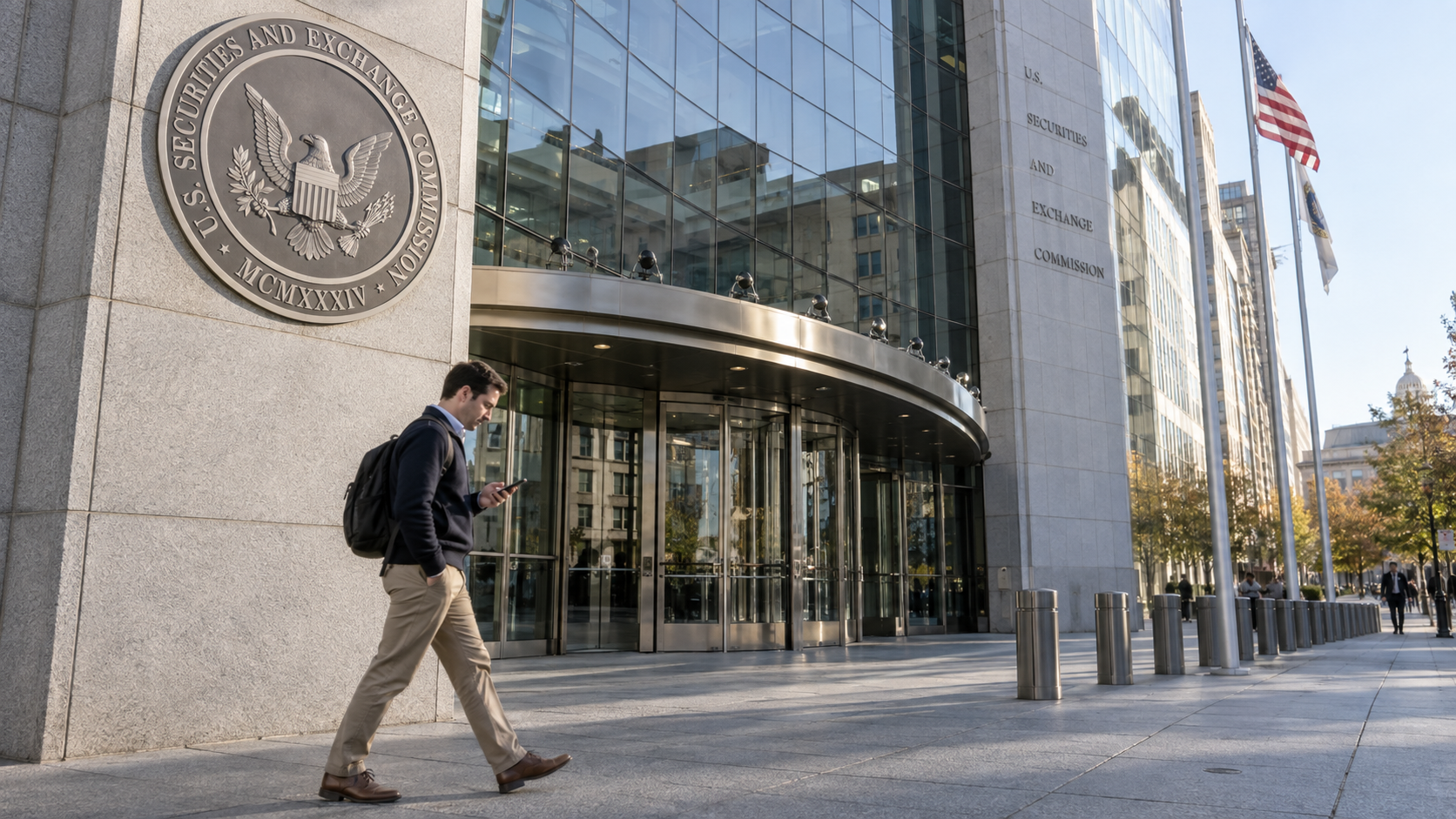
A five-year rule opening onchain markets for tokenized stocks rewards platforms built on full shareholder rights while leaving today's most popular synthetic tokenized-equity products out in the cold.
The Securities and Exchange Commission issued a five-year Innovation Exemption that lets what it calls Tokenized Securities Venues run onchain secondary markets for tokenized U.S. stocks through automated market makers and liquidity pools, without those venues having to register as stock exchanges. Liquidity providers operating on these venues also get conditional relief from dealer-registration requirements. The exemption comes wrapped in guardrails: the venue operator must be a U.S. person, the venue must set identity verification standards for its users, no leverage may be offered, trading must halt whenever the underlying stock halts on its primary exchange, and the venue's smart contracts must be published on a public, permissionless blockchain.
Volume is capped as well. Large-cap stocks are limited to a maximum of 75 symbols, with trading volume capped at 0.25% of the stock's average daily volume, while small-cap stocks can go up to 250 symbols at up to 2.5% of average daily volume. To put a number on it, a token tied to a large stock like Nvidia would be capped at roughly 300,000 shares a day, or about $65 million in value, a meaningful market but a small fraction of Nvidia's actual daily turnover. Issuers get 30 days to object and block their own shares from being offered this way, and any token that qualifies must carry dividend, voting, and liquidation rights identical to the underlying shares. Purely synthetic tokenized-equity products, which do not carry those rights, are excluded from this core relief entirely.
SEC Chairman Paul Atkins framed the move as allowing these venues to trade in a permissioned environment today, calling it a bridge toward durable rulemaking. He explicitly tied the timing to the U.S. Senate's failure, two days earlier, to advance the CLARITY Act, a crypto market-structure bill that fell short on a cloture vote by a margin of 49 to 50.
Markets moved quickly to sort winners from losers. On the day the exemption was disclosed, Coinbase Global shares rose as much as 6.6% and Robinhood Markets gained nearly 6%, while smaller, more specialized names Securitize and Bullish jumped about 14% and 10% respectively. That reaction captures the real distinction investors need to draw. Full-rights tokenization infrastructure, and the exchanges positioned to support it, stand to benefit directly from a clear, if capped, regulatory path. But the synthetic or offshore tokenized-equity products that Robinhood and Kraken already offer today, which are more widely used right now, do not qualify for the exemption's core benefit precisely because they lack full shareholder rights such as dividends and voting. Robinhood's crypto leadership publicly welcomed the SEC's announcement regardless, even though its existing tokenized-equity offering sits outside the new relief.
Coinbase, separately, had already begun offering tokenized shares of Apple, Nvidia, Meta, Alphabet, Tesla, and Microsoft on the Base blockchain starting August 24, with daily volumes reported in the tens of millions of dollars, putting it in a position to expand that offering under the new framework rather than build from scratch.
The distinction between compliant, full-rights tokenization and the popular synthetic products already on the market is easy to miss in a headline about crypto stocks rallying together, but it is the detail that will determine which platforms actually gain durable ground as the exemption's five-year window plays out and any follow-on rulemaking takes shape.