
Core consumer prices beat forecasts hours after the New York Fed's John Williams saw one more hike, then a stop. The IEA said diesel stays tight well into 2027. ASML said its planned supply won't meet demand in 2027 or 2028.
Core Prices Beat Forecasts, and the 10-Year Yield Jumped
September consumer prices rose 0.6% from August and 3.7% from a year earlier, the Labor Department said at 8:30 a.m. Economists surveyed by Bloomberg had expected 3.6%. Core prices, which exclude food and energy, rose 0.3%, against a 0.2% forecast.
The 10-year Treasury yield rose to about 5.31% by 9:20 a.m., from about 5.19% just before the report. S&P 500 futures, up about 0.3% before the report, were down about 0.3% at 9:10 a.m.
Bank of America (BAC) traded nearly 8% lower before the open, and Morgan Stanley (MS) about 3% lower. ASML (ASML) was little changed in Amsterdam by afternoon, after gaining as much as 3.6%.
Investor Signal
Early Wednesday, Kalshi's October hike contract traded at 18 cents, and futures still priced a December increase. A core beat tests both. The Fed's Beige Book at 2 p.m. and producer prices on Thursday come next.
Better Than Oil Stocks
The best way to profit from energy is NOT a stock...
Rather, it's this little-known alternative investment.
Williams Sketched One More Hike, Then a Stop. Core Prices Beat the Next Morning.
New York Fed President John Williams said Tuesday, in an interview with Bloomberg, that one more increase this year may still be appropriate. He sees no reason now for more in 2027. He also expects energy prices to stop adding to inflation next year.
Boston Fed President Susan Collins said she expects it will be appropriate to raise rates "a bit further" this year. She called two higher-inflation scenarios, one driven by AI-related demand and one by tariffs and energy, "almost as likely" as her base case.
Bond traders sat closer to Collins. The two-year yield closed Tuesday at 4.79%, about 90 basis points above the midpoint of the Fed's 3.75% to 4.00% range.
Williams's outlook depends on energy and tariff effects fading. Core prices leave out energy, and they rose 0.3% for a second straight month, above the 0.2% forecast.
Investor Signal
Williams is the committee's vice chair and a permanent voter, so his outlook carries weight when the Fed meets Oct. 27 to 28. The two-year yield already priced a longer path than his. A second 0.3% core month makes that longer path harder to dismiss.
The IEA Says Diesel Stays Tight Into 2027. Iranian Officials Say They Want Oil High.
World diesel exports ran about 700,000 barrels a day below a year earlier in September, the International Energy Agency said Wednesday. The agency said the market "will remain tight well into 2027."
U.S. diesel futures settled Tuesday at $4.93 a gallon, up 4.5%. They were down about 1% at 9:20 a.m. Wednesday.
Saudi Arabia told OPEC it pumped 8.37 million barrels a day in September, more than 2 million above August. Two senior Iranian officials told Reuters that Tehran aims to keep crude prices high through the U.S. elections by stepping up attacks on Hormuz shipping. They declined to give details. An Aramco office building in Dhahran was struck Tuesday, causing a "limited fire," Saudi Arabia's energy ministry said. The Houthis had threatened the site but did not immediately claim the attack.
Investor Signal
Williams expects energy to stop adding to inflation next year. The IEA says diesel stays tight well into 2027, with relief dependent on a recovery in Middle East fuel supply. Collins named jet fuel, diesel and heating oil on Tuesday as reasons inflation will run above target in coming months. Winter heating demand will test which view holds.
Satellite Confirms: Elon Musk Activating Strange 'Dark Energy' Across U.S. South
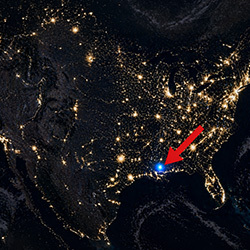
Confirmed by satellites 300 miles above the Earth's surface... Elon Musk is rolling out a breakthrough technology that could replace our need for foreign oil and ignite a $10 trillion boom a small group of stocks. Click here to learn how you can invest in this before it becomes mainstream.
Bank of America Admitted Willful Violations. Its Trading Mix Matched Tuesday's Banks.
Bank of America admitted it willfully violated the Bank Secrecy Act. Federal penalties top $1.21 billion, including a record $750 million from the Comptroller of the Currency. Regulators said it failed to report more than $5 billion of suspicious transactions on time.
Its results Wednesday carried a $1.2 billion charge. Net income fell to $6.93 billion, or 91 cents a share, from $8.33 billion a year earlier. Net interest income, the part of bank earnings that tends to rise with rates, grew 8% to $16.4 billion.
Equities trading revenue rose about 11% to $2.51 billion, while fixed income fell 17% to $2.57 billion. That is the mix JPMorgan, Goldman and Wells Fargo showed Tuesday.
Investor Signal
The cash cost of the penalty is booked. The bank says current remediation costs are already in its expense base, but the orders add independent reviews. It also remains under its 2024 consent order. Comptroller Jonathan Gould called its response "unacceptable." Management's comments on remediation spending will show whether the cost stays in one quarter.
ASML Says Its Planned Supply Won't Meet 2027 or 2028 Demand
ASML said Wednesday that its planned supply for 2027 and 2028 "will not fully meet the demand of our customers." Some customers want to place orders for 2029 and even 2030, Chief Executive Christophe Fouquet said.
Third-quarter sales rose 55% from a year earlier to €11.66 billion, a fraction below forecasts. Net income of €4.96 billion beat the LSEG consensus by about 21%. A roughly €500 million gain on its stake in Mistral AI accounts for about half that beat. ASML no longer reports quarterly orders, so demand is described, not measured.
Investor Signal
On Monday, Broadcom's Hock Tan said capital "might be the biggest constraint" on AI. ASML points to a different limit: machines. Collins named AI-driven demand as one of two scenarios that would keep inflation higher. Taiwan Semiconductor reports Thursday, a test of whether customers are acting on that demand.
What is Elon Building in Texas?

Elon's mysterious Texas project will be 3X the size of Central Park… Cost $122 billion to build… And singlehandedly DOUBLE American chip production. One investment (not Tesla/SpaceX) is at the center of it all.
Click here to get its name and free ticker.
This ad is sent on behalf of InvestorPlace Media at 1125 N. Charles Street, Baltimore, Maryland 21201. If you're not interested in this opportunity, pleaseclick here.
Fewer Investors Want Out of Private Credit Funds. Fewer Are Putting Money In.
Redemption requests fell at 13 of 15 non-traded private credit funds that Fitch Ratings tracks. Requests still averaged 9.8% of shares. Nine funds remain above the 5% quarterly cap on repurchases.
Much of the demand is a backlog. Two-thirds of requests at North Haven Private Income Fund came from investors who were only partly paid earlier this year.
New money is the weaker half. September fundraising, excluding reinvested dividends, fell below May's low. Net flows remain negative, and Fitch expects it to take "several quarters" for the average request to drop under 5%.
Investor Signal
Fitch said the funds it rates have enough liquidity to cover several quarters of repurchases at the maximum. Repurchases above 5% for long, with soft inflows, could pressure ratings. Those funds now compete for savers' cash with a 10-year Treasury yielding near 5.3%, and the Fed may not be done raising rates.
The New York Fed's John Williams described a short path to the end of rate hikes. Core prices, diesel forecasts and the two-year yield all pointed to a longer one. ASML showed AI demand still outrunning supply, and private credit funds showed savers slow to return.
Producer prices and the Fed chairman arrive Thursday. Together they will show whether this morning moved the finish line.
3 Stocks at a Major Turning Point
Something unusual is happening beneath the surface of three widely followed stocks.
In each case, the fundamentals are saying one thing... while institutional activity, management signals or the options market are saying something else.
That kind of disagreement can matter.
Because when the evidence stops lining up, the next move in the story often comes down to a handful of signals most investors never think to watch.
Our new FREE Market Tell Special Report breaks down three of these situations, and shows you exactly what we’re watching next.