
Bessent promised to go big, delivered a $6 billion buyback, and yields hit a three-year high anyway. A stronger yen and rising rates are now the bull market's biggest risk. Energy Transfer is leaving New York for the Texas Stock Exchange.
Bessent said he was the house now.
Yesterday the market called his bluff. Treasury's buyback didn't hold the 10-year down, and it rose to a three-year high anyway. He cannot control what's actually driving yields, a deficit near $2 trillion and a war keeping oil above $100. A stronger yen atop higher yields is now called the bull market's biggest risk. Energy Transfer is leaving the NYSE for Texas, and CPI lands Friday, three days ahead of the Fed's September 15-16 decision.
PMD LENS
For two weeks PMD has tracked whether anyone can hold the line on yields against the AI-debt flood, the deficit, and the war. Yesterday answered. Not with words. Bessent has leaned on rhetoric, "asymmetric information," then "I am the house now," a line used four times in three weeks. But verbal intervention only works if the market believes force will follow, and yesterday's buyback was not that force.
Great Companies Don’t Stay Under the Radar Forever
Most great stocks look boring when the real opportunity begins.
They’re still building scale, executing quietly, and being ignored by most investors.
That’s often when long-term winners are made.
The original market leaders didn’t become obvious overnight.
Our analysts believe the same pattern is forming again.
In These 7 Stocks Will Be Magnificent in 2026, we highlight companies that may look unremarkable today…
But you’ll soon see they all have the traits that historically define future market leaders.
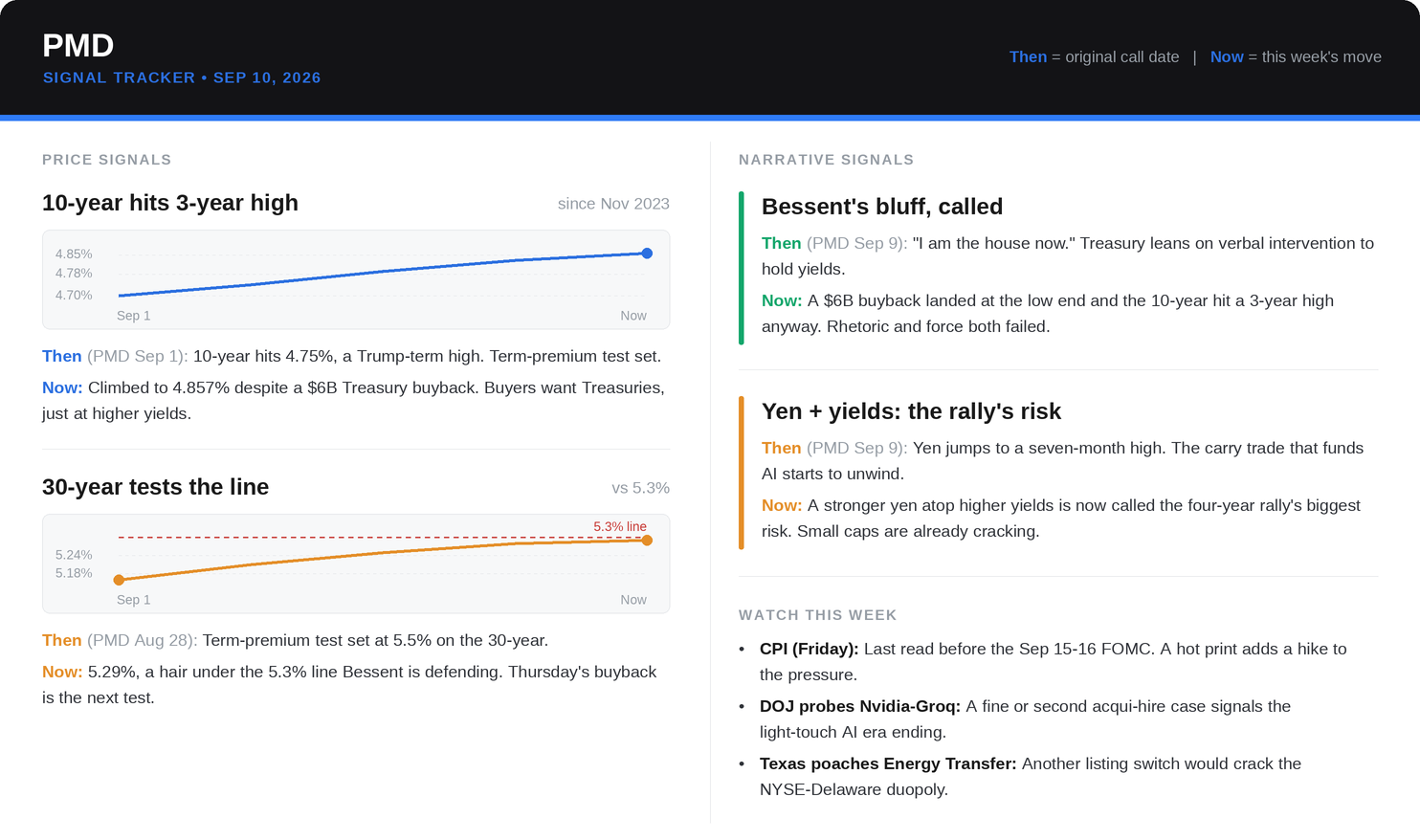
- The 30-year sits at 5.29%, a hair under the 5.3% "line in the sand" analysts say Bessent is defending.
- Japan's foreign-security holdings fell by almost $88 billion in August. It may be selling Treasuries even as the US props up its currency.
The Market Called Bessent's Bluff. He Can't Control What's Driving Yields.
Yesterday, Treasury's buyback of up to $6 billion in long-term debt landed at the low end of the $6 to $8 billion dealers reportedly expected, and the 10-year yield climbed to 4.857%, its highest since November 2023, instead of falling.
"The market has called his bluff," said Potomac River Capital's Mark Spindel. The American Enterprise Institute's Michael Strain was harsher. "He's tried three times to get the long end to do what he wants, and he's failed each time. He's already lost credibility."
Why the Words Aren't Working
The two forces driving yields, a deficit near $2 trillion and an Iran war keeping oil above $100, are outside Bessent's reach. He can jawbone, but he cannot legislate the deficit down or end the war.
The One Thing That Did Work
A strong $39 billion auction of 10-year notes pulled yields back from their session highs. Buyers still want Treasuries, just at these higher yields, not the lower ones Bessent is trying to engineer. The market is not rejecting US debt; it is repricing it and demanding to be paid more to hold it, a harder problem than a liquidity gap because the level itself is the market's verdict.
The Closest Thing to a Virtual AI Monopoly Wall Street Is Ignoring
A little-known company is building what may be the closest thing to a virtual monopoly the AI era has ever seen.
Only 3...
Yet it beat Apple, Amazon, and the S&P 500 combined...
While paying out $146,000 in total dividends on a 1,000-share stake.
Kevin O'Leary calls what it controls a "unicorn."
Right now, it's trading at a rare discount.
>>>Whitney Tilson reveals the name, completely free.<<<
This ad is sent on behalf of Stansberry Research, 1125 N Charles St, Baltimore, MD 21201. If you would like to optout from receiving offers from Stansberry Research please click here.
SIGNAL 1: The Yen-and-Yields Combination Is Now the Bull Market's Biggest Risk.
A stronger yen and higher Treasury yields, both partly born of this summer's interventions, are being called the greatest threat to the nearly four-year rally, with the 10-year at a three-year high, oil above $100, and the yen climbing toward its February peak. GammaRoad's Jordan Rizzuto named it "the greatest risk to the bull market." A rising yen threatens the carry trade, the borrow-cheap-yen-buy-US-tech bet an unwind would hit AI stocks hardest.
The early warning is in small caps. The Russell 2000 slid below its 50-day moving average, on pace for its first quarterly loss since early 2025.
The Signal to Watch
The yen passing its February high before the BOJ meeting, or a decisive small-cap break, would confirm the risk is spreading.
SIGNAL 2: The DOJ Is Probing Nvidia's Groq Deal. AI Dealmaking Is Drawing Federal Heat.
The Justice Department is investigating whether Nvidia's (NVDA) $17 billion Groq deal, a "non-exclusive license" to Groq's chip technology paired with hiring its founder and several executives, was structured to skirt antitrust scrutiny. This acqui-hire structure lets a giant absorb a rival's technology and talent without a formal acquisition that would trigger merger review. The DOJ opened its probe right after the December deal and may fine Nvidia but likely will not unwind it.
The Signal to Watch
An Nvidia fine, a second acqui-hire probe, or an AI-safety bill advancing would each confirm the light-touch era on AI dealmaking is ending.
SIGNAL 3: Texas Just Poached Its First Major Listing From New York.
Energy Transfer (ET), a $75 billion pipeline company, is set to move its primary listing from the NYSE to the Texas Stock Exchange as soon as next month, the first major corporate defection to the two-year-old venue, which is backed by BlackRock (BLK) and Citadel Securities. Energy Transfer's chairman owns 30% of TXSE's parent, and more switches are reportedly coming.
Texas is building a parallel financial system with its own exchange, its own business courts challenging Delaware's grip on corporate law, and its own pull for companies that want distance from New York and Wilmington. TXSE trades under 1% of US volume, though a $75 billion company leaving the NYSE is the first crack in a decades-old listings duopoly.
The Signal to Watch
Another major listing switch, or a company reincorporating in Texas over Delaware, would confirm the fragmentation is reaching corporate law itself.
AI CEO Issues Code Red: Prepare for Meltdown
The CEO of this AI company (click here to get the name, 100% free) just issued a CODE RED in an internal memo…
Warning his employees that they’re dealing with a critical situation.
Another company executive even implied they might need a government bailout.
And now Jim Rickards is predicting this company is about to go bust, in a full-blown AI meltdown that could be 10 times bigger than Lehman Brothers.
Watch the 30-year against 5.3%, the Thursday buyback operation, and the yen into the September 18 BOJ meeting.
Every position carries an assumption this week tests.
- Washington can hold yields down. Bessent failed at it, publicly, for the third time.
- The four-year rally continues, even as a stronger yen and higher yields are now called its biggest risk.
- AI consolidation runs unimpeded, though the DOJ is now probing how the deals are structured.
- Companies stay in New York and Delaware. A $75 billion firm left for Texas.
The bond market named the limits of intervention. The yen-and-yields combo named the risk to the rally. The Nvidia probe named the scrutiny reaching AI. Texas named the machinery decentralizing. One thread ties them. The grip of the traditional centers, Treasury, the Fed's implied backstop, the NYSE, Delaware, is being tested from several directions at once.
Bessent has tried rhetoric and a buyback, and the market repriced through both; what's left is slow. Friday's CPI decides whether the Fed adds a hike to the pressure. If it does, the 30-year meets the 5.3% line with no one able to stop it, and the cost of capital resets higher on the market's terms, not Washington's.
FREE MARKET ALERTS
Know What’s Moving the Market Before You Miss the Move
Get market-moving news, analyst trade ideas, and key catalysts delivered directly to your phone so you can spot opportunities faster.