

On Tuesday, the Nasdaq closed at an all-time high. On Wednesday, the 10-year Treasury yield surged past 5.1%, its highest level since July 2007, in the biggest one-day move in 18 months. Two markets staring at the same economy, arriving at opposite conclusions. One says profits are booming. The other says inflation isn't finished, and neither is the Fed. The question isn't which one is right. It's which one blinks first.
But before we get to that, let's take a quick look at the markets and what matters today...
3 Movers in 3 Minutes
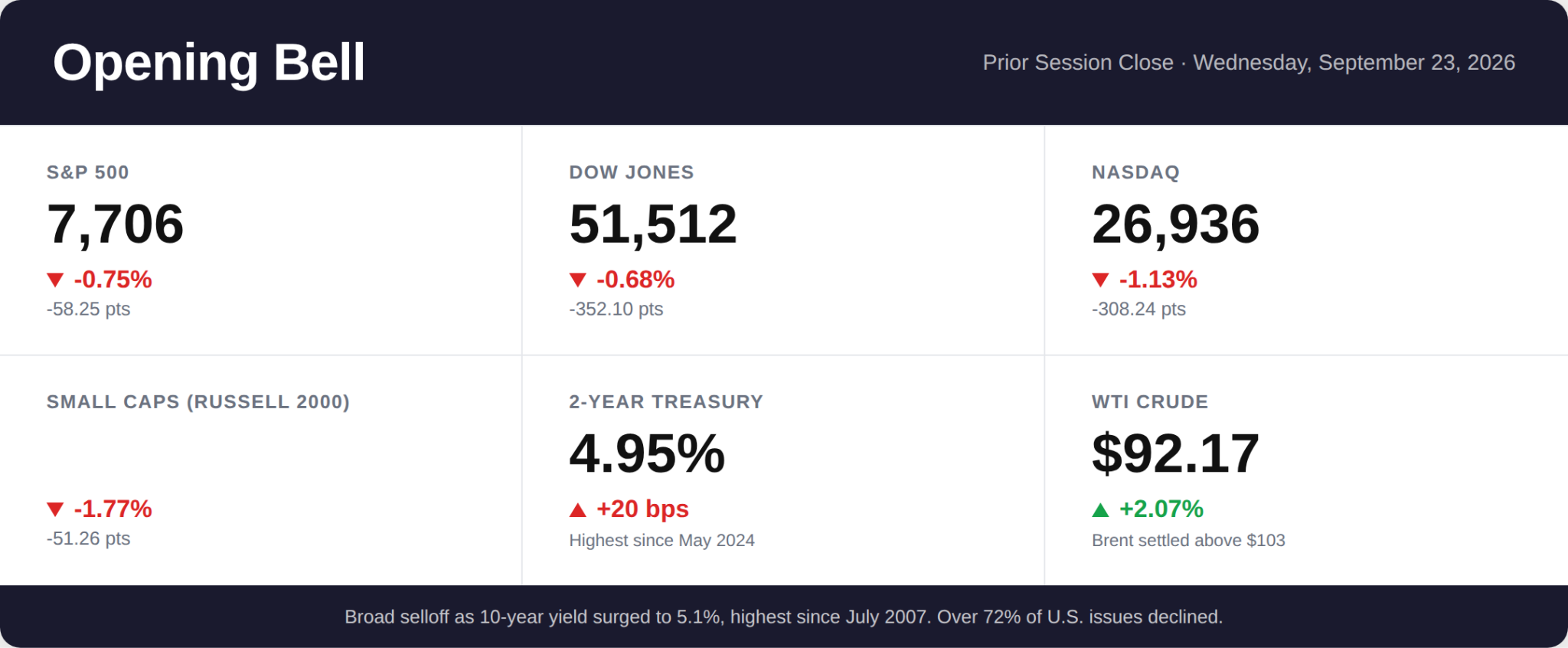
- Bond yields hit 19-year highs. The 10-year Treasury yield surged past 5.1% on Wednesday, its highest level since July 2007, after S&P Global's September PMI data showed the U.S. economy expanding at its fastest pace in over five years. The manufacturing PMI came in at 57, well above the expected 53.7. A weak $70 billion five-year note auction, where indirect bidders took just 54% versus a 65% six-auction average, deepened the selloff. The 2-year yield climbed to 4.95%, its highest since May 2024. Over 72% of U.S. listed issues declined.
- McDonald's crashes to a 52-week low. McDonald's Corporation (MCD) dropped 6.1% to $235.04 after its Investor Day revealed an $8.5 billion franchisee support plan through 2036 and a delay of its 50,000-restaurant global target from 2027 to 2028. Management cautioned that U.S. dining foot-traffic recovery may lag longer than anticipated. The stock is now down roughly 30% from its February peak, with its RSI in the mid-20s, deep in oversold territory.
- Oil bounces, adding to the inflation fire. Brent crude settled above $103 a barrel, up more than 4% on the day, as uncertainty persisted over formal Strait of Hormuz reopening talks. WTI crude climbed above $92. Iran's President Pezeshkian used his UN General Assembly address to reject U.S. restrictions, complicating diplomatic progress. Saudi Arabia is preparing to restart its East-West pipeline exports, but the timeline remains unclear.
3 Signals for Today
Trump-Xi Summit kicks off in Washington. The tariff truce negotiated at the 2025 Busan Summit expires November 10, and markets will parse any sign of extension. OpenAI CEO Sam Altman and Nvidia (NVDA) CEO Jensen Huang are confirmed for the state dinner, putting AI governance squarely on the agenda.
Darden Restaurants (DRI) reports pre-market (EPS est. $2.05, revenue est. $3.21B) and Costco Wholesale (COST) reports after the close. Together they represent a real-time read on the American consumer across income brackets.
Initial Jobless Claims at 8:30 AM ET and August New Home Sales at 10:00 AM ET will land into a market already spooked by yesterday's PMI blowout. Any upside surprise could push yields even higher.
Before the AI Wealth Gap Widens, See This List
Blue-chip stability meets AI growth in 7 AI Stocks to Invest in Today
Inside: a top-10 dividend payer rolling out AI-powered logistics across 200 countries… a $300B titan embedding AI across its full product stack… and a semiconductor leader still trading 15% below its 52-week high.
All proven operators, all using AI to widen their lead.
See the list for free today – after that, you’ll have to pay.
And with that out of the way, let's get to today's big story: what happens when the bond market sends a message this loud.
The Sip
The Number That Changed the Mood
On Tuesday evening, the Nasdaq Composite closed at a fresh all-time record of 27,244. Chip stocks were surging. The S&P 500 sat within 1% of its own all-time best. AI euphoria was back.
Twenty-four hours later, the mood was unrecognizable.
The 10-year Treasury yield surged past 5.1% on Wednesday, its highest level since July 2007. The move, roughly 16 basis points in a single session, was the largest one-day spike since the April 2025 tariff shock. The S&P 500 dropped 0.75%. The Nasdaq gave back 1.13%. Over 72% of U.S. listed equities closed in the red.
Two markets. Same economy. Completely different verdicts.
Too Strong for Its Own Good
The trigger was a single data release. S&P Global's September Flash PMI showed U.S. business activity expanding at its fastest pace in over five years. Manufacturing came in at 57.0, blowing past the expected 53.7. Services hit 58.7 versus 55.8 expected. The composite reading of 58.4 made a mockery of the 55.3 consensus.
On the surface, this is good news. Growth is strong. Businesses are expanding. Orders are flowing.
But for the bond market, it was a fire alarm.
If the economy is running this hot, then inflation isn't dying. If inflation isn't dying, the Fed isn't done hiking. And if the Fed isn't done, every borrower in America, from homebuyers to the U.S. Treasury itself, is about to pay even more.
The 30-year fixed mortgage rate has already climbed to 7.12%, its highest point in more than two years. U.S. CPI inflation was running at 3.4% annually as of August, well above the Fed's 2% target. Gas prices rose 3.9% in August alone, accounting for more than a third of that month's CPI increase.
The PMI told the Fed exactly what it didn't want to hear: the economy doesn't need help. It needs a leash.
The Auction That Made It Worse
The PMI alone might have rattled bonds. But what sealed Wednesday's selloff was the five-year Treasury auction.
The Treasury Department sold $70 billion in five-year notes, and demand was historically weak. The notes priced at a yield of 5.033%, more than three basis points above the pre-auction level of 5.002%. Indirect bidders, a proxy for foreign central banks and sovereign wealth funds, took just 54% of the sale versus a six-auction average of 65%.
In bond market language, that's a failed auction. Not technically, but practically. It means the largest, most creditworthy borrower on Earth is starting to struggle to find willing lenders at these prices.
And the context makes it worse. The U.S. government is issuing enormous volumes of debt, AI companies alone have floated over $1.5 trillion in corporate bonds this year, and every new issuance competes for the same pool of buyer capital. The U.S. Treasury has responded by doubling its buyback operations from $2 billion to at least $4 billion through November. That a $30-trillion Treasury market needs buyback support to stay orderly tells its own story.
Major Buy Alert Issued

Keith Kaplan has invested $17 million into his own AI research and tools. He's built a platform that 180,000 people worldwide use in the stock market. Now he says there's a handful of stocks you need to buy asap, to set yourself up for 1,000% potential returns in the near future. Here are the stocks you need to buy for the chance to profit.
This ad is sent on behalf of TradeSmith at 1125 N. Charles Street, Baltimore, Maryland 21201. If you're not interested in this opportunity, please click here.
The July 2007 Problem
The comparison keeps surfacing for a reason. The last time the 10-year yield was at 5.1% was July 2007. Fifteen months later, Lehman Brothers collapsed.
Nobody is suggesting an imminent financial crisis. But the parallel captures something important about what happens at these yield levels: things that were sustainable at 3.5% or 4% start to fracture at 5%.
Commercial real estate refinancing gets harder. Corporate debt servicing costs climb. Government interest payments, already projected to exceed defence spending, grow even faster. And for the average American household, a 7% mortgage means the monthly payment on a median-priced home is roughly double what it was three years ago.
Meanwhile, the stock market keeps telling a different story. The S&P 500 is still up more than 10% this year. Nvidia alone has added hundreds of billions in market cap. The logic is simple: AI is driving earnings growth so powerful that it overrides the gravitational pull of higher rates.
But there is a limit to how long two markets can look at the same economy and reach opposite conclusions.
What the Bond Market Is Actually Saying
The bond market isn't predicting a recession. It's pricing something arguably more uncomfortable: an economy strong enough to keep inflation alive, oil prices high enough to keep it fueled, and a government borrowing too much to leave rates alone.
The term premium, the extra yield investors demand for holding long-dated bonds, is climbing not because the economy is weak, but because the fiscal picture is ugly. Investors are demanding compensation not just for inflation risk, but for the risk that the U.S. simply has too much debt to service comfortably at these levels.
In bond market terms, this is a "bear steepener," where long-term yields rise faster than short-term ones. Historically, bear steepeners preceded every major equity correction of the last two decades.
The question for stock investors is simple. The Nasdaq can keep hitting records as long as earnings keep delivering. But the bond market is repricing the cost of capital for every business and consumer in America. Eventually, those two forces collide.
And when they do, history says bonds are right more often than stocks.
There's a HUGE Downside to This Bull Market (And It's Not a Crash)
It's hard to deny we're in a bull market.
Stocks, real estate, gold, and bitcoin are hitting record highs month after month.
But one multi-millionaire investor says this is unlike any bull run we've seen before.
"There's a dark reason why so many assets are levitating—it's a sign we've entered the Most Terrifying Bull Market in History."
For the full story, click here.
The MarketSipsTakeaway
The 10-year at 5.1% isn't just a number. It's the bond market's way of saying the "soft landing" narrative has expired. What replaces it, a no-landing scenario where growth and inflation coexist at uncomfortable levels, is harder to trade and harder to live with. Watch the 30-year mortgage rate. Watch Darden and Costco today for what the consumer is actually doing versus what the PMI says they should be doing. And pay attention to the Trump-Xi summit, because if the tariff truce collapses in November, the inflation picture gets messier. The bond market is wide awake. The stock market is still dreaming.
Until then, sip slowly!
The Market Sip Desk
Reply prompt: Where are you placing your bets for the last quarter of 2026, stocks or bonds?
3 Stocks at a Major Turning Point
Something unusual is happening beneath the surface of three widely followed stocks.
In each case, the fundamentals are saying one thing... while institutional activity, management signals or the options market are saying something else.
That kind of disagreement can matter.
Because when the evidence stops lining up, the next move in the story often comes down to a handful of signals most investors never think to watch.
Our new FREE Market Tell Special Report breaks down three of these situations, and shows you exactly what we’re watching next.
Tickers: UI MS PMI MCD RSI WTI UN NVDA DRI EPS COST ET CPI HUGE POLL