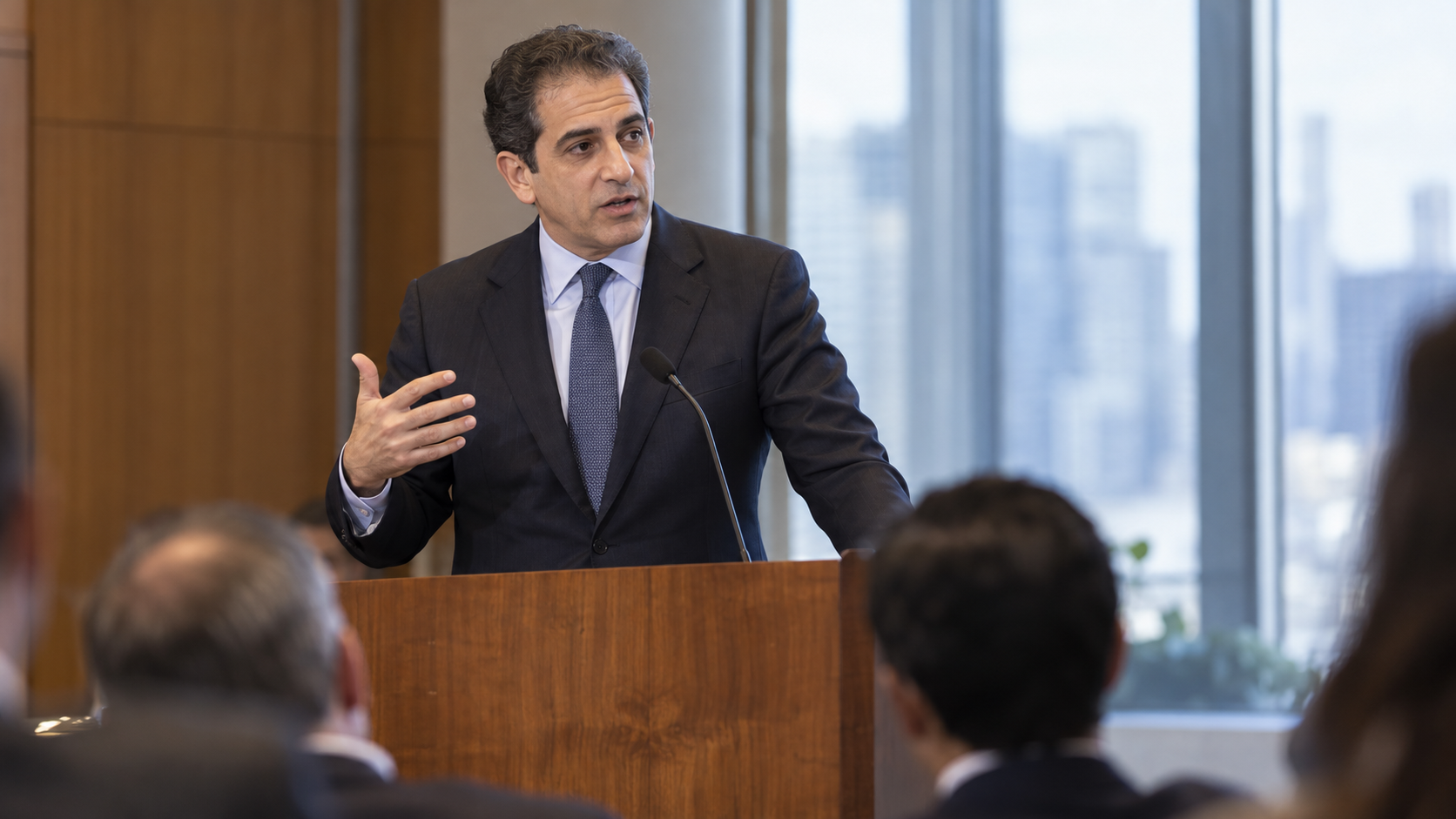
The St. Louis Fed president said more firming will be needed to return inflation to 2% within about 18 months, but would not commit to the Oct 27, 2026–Oct 28, 2026 meeting. Traders still expect a hold this month and an increase in December.
Federal Reserve officials have been saying for weeks that rates are likely headed higher. On Thursday one of them attached a time frame.
"To bring inflation back to target in a timely manner, more monetary policy firming will be required," Alberto Musalem, president of the Federal Reserve Bank of St. Louis, said at an event in New York. He then defined timely: "If a timely manner is something like 18 months, that kind of suggests that rates ought to be going up further in an appropriate period of time in the next six to nine months."
Counted from this month, that window closes somewhere between April and July of next year.
What he did not say
Musalem would not be drawn on the Oct 27, 2026–Oct 28, 2026 meeting. "I go into every meeting with a very open mind, and I haven't prejudged what the outcome of that meeting is going to be, or what I'm going to do at that meeting," he said. He does not hold a vote on policy this year.
September's meeting produced the Fed's first increase since 2023, and the projections released with it pointed to one more before year-end. Expectations for an October move faded last week, when New York Fed President John Williams said there was no urgency to act and Vice Chair Philip Jefferson said he saw no imminent need. Futures traders now mostly see the benchmark staying in its 3.75% to 4% range this month, with the next increase penciled in for December.
Event contracts drifted the other way overnight. Kalshi's contract on a quarter-point October increase rose from 16 cents to 18 cents, much of the move on a single block of about 16,000 contracts late Thursday evening. At 18 cents, the contract still implies an 82% chance of no increase this month.
His view of the bond market
Musalem also took up the climb in Treasury yields, which took the 10-year to its highest intraday level since 2002 earlier this week. He rejected the idea that it reflects doubts about the Fed. In his account, investors expect real rates to rise in a fast-growing economy where many borrowers are competing for capital, and both the technology spending boom and Washington's borrowing needs are adding to that pressure.
"The US federal government has been on an unsustainable fiscal path now for the better part of two decades," he said, adding that "the risk is there" that heavy borrowing could create problems for the economy. Even after the climb in yields, he said, "financial conditions remain accommodative and supportive of economic growth."
The two-year Treasury yield, the maturity most tied to Fed expectations, ended Thursday at 4.75% according to Treasury data, down from 4.77% a day earlier. It was little changed early Friday.
The investor debate
Read one way, the market is underpricing how far the Fed will go. Musalem joins Governor Christopher Waller in calling for further increases, he describes financial conditions as still easy, and an 18-month inflation target leaves room for more than one move.
Read another way, his framing matches the path futures already imply. He set a window of six to nine months rather than weeks, he does not vote this year, and the officials who argued against urgency, Williams and Jefferson, do.
Upcoming data
Friday brings the University of Michigan's preliminary October survey at 10 a.m., with its gauge of household inflation expectations, and remarks from Boston Fed President Susan Collins at 4 p.m. After that, September consumer prices, published Oct 14, 2026, are the final major inflation figure policymakers will see before they meet. A hot reading would put October back in play; a soft one would leave Musalem's six-to-nine-month window as the operative guide.