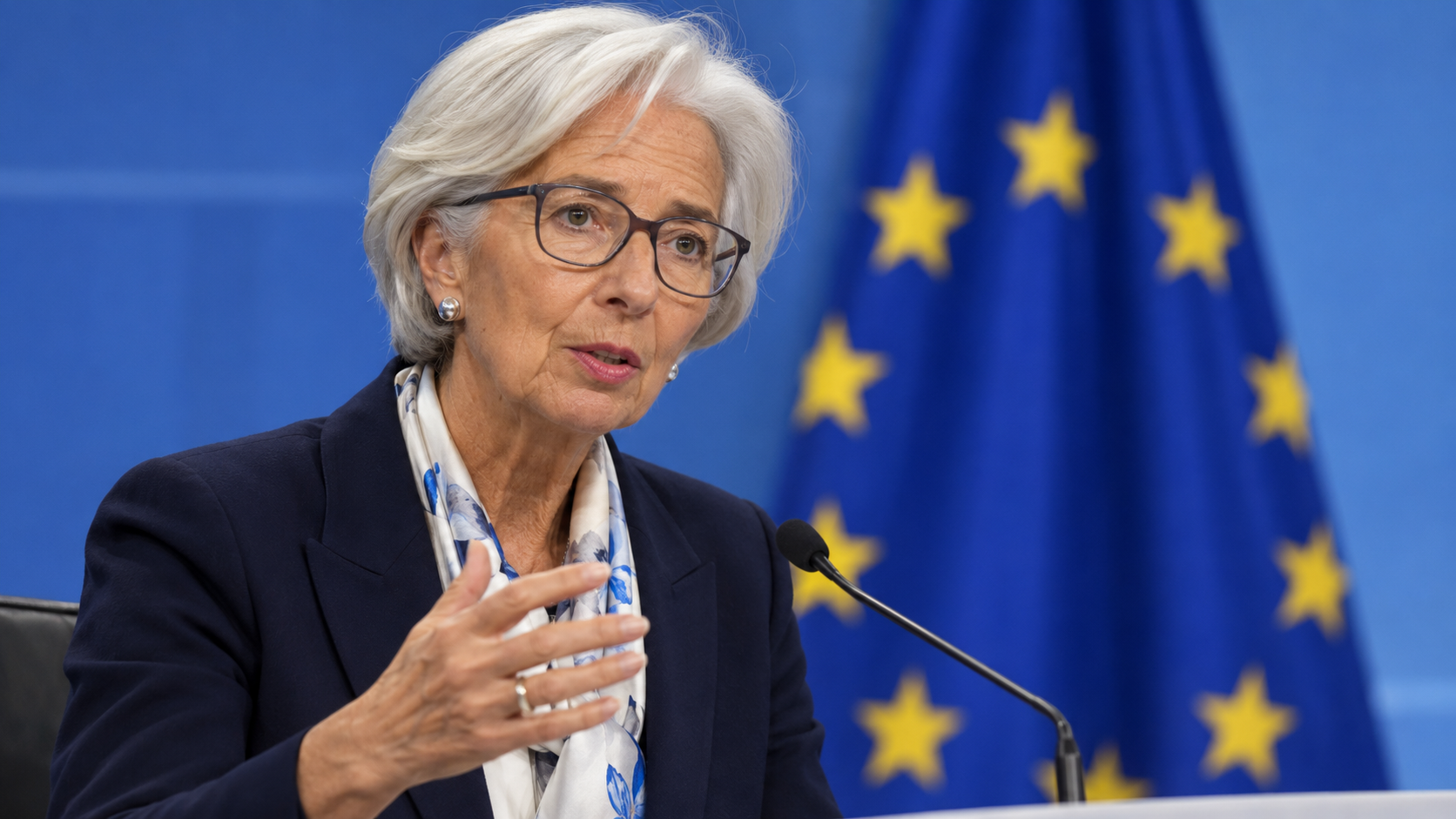
Christine Lagarde will step down on Feb. 7, 2027, more than eight months before her term ends. The ECB kept rates unchanged without committing to a path, while warning about energy prices and bond-market spillovers. The euro recovered from a 17-month low.
The European Central Bank left interest rates alone on Thursday. The bigger news came from its president, and from the central bank's own description of how much work the bond market has already done.
The ECB kept its deposit rate at 2.50%, its main refinancing rate at 2.65% and its marginal lending rate at 2.90%. "The Governing Council is not pre-committing to a particular rate path," it said.
On the same morning, the ECB announced that President Christine Lagarde had informed the Governing Council and European Council President António Costa "that she will step down from her position on 7 February 2027." The ECB's announcement gave no reason. At her press conference, Lagarde said she wanted "the freedom to engage on matters that are not monetary policy matters" and added, "I don't think that I can be comfortable in that neutrality at the present time," according to the Associated Press. Costa said the process to choose a successor "will be initiated today and will proceed without delay."
Why the ECB could wait
The statement explains the hold. "Energy prices have continued to rise, posing upside risks to the inflation outlook and downside risks to the growth outlook," the ECB said. But "underlying inflation has remained broadly stable so far and wages do not show a material response at this stage." Compensation per employee grew 3.3% in the second quarter, down from 3.6% in the first.
The key sentence is about financing. "Financing conditions have tightened since the Governing Council's last meeting, which is likely to weigh on inflation and growth," the statement said. The cost of market-based debt for companies rose to 4.1% in August from 4.0% in July. In plain terms, the ECB was saying that higher bond yields were already restraining the economy. Analysts at ING concluded that the worsening of financing conditions took a hike off the table on Thursday.
At her press conference, Lagarde said the Governing Council had debated whether a hike was appropriate before deciding unanimously to hold, and that the next six weeks of data would give policymakers a lot more information.
The statement also contained a line on the source of some of Europe's strength: "Manufacturing, digital services and exports are benefiting from AI-related business investment."
Continuity or a changed constraint?
Analysts split on what the hold means for December. "We expect one more hike to 2.75% in December while Lagarde is still President, and that's probably the end of the hiking cycle," said Mark Wall of Deutsche Bank.
Others see the problem shifting. "The ECB's problem is no longer just inflation; it is inflation plus spreads," said Kevin Thozet of Carmignac. Analysts at ING put it more bluntly: "The bond market has taken over the ECB's job."
What markets did
Euro-area bonds rallied. Germany's 10-year yield fell about 3 basis points to about 3.35% and France's about 3 basis points to about 4.91%, leaving the French premium over Germany near 1.56 percentage points. The euro, which touched a 17-month low near $1.1105 earlier in the day, was at about $1.117 in early afternoon, up about 0.1%.
Energy, the risk the ECB flagged first, eased. Dutch TTF natural gas, the European benchmark, fell about 3.9% to 96.80 euros per megawatt-hour after touching 100 euros on Wednesday for the first time since 2022. It is on track for a gain of about 34% in October.
A transition during a tightening
The change at the top does not alter policy by itself. The Governing Council sets rates, and the statement is explicitly data-dependent. But it means the December decision, and the months of French bond-market stress that have pushed up borrowing costs across the region, will be handled by a president with a fixed departure date while governments choose her successor.
What comes next
Friday's euro-area third-quarter GDP flash and German inflation flash, the published transcript of Thursday's press conference, the timetable for nominating a successor, the French-German bond spread, and the Dec. 17 policy meeting.