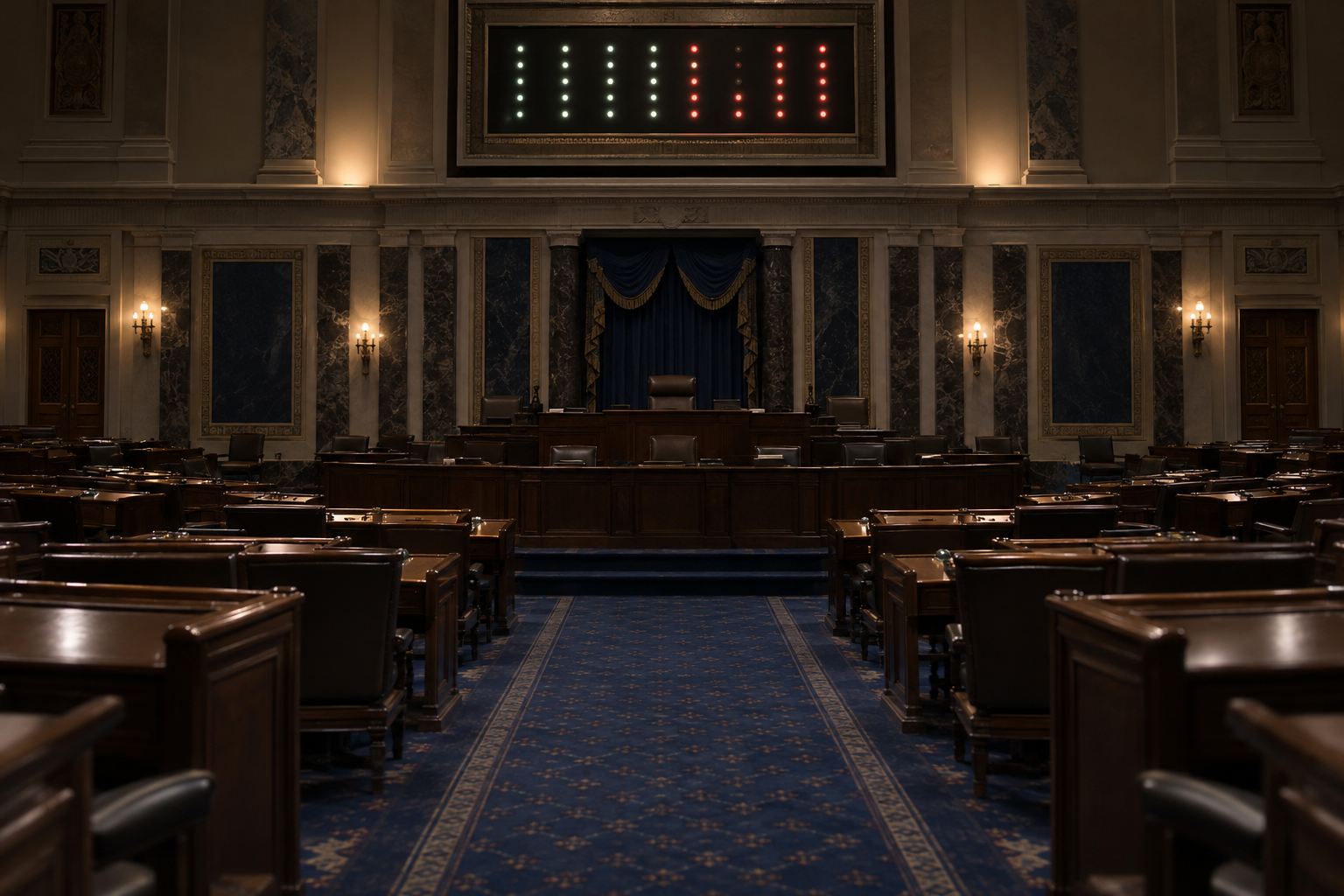
Cloture on the Digital Asset Market Clarity Act failed 49 to 50. The path forward now runs through regulators rather than through Congress.
The Senate's cloture vote on H.R. 3633, the Digital Asset Market Clarity Act, failed 49 to 50 on Tuesday, leaving the crypto industry without the statutory market-structure framework it has pursued for years.
The arithmetic of the defeat is unusually legible. Republicans Susan Collins, Josh Hawley and Jerry Moran voted against the bill on substantive grounds, with concerns centering on community banks and on stablecoin yield provisions. Thom Tillis voted no on procedural grounds specifically in order to preserve his right to file a motion to reconsider, which he filed at 3:01 p.m. Eastern immediately after the result was announced. No Democrats voted in favor. Senator Chris Coons did not vote.
Senator Cynthia Lummis, among the bill's most prominent supporters, said afterward: "I think we're done. It's over."
Why three Republican no votes matter more than the margin
A one-vote loss normally reads as a scheduling problem, something a whip operation fixes on a second attempt. This one is harder to fix, because three of the four Republican defections were substantive rather than procedural.
Tillis is recoverable by construction; he voted no to hold open the option of another vote. Collins, Hawley and Moran are not. Their stated objections concern the bill's treatment of community banks and of yield on stablecoins, which are drafting questions, not timing questions. Resolving them requires reopening text that took years to negotiate, and reopening that text risks losing support elsewhere.
Lummis's assessment is an opinion rather than a procedural fact, and a motion to reconsider technically remains available. But there is no confirmed timeline for a second vote, Senate floor time is scarce ahead of the November midterms, and the House has finished its work on this bill for the year.
What replaces a statute
The practical consequence is that the active regulatory track for digital assets in the United States is administrative rulemaking and enforcement by the Securities and Exchange Commission and the Commodity Futures Trading Commission, not legislation.
For incumbent exchanges and custodians, that is the environment they have operated in for years, and it is a known quantity. For new entrants and for firms whose business models depend on a clear line between securities and commodities, it means the line continues to be drawn case by case, in enforcement proceedings and no-action positions rather than in statute.
That asymmetry favors scale. Firms with the legal and compliance budgets to operate under interpretive uncertainty are advantaged relative to firms that were counting on a statute to lower the cost of entry.
The next markers
Whether the motion to reconsider is acted on before the end of the legislative year, and whether either agency moves to fill the gap with formal rulemaking rather than continuing case by case. The second would be the more consequential development for how digital asset markets are actually supervised in 2027.