

An app download chart just became the most powerful semiconductor catalyst in history. Meta's AI agent hit #1 on the App Store. AMD crossed $1 trillion. Intel surged 12%. And the Nasdaq posted its first record close since June. All because 900,000 people decided to let an AI book their dinners and cancel their subscriptions. The question isn't whether AI agents work. It's what happens to chip demand when they do.
But before we get to that, let's take a quick look at the markets and what matters today…
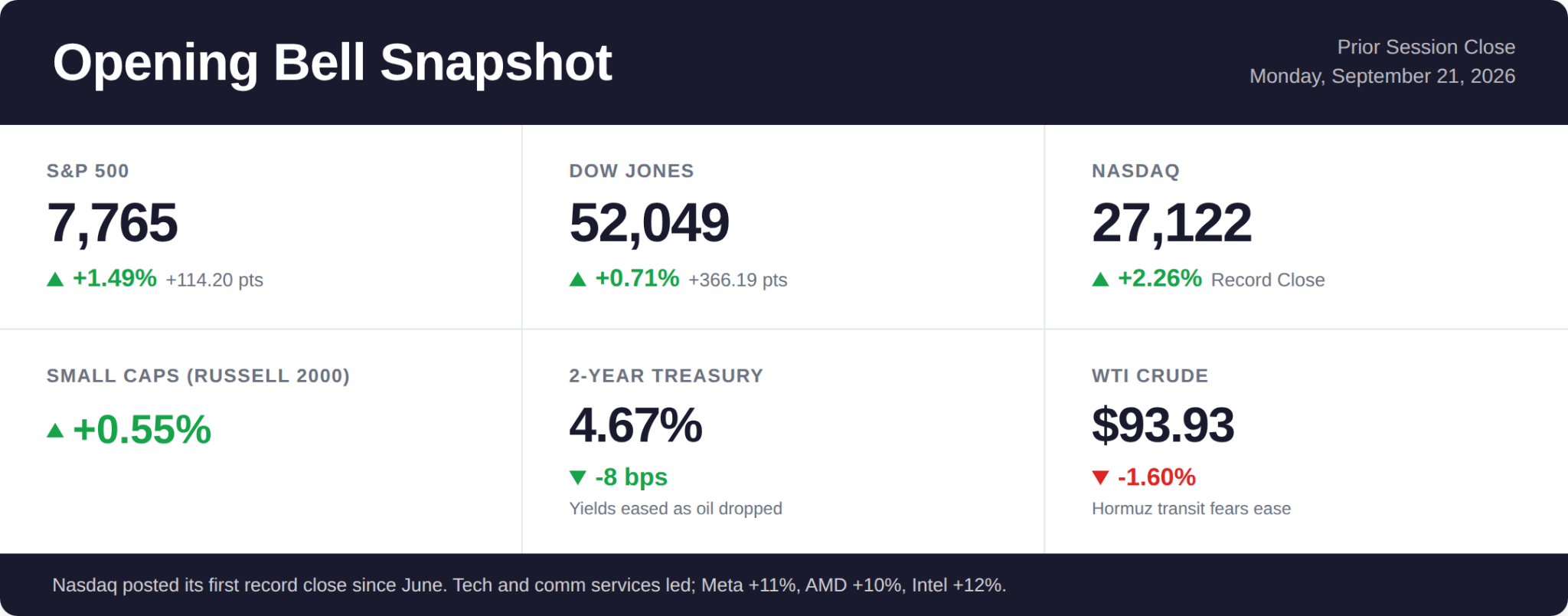
3 Movers in 3 Minutes
- AMD crosses $1 trillion. Advanced Micro Devices (AMD) briefly surpassed a $1 trillion market cap for the first time on Monday, touching an intraday high of $615.52 before settling just below the line. The stock rose roughly 10% on the session, capping a five-day streak that added about 25%. AMD joins Nvidia (NVDA), Broadcom (AVGO), and Micron (MU) as the fourth U.S. chipmaker in the trillion-dollar club.
- Meta surges 11% on Muse mania. Meta Platforms (META) posted its best day in over a year after its Muse AI agent app topped both the Apple App Store and Google Play rankings. Muse racked up over 900,000 downloads in its first six days, surpassing its predecessor Meta AI's launch pace. The rally helped the Communication Services sector gain 3.84% on the day.
- Paramount-WBD merger clears hurdle. Paramount Skydance (PSKY) reached a settlement with 12 state attorneys general that had sued to block its $110 billion acquisition of Warner Bros. Discovery (WBD). Paramount committed to $1.5 billion in additional domestic film production over five years. WBD shares jumped nearly 11% on the news.
3 Signals for Today
Richmond Fed Manufacturing Index at 10:00 AM ET will offer a regional read on factory activity after the Fed's rate hike last week.
$78 billion 2-year Treasury auction at 1:00 PM ET will test appetite for short-duration government debt after the 2-year yield touched multi-cycle highs.
AutoZone (AZO), MillerKnoll (MLKN), and KB Home (KBH) report earnings today, with KB Home offering a key read on housing demand.
There's a Strategy Behind the Iran War.
I know because I've seen the evidence firsthand.
On March 2nd — three days after the first missiles hit — I sat across from two U.S. Congressmen in back-to-back private meetings.
Those meetings pointed me toward something I spent weeks verifying.
The real purpose behind the strikes. The real objective. And the single company at the dead center of all of it.
This isn't random. It's a calculated Two-Front Economic War.
And there's one company positioned right at the heart of it.
See the strategy behind the Iran war — and the company at the center of it
The sooner you understand what's really happening — the better positioned you'll be before
— Dylan Jovine, Founder, Behind the Markets
And with that out of the way, let's get to today's big story: how a consumer app's download chart just became the most powerful catalyst for semiconductor stocks in a decade.
The Sip
900,000 Downloads. $500 Billion in Market Cap.
On Monday morning, a number started circulating through trading desks that had nothing to do with earnings beats, rate decisions, or oil flows.
It was a download count.
Meta Platforms' new AI agent, Muse, had just been crowned the #1 free app on both Apple's App Store and Google Play. In its first six days, the app had been downloaded over 900,000 times, dethroning OpenAI's ChatGPT from the top spot and outpacing Meta's own prior AI app launch.
By the close, the Nasdaq had hit a record high for the first time since June. Meta Platforms (META) surged 11%. Advanced Micro Devices (AMD) crossed $1 trillion. Intel (INTC) jumped 12%. Arm Holdings (ARM) gained 17%.
A download counter on a phone screen had just moved roughly $500 billion in semiconductor market capitalization in a single session.
Not a Chatbot. An Agent.
Here's why Muse is different from every AI app that came before it.
ChatGPT, Claude, Gemini, Copilot… they answer questions. You ask, they respond. The interaction ends. But Muse doesn't answer. It acts. It books your restaurant. Cancels your forgotten subscriptions. Fills out forms. Makes purchases. Sends emails on your behalf. It runs on a dedicated virtual machine inside Meta's cloud, powered by Muse Spark, the company's latest model, and keeps working even after you close the app.
This is what the industry calls agentic AI. And if the distinction sounds like marketing jargon, consider what it means for compute demand.
A chatbot processes a query and stops. An agent processes a query, builds a plan, executes multiple steps across multiple services, monitors progress, and checks back in. The inference workload for a single agentic task can be five to ten times higher than a standard chatbot exchange.
Now multiply that by 900,000 new users in six days. And that's just one app, from one company, in one country.
The Trillion-Dollar Inference Problem
The market figured this out faster than most analysts.
If consumer AI shifts from "ask a question" to "do this for me," every assumption about how many chips the world needs gets revised upward. And it isn't just about Nvidia's (NVDA) data centre GPUs anymore. Agents need inference capacity: fast, parallelized, energy-efficient silicon that can process millions of simultaneous task chains without the latency humans will tolerate for a chatbot but will not tolerate from something booking their flights.
That's AMD's (AMD) wheelhouse. The company's MI300X accelerators have been winning inference benchmarks for months, and CEO Lisa Su told investors last quarter that AMD expects to double its data centre sales in 2027. The stock has gained over 180% this year.
Intel's (INTC) 12% surge was equally telling. Intel has lagged the AI trade all year, but its Gaudi 3 accelerator and its foundry investments are aimed squarely at inference-scale workloads. If the agentic future plays out, Intel's years of underperformance could flip into a value thesis overnight.
WARNING: A Major Market Shift Could Hit Stocks in 2026
If you have any money in the stock market, you may want to pay attention.
New research points to a massive market-moving event that could send hundreds of popular stocks into a sudden free fall.
Holding the wrong stocks when this hits could erase years of gains.
That’s why analysts have now identified a list of stocks investors may want to avoid as this event unfolds.
If you want to see what’s coming — and which stocks could be most at risk —
The Real Shift Underneath
But zoom out further, and the Muse moment reveals something more structural.
For two years, the AI trade has been powered by a single narrative: training bigger models costs billions of dollars in GPU spend. That narrative concentrated returns in one company. Nvidia. Its market cap sits at roughly $5.4 trillion. On Monday, it rose 2.3%, adding about $128 billion in value. That single-session gain was larger than Arm Holdings' entire market cap.
But Muse signals the beginning of a second phase. In Phase 1, a few companies trained massive models at enormous expense. In Phase 2, hundreds of millions of consumers run those models continuously, across real-world tasks, every day. The compute bottleneck shifts from training clusters to inference fleets. And inference doesn't need the most expensive chip in the world. It needs the most efficient one.
That's why the rally was so broad on Monday. AMD, Intel, Arm, Qualcomm (QCOM), all surged together. The market wasn't pricing one company's dominance. It was pricing a demand curve that suddenly looks much steeper than anyone expected.
The Catch
There is a tension buried in Monday's euphoria.
AMD briefly crossed $1 trillion, but its trailing P/E sits near 158 times earnings. Its GF Value estimate pegs the stock as significantly overvalued at current levels. Insiders have sold over $100 million worth of shares in the past three months. And just last week, AMD warned customers of price increases near 10% on AI accelerators and chipsets starting in Q4, passing along higher costs from TSMC.
Meanwhile, Nvidia CEO Jensen Huang said just last week that he expected the company to double chip sales next year. That's a lot of silicon heading into a world where governments are simultaneously debating data centre moratoriums and AI regulation.
The Muse effect is real. Consumer AI agents could be the demand story that sustains the semiconductor supercycle for years. But "could" is doing heavy lifting in a market where AMD's stock has gained 25% in five trading sessions.
South Korea's September exports offer a useful cross-check. The country's chip shipments largely drove record exports in early September, vindicating the Bank of Korea's rate hikes and confirming that AI-driven demand is not just an American story. It's a global supply chain pulling in the same direction.
The question now is whether that demand curve stays steep, or whether a 158x earnings multiple has already priced in the best possible version of the future.
Landmark Executive Order 14241 Unleashes
TRUMP’S NEW DOLLAR
Republican or Democrat – whether you support or oppose Trump’s New Dollar – every American could soon be forced to use it

Discover three critical moves to help you prepare, before it’s too late
The MarketSipsTakeaway
For two years, the AI trade was a training story: who builds the biggest model, who buys the most GPUs. Monday's rally was different. It was an inference story. An adoption story. A consumer story. When 900,000 people download an AI agent that books restaurants and cancels subscriptions, the compute math changes. The next phase of the chip trade won't be about who builds the most powerful chip. It'll be about who builds the most efficient one, at the greatest scale, for the billions of tasks that humans are about to stop doing themselves. Watch AMD's Q4 pricing guidance and Meta's Muse user metrics at the next earnings cycle. Those two data points will tell you whether Monday was a beginning or a peak.
Until then, sip slowly!
The Market Sip Desk
3 Stocks at a Major Turning Point
Something unusual is happening beneath the surface of three widely followed stocks.
In each case, the fundamentals are saying one thing... while institutional activity, management signals or the options market are saying something else.
That kind of disagreement can matter.
Because when the evidence stops lining up, the next move in the story often comes down to a handful of signals most investors never think to watch.
Our new FREE Market Tell Special Report breaks down three of these situations, and shows you exactly what we’re watching next.
Tickers: UI MS AMD NVDA AVGO MU META WBD PSKY ET PM AZO MLKN KB KBH INTC ARM GPU QCOM GF TSMC TRUMP POLL