

Last week, four of Google's AI chips left Earth on a SpaceX rocket and began circling the planet at 17,000 miles per hour. That is not a metaphor. It is a real satellite, carrying real processors, running real tests. And the strangest part? The reason Google is looking up has less to do with science fiction and more to do with something painfully terrestrial: $130 billion worth of data centers have been blocked or delayed on the ground by communities that simply do not want them. When the biggest obstacle to building AI is not silicon but zoning boards, maybe orbit starts to make sense.
But before we dig in, let's take a quick look at the markets and what matters today...
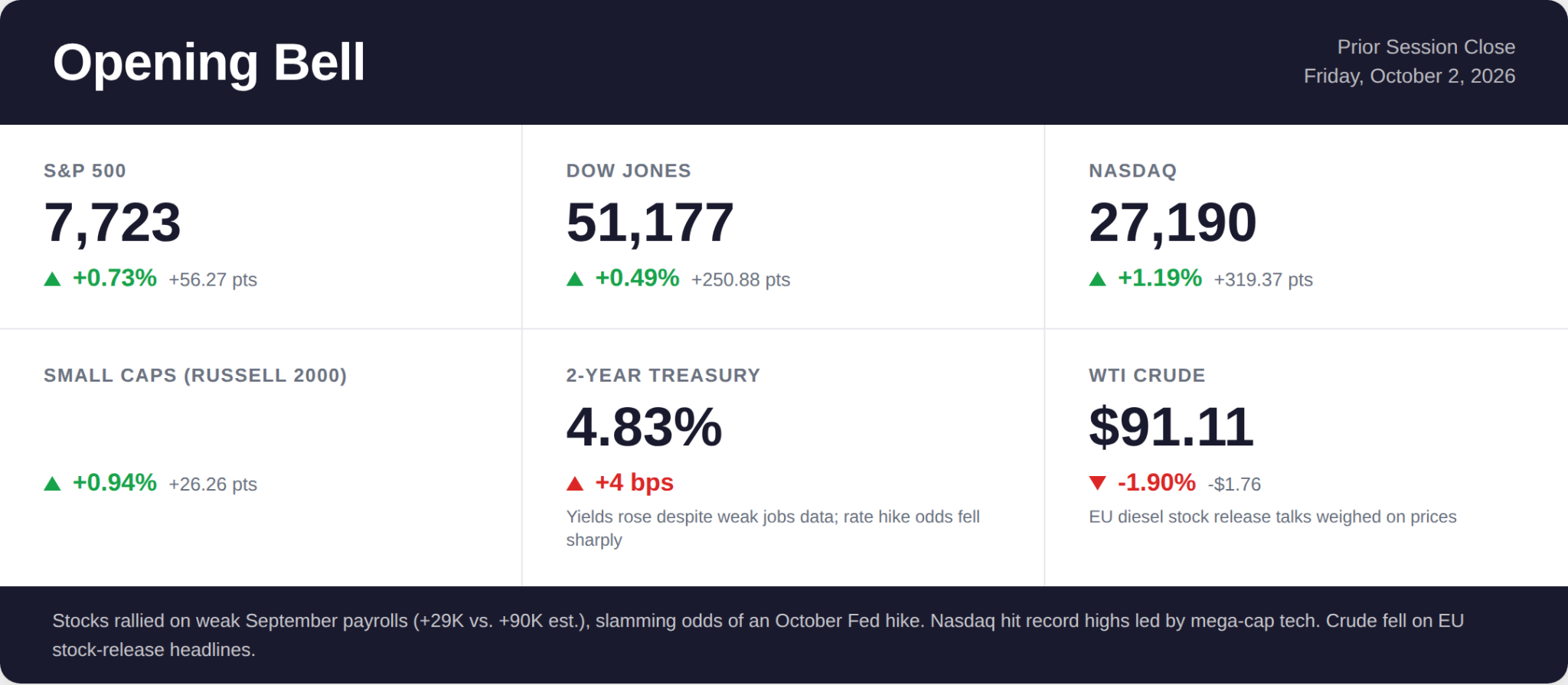
3 Movers in 3 Minutes
- Tesla (TSLA) Q3 deliveries crushed estimates. The EV maker delivered 486,532 vehicles in the July-September quarter, handily beating the 456,896 consensus. Europe was the surprise contributor as sales recovered from last year's slump, while Shanghai factory exports nearly doubled in July and August. Shares jumped more than 5% on Friday.
- Washington is about to shake up your mortgage. The Federal Housing Finance Agency is moving to let lenders use credit data from two bureaus instead of three for mortgages sold to Fannie Mae and Freddie Mac. FHFA director Bill Pulte could unveil the change as early as October 12. Shares of Fair Isaac Corporation (FICO), Equifax (EFX), and TransUnion (TRU) were all active on Friday.
- ON Semiconductor (ON) rewrites its Synaptics deal in cash. ON said it will acquire Synaptics (SYNA) for $123 per share in all cash, valuing the deal at approximately $5.7 billion. The original June agreement was a stock-for-stock transaction valued at roughly $7 billion. The restructured terms reflect both a weaker semiconductor tape and ON's preference for balance sheet clarity over dilution.
3 Signals for Today
ISM Services PMI (10:00 AM ET): After the weakest payrolls print in over a year (29,000 vs. 90,000 expected), today's services gauge is the next critical test. A reading below 50 would mark the first services contraction since early 2023.
FOMC September meeting minutes (Wednesday, October 7): The Fed held rates at its September 15-16 meeting. The minutes will reveal how many officials pushed for a hike and whether Friday's dismal jobs number changes the calculus for October.
Moderna (MRNA) joins the Nasdaq-100 (Friday, October 9, before open): The index rebalancing will force passive funds tracking the QQQ to buy MRNA shares, creating short-term demand. Expect positioning activity throughout the week.
The markets are in a dramatically different place than they were in January.
The Fed is raising rates. Geopolitical instability and energy prices are pushing inflation up.
But S&P 500 earnings growth is still expected to continue — and our analysts have identified 10 stocks well-positioned to perform through Q4 and into year-end.
From tech powerhouses to fuel cell makers to reliable dividend growers — all 10 vetted by MarketBeat's analysts and featured in our just-updated 10 Best Stocks to Own: Fall 2026 report.
Tickers, trends, and growth potential. Yours free.
And with that sorted, let's get to today's big story: the day Google's AI chips left Earth.
The Sip
The Satellite That Thinks
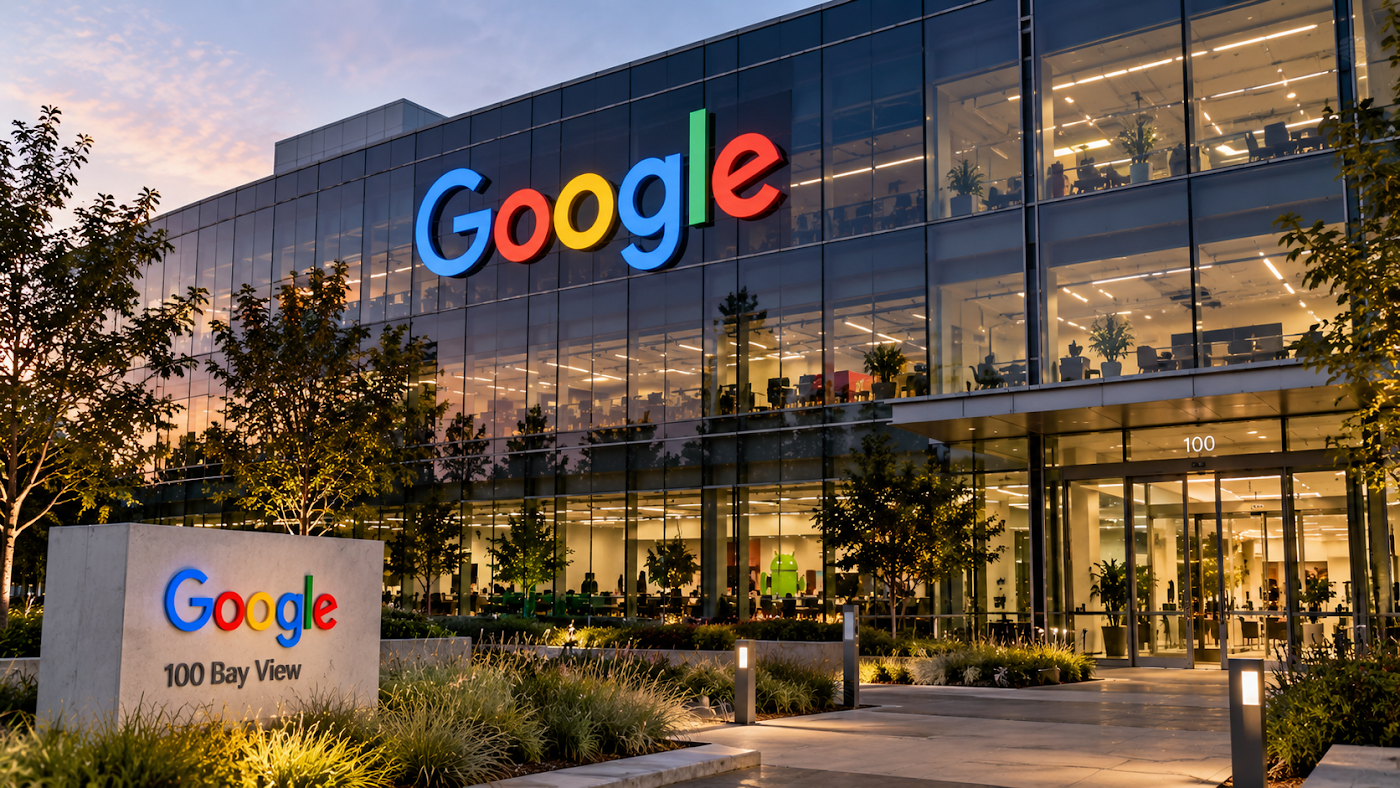
On October 1, at roughly 2:32 PM Eastern, a SpaceX Falcon 9 lifted off from Vandenberg Space Force Base carrying a refrigerator-sized satellite packed with four of Google's Tensor Processing Units. The same chips that power search results, translate languages, and train AI models on the ground were now hurtling through low Earth orbit at five miles per second.
Google (GOOGL) calls it Project Suncatcher. The satellite, built with Planet Labs (PL), is a prototype, a proof-of-concept for something that sounds outlandish until you examine why it exists: Google wants to know if data centers can work in space.
Not someday. Not theoretically. The company has confirmed contact with the satellite and is now collecting real operational data. If the TPUs survive launch stress, radiation, and the temperature extremes of orbit, Google will have answered the first question in what could become the most consequential infrastructure bet in the AI era.
The natural reaction is to ask: why?
The $130 Billion Problem on the Ground
The answer is not ambition. It is frustration.
The AI industry's most critical bottleneck in 2026 is not chips. It is not capital. It is not even electricity, though power is close. It is community consent. Ordinary people in ordinary towns who do not want a humming, water-guzzling data center warehouse built next to their homes.
In just the first three months of 2026, local resistance blocked or delayed at least 75 data center projects across the United States worth approximately $130 billion. That is more disruption in a single quarter than the entire prior year. Opposition groups have more than doubled to 833, active across 49 states. State legislatures introduced more than 300 bills related to data center regulation in the first six weeks of the year alone. New York passed what could become the nation's first statewide data center moratorium.
As Forbes reported, community consent has become scarcer than the chips and equipment needed to build data centers. More than 70% of Americans now oppose having a large data center built near their homes.
This is the context that makes Project Suncatcher less ridiculous than it sounds. Google is not going to space because it can. It is going to space because Earth is running out of places that will say yes.
The Physics Favor Space
The economics, however, are another matter.
In the right orbit, solar panels can be up to eight times more productive than on Earth. No atmosphere means no clouds, no night cycles, and no weather. A satellite in a sun-synchronous orbit receives near-continuous sunlight, eliminating the need for expensive battery storage. And roughly 40% of the energy that terrestrial data centers devote to cooling can, in theory, be eliminated entirely in the vacuum of space, where excess heat simply radiates away.
What is Elon Building in Texas?

Elon's mysterious Texas project will be 3X the size of Central Park… Cost $122 billion to build… And singlehandedly DOUBLE American chip production. One investment (not Tesla/SpaceX) is at the center of it all.
Click here to get its name and free ticker.
This ad is sent on behalf of InvestorPlace Media at 1125 N. Charles Street, Baltimore, Maryland 21201. If you're not interested in this opportunity, pleaseclick here.
Google's full vision is ambitious: 81-satellite clusters linked by 1.6 terabits-per-second optical interconnects, orbiting about 400 miles up, forming what would essentially be a floating supercomputer powered by the sun. Early ground tests have already demonstrated those communication speeds. The question is whether they hold when every node is moving at orbital velocity.
But here is where skepticism earns its keep. A TechCrunch analysis found that a 1 GW orbital data center might cost $42.4 billion, nearly three times its terrestrial equivalent. Launch costs remain the killer variable. At SpaceX's current rate of roughly $3,600 per kilogram to orbit, the math does not close. Google's own research suggests launch costs need to fall below $200 per kilogram for orbital data centers to approach cost parity with terrestrial facilities, something the company projects could happen by the mid-2030s.
Which is exactly why this is a prototype and not a product launch.
The Race Nobody Expected
Google is not alone. Starcloud, a startup backed by significant venture capital, launched its first two data center nodes into low Earth orbit in January 2026 and has been awarded up to $5.5 million from the Texas Space Commission. Former Google CEO Eric Schmidt reportedly acquired rocket company Relativity Space with plans to deploy data centers in orbit. SpaceX itself is positioned on every side of this equation, both the launch provider and a potential competitor through Starlink's infrastructure.
For investors, the immediate signal is not that orbital data centers are ready. They are not. The signal is that the terrestrial constraints around AI infrastructure, power availability, water consumption, community resistance, are now severe enough that serious companies are spending real money to explore alternatives that would have been dismissed as fantasy five years ago.
A Turner and Townsend report covering more than 300 data center projects across 20 countries found that nearly half cite power availability as their biggest construction delay. Amazon (AMZN) is spending $200 billion in capital expenditure this year, much of it on AI infrastructure. The hyperscalers are not building toward space because they want to. They are building toward space because the ground is getting harder.
The October 1 launch will not change that equation overnight. But it will produce data, real data from real chips in real orbit, that turns the conversation from "could this work?" to "under what conditions does this work?" And in a $650 billion annual AI infrastructure arms race, that is the kind of question that moves markets.
Wall Street veteran goes ALL in on Bank of Elon

A 20-year Wall Street veteran – who worked at a $10 billion hedge fund – is putting ALL his money in Elon Musk's new bank. He says he can see the writing on the wall for traditional banks. And he's not the only one. See if you should join him here (not just for the 6% yield).
This ad is sent on behalf of InvestorPlace Media at 1125 N. Charles Street, Baltimore, Maryland 21201. If you're not interested in this opportunity, pleaseclick here.
The MarketSipsTakeaway
Google's Suncatcher launch is not a product announcement. It is a signal. The AI infrastructure buildout, currently the largest capital expenditure cycle in corporate history, has collided with a force no amount of money can override: communities that do not want data centers. When $130 billion in projects are blocked in a single quarter, the industry is forced to look for alternatives. Some are going nuclear. Some are going offshore. Google is going orbital. The chips are now in space, and the data coming back over the next few months will tell us whether the most audacious infrastructure bet in tech history has legs, or whether data centers in space remain exactly where they sound: in science fiction. Either way, the ground-level constraints that pushed Google to this point are not going away. And that has implications for every company building the infrastructure that AI runs on.
Until then, sip slowly!
The Market Sip Desk
Reply prompt: Would you invest in a company building data centers in space?
3 Stocks at a Major Turning Point
Something unusual is happening beneath the surface of three widely followed stocks.
In each case, the fundamentals are saying one thing... while institutional activity, management signals or the options market are saying something else.
That kind of disagreement can matter.
Because when the evidence stops lining up, the next move in the story often comes down to a handful of signals most investors never think to watch.
Our new FREE Market Tell Special Report breaks down three of these situations, and shows you exactly what we’re watching next.
Tickers: UI MS TSLA EV FHFA FICO EFX TRU SYNA ISM PMI ET FOMC MRNA QQQ PM GOOGL PL GW AMZN POLL