

Everyone knows the AI trade. Nvidia, data centres, soaring compute demand. But almost nobody knows how it is actually being financed. This summer, a chip company, a private equity giant, and an alternative asset manager quietly assembled the largest private financing in history. The collateral was not real estate, aircraft, or oil wells. It was AI chips. And if that sentence doesn't make you sit up, the $29 billion backstop behind it probably will.
But before we get to that, let's take a quick look at the markets and what matters today...
3 Movers in 3 Minutes
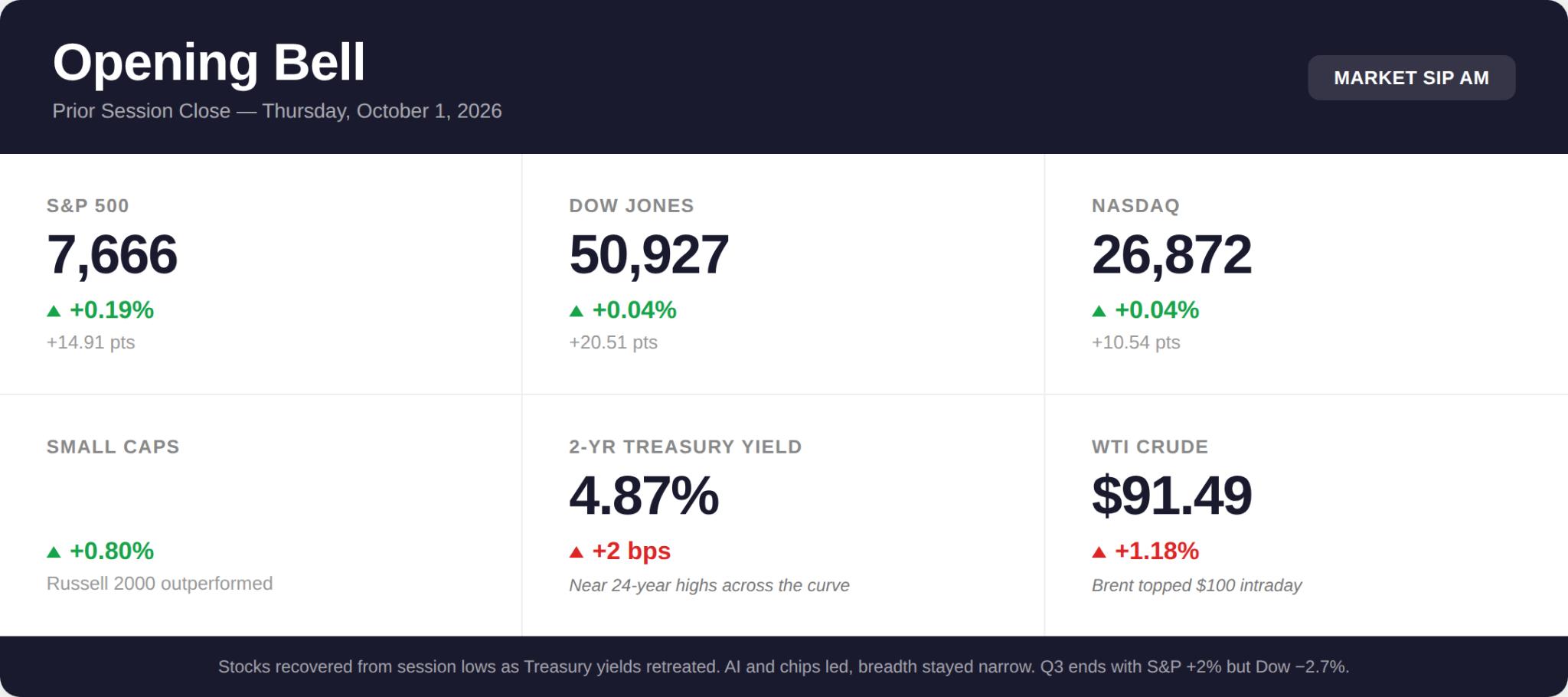
1. Micron's blowout quarter lifts the chip trade. Micron Technology (MU) delivered stronger-than-expected earnings, sending shares up about 3% and pulling the broader semiconductor sector higher. Memory demand for data centre GPUs continues to outstrip supply, reinforcing the AI infrastructure thesis that has powered the Nasdaq's outperformance all year.
2. Nike stumbles on Q4 guidance despite earnings beat. Nike (NKE) beat Wall Street's earnings expectations at 35 cents per share versus the 28 cents consensus, but the company warned Q4 revenue would fall 2% to 4%, with China revenues expected to drop 20%. CEO Elliott Hill's turnaround plan faces a tougher consumer backdrop than the playbook assumed.
3. Oil surges as Brent breaches $100. Brent crude topped $100 per barrel intraday. WTI climbed to roughly $91.49. China suspended fuel exports for October, tightening global supply as the Middle East conflict continues to threaten Strait of Hormuz transit.
3 Signals for Today
September jobs report. Nonfarm payrolls will set the tone for the October Fed meeting. A hot number could cement another rate hike; a soft print could change the conversation entirely.
Fed's Jefferson in focus. Vice Chairman Philip Jefferson said Thursday that inflation remains "too high," but that the Fed "needs more time." Markets will parse any follow-up remarks today for clues on an October pause.
Manufacturing PMI confirms expansion. The final S&P U.S. Manufacturing PMI for September came in at 55.9, the highest reading in more than four years, marking the 14th consecutive month of expansion. Strong demand underneath hawkish policy.
The Iran War Didn't Just Make Headlines.
It broke the gold market wide open.
Investors are racing into the one asset Wall Street can't print.
But the metal isn't where the real money gets made.
There's one tiny company sitting on more gold than France, Italy, and China combined.
It moves 10x faster than the metal — and it's still trading at a 99% discount to what it's actually worth.
The ticker is waiting for you.
Get the full gold briefing — including the stock name and buy-up-to price
And with that out of the way, let's get to today's big story: the financial engineering behind the AI boom.
The Sip
When Chips Became Collateral
On June 9, 2026, three names showed up on the same press release that normally do not appear in the same sentence.
Broadcom (AVGO), the semiconductor company behind custom AI chips for the world's largest AI labs. Apollo (APO), the $700 billion private equity and credit powerhouse. And Blackstone (BX), the world's largest alternative asset manager.
Together, they announced something called the AI XPV Platform. The opening transaction: $35 billion. Apollo's own partner, Jamshid Ehsani, called it the largest private financing ever executed. The platform was designed to deliver more than 20 gigawatts of compute capacity for frontier AI labs through 2028.
And if that sounds like the kind of announcement you would normally scroll past, here is the part worth stopping for: the collateral underlying this $35 billion deal is not real estate, not ships, not oil reserves. It is AI chips.
How It Actually Works
The mechanics are surprisingly simple, and that is precisely what makes them significant.
Here is what happens. Apollo and Blackstone raise tens of billions in debt from institutional investors. That capital is used to purchase AI racks, built around Broadcom's custom XPU chips and networking equipment. Those racks are then leased to frontier AI labs, starting with Anthropic, who need massive compute capacity but do not want to (or cannot) fund the entire upfront cost themselves.
The AI labs get guaranteed access to the silicon they need. The investors get contracted lease payments. And Broadcom gets something extraordinary: a guaranteed buyer for its most advanced chips, at scale, for years.
But Broadcom does not merely supply the hardware. According to its 10-Q filing with the SEC, the company backstops the deal. If the AI lab defaults on its lease, if the contracted cash flows do not materialise, Broadcom absorbs the loss. Its maximum potential liability: approximately $29 billion.
That is not a typo. A semiconductor company has put $29 billion of its own balance sheet behind a bet that AI compute demand will not slow down.
The New Asset Class
Apollo's Ehsani framed AI compute as "one of the most compelling new asset classes in finance", characterised by contracted cash flows, mission-critical utility, and a supply-demand dynamic that keeps intensifying.
Read that sentence again. "New asset class." Wall Street has financialised everything from mortgages to music royalties to catastrophe risk. Now it is doing the same thing with AI chips.
The structure mirrors how the world finances aircraft or commercial real estate. Airlines do not always buy their planes outright. They lease them through financial intermediaries who raise debt against the asset and collect rental payments over the life of the contract. The AI XPV Platform applies that same logic to silicon. The chip is the plane. The AI lab is the airline. Apollo is the lessor. Broadcom is Boeing, except Boeing does not normally backstop $29 billion in lease payments.
Louis Navellier: My #1 AI stock for 2026 (name & ticker inside)

"I want to give you a free stock pick today. This company's sales are up 28% year over year. It holds over 30,000 patents in wireless and video technology. And it just earned an A-rating in my proprietary Stock Grader system. That's the same system that helped me flag Nvidia back in 2005 — before its 82,000% run. In fact, this system has identified the top-performing S&P 500 stock for 12 years running. Over the years, it has cost me $9 million to build and maintain. And right now, it's flashing its highest possible rating on this AI play." — Louis Navellier Click here to see which AI stock my $9 million system is flagging right now, free.
This ad is sent on behalf of InvestorPlace Media at 1125 N. Charles Street, Baltimore, Maryland 21201. If you're not interested in this opportunity, pleaseclick here.
And the scale is accelerating. Broadcom is already in talks to raise more than $60 billion in additional debt for the next wave of deployments. Mizuho analysts estimate that Broadcom could generate $21 billion in AI revenue from Anthropic alone in 2026, potentially doubling to $42 billion in 2027. Broadcom's CEO Hock Tan has said the company expects its custom AI chip business to top $100 billion in annual revenue by next year.
The Question Nobody Is Asking Loudly Enough
The bull case writes itself: AI labs are generating real revenue. Anthropic's annualised run rate has crossed $30 billion, up from roughly $9 billion at the end of 2025. That is not speculation. That is cash flow. And cash flow can service debt.
But $35 billion is a lot of debt. And $60 billion more is a lot more debt. And the entire structure rests on one assumption: that demand for AI compute will continue to grow at a pace that justifies leasing chips at these prices. If a frontier lab's revenue growth slows, if a new architecture makes current chips obsolete faster than expected, if a major customer defaults on a multi-year lease, the losses cascade through the same structured finance chain that was designed to distribute them.
That does not mean this is 2008. Mortgages were extended to borrowers who could not repay them. AI chips are being leased to companies generating tens of billions in revenue. The comparison is structural, not moral. But the mechanism is familiar: take an asset, wrap it in debt, tranche the risk, and distribute it to institutional investors who trust the credit rating more than they understand the underlying collateral.
The difference, this time, is that the collateral depreciates faster than a house. A chip that is cutting-edge today may be a paperweight in three years.
The Long View
Broadcom's Q1 fiscal 2026 results underscore why the company is willing to take the risk. AI revenue hit $8.4 billion in the quarter, up 106% year-over-year, with Q2 expected to reach $10.7 billion. Total revenue was $19.3 billion. Adjusted EBITDA margin: 68%.
Those are not the financials of a company gambling on a hunch. Those are the financials of a company that has already built the toll road and is now financing the traffic.
The real question is not whether Broadcom can afford the bet. It is whether the rest of the market understands what kind of bet it is making when it buys the stock.
Renowned tech investor James Altucher – the man who called the rise of Nvidia, Apple and SpaceX years in advance – just uncovered Elon Musk’s latest breakthrough idea…
And according to James, it’s going to be even bigger than the SpaceX IPO – creating up to 1.8 million new millionaires over the coming years.
The pieces behind it are inside this briefcase – which he reveals 100% FREE in this video.
The MarketSipsTakeaway
The AI boom is no longer just a tech story. It is a structured finance story. Broadcom, Apollo, and Blackstone have quietly built the largest private financing vehicle in history, collateralised by silicon, and they are going back for more. If AI compute demand keeps growing, this structure will look like genius. If it doesn't, the losses are backstopped by a chip company that has never been in the insurance business before. For investors in Broadcom, the $29 billion backstop is not a footnote. It is the story.
Until then, sip slowly!
The Market Sip Desk
Reply prompt: Do you think structured AI financing is brilliant or dangerous? Hit reply and tell us.
3 STOCKS OUR SIGNAL ENGINE SAYS TO WATCH CAREFULLY
Three stocks. Three signals. Two weeks later, the story changed.
On September 2, we published three market questions around KLAC, HPE and PG&E.
Two weeks later, every one of them produced new evidence.
One company delivered record revenue and raised its outlook.
Another saw weakness spread across its entire peer group.
And in the third, a market risk that had only been showing up beneath the surface suddenly became explicit.
Yet none of these stories is finished.
That’s why we built Market Tell.
To track the signals that keep moving after the headline is gone — and show you what investors should be watching next.
We’ve put the latest analysis into a new FREE Special Report:
3 Stocks at a Major Turning Point
See what changed… what still hasn’t been resolved… and the signals we’re watching now.
Tickers: UI MS MU NKE WTI PMI AVGO APO BX XPV XPU WATCH KLAC HPE PG POLL