

Yesterday in Austin, Tesla unveiled a gold-coloured, two-seat pod with butterfly doors, wheelchair-friendly seating, and braille on the handles. It has no steering wheel. No pedals. No option for a human to intervene. This is not a car launch. It is an identity declaration from a $1.4 trillion company that its future has nothing to do with selling cars. Whether you buy that thesis or not, the Cybercab forces a question the market has been dancing around for years: what exactly is Tesla worth, and why?
But before we get to that, let's take a quick look at the markets and what matters…
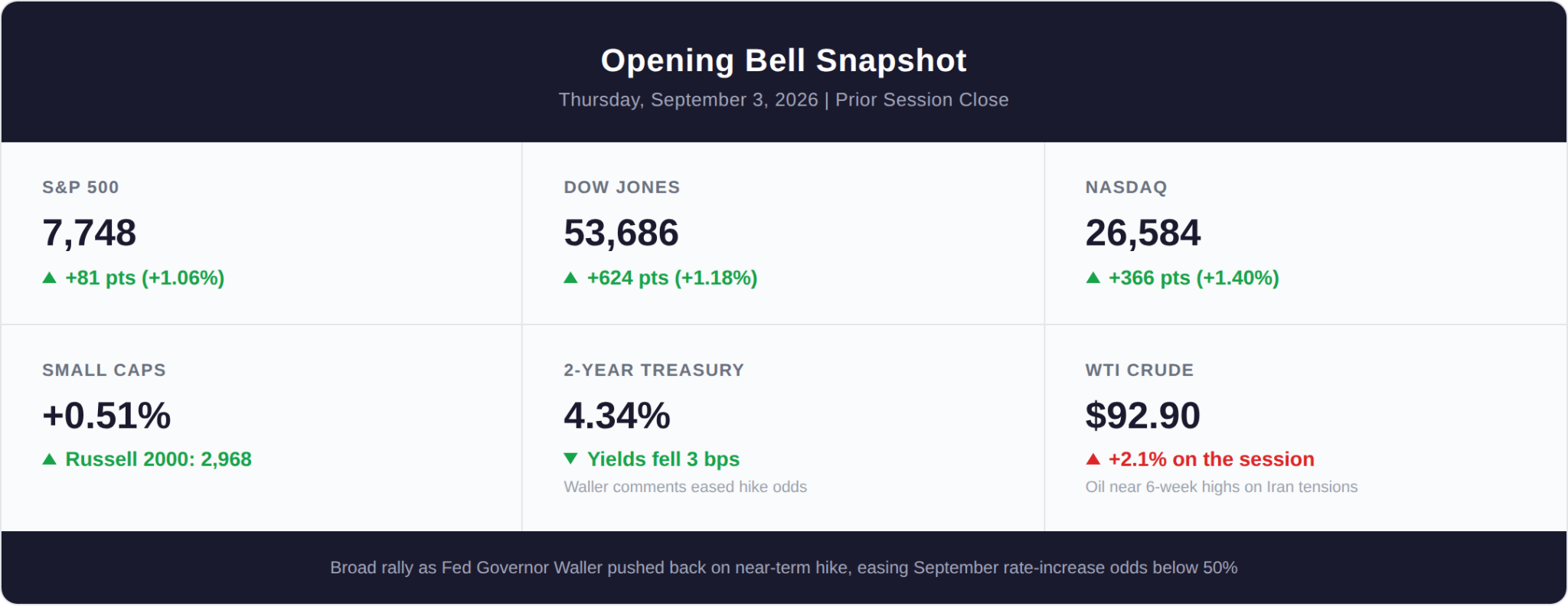
3 Movers in 3 Minutes
- Tesla (TSLA) surged 6% ahead of Cybercab launch. Shares climbed to $383 on 2.3x average volume as traders positioned before the Austin robotaxi event. The stock had already rallied 18% in August, and the question heading into the evening was whether the reveal would clear a bar an $80 billion monthly market-cap addition had already priced in.
- Robinhood (HOOD) jumped 13% to $123 after Morgan Stanley upgraded the stock. The catalyst was prediction markets: Q2 event contracts traded rose over 10x year-over-year to 13.6 billion, and the bank now sees revenue reaching $8 billion by 2028. Deutsche Bank added fuel, projecting that company KPI contracts alone could become a $1 trillion asset class by 2028. Volume hit 51.5 million shares, more than double the daily average.
- Broadcom (AVGO) fell 4.4% despite beating on both revenue and EPS. The chipmaker posted $29.59 billion in Q3 revenue (vs. $29.36B expected) and $3.32 adjusted EPS (vs. $3.24), with AI semiconductor revenue up 221% year-over-year to $16.7 billion. But a Q4 revenue guide of $34.8 billion missed the $35.03 billion consensus by a hair, and in the current AI trade, barely beating is the new missing.
3 Signals for Today
August nonfarm payrolls at 8:30 AM ET, the single most important number before the Fed's September 15-16 meeting, arriving after July's downwardly revised figures showed a combined 103,000 fewer jobs than previously reported for May and June.
Fed pricing recalibration, with markets now split roughly 50/50 on a September rate hike after Governor Waller's comments yesterday pushed back against near-term tightening, directly contrasting Chairman Warsh's hawkish tone from Jackson Hole.
Tesla (TSLA) Cybercab aftermath, as markets digest the Austin launch event details, whether Cybercabs begin commercial rides this week, and how the deployment narrative reshapes the autonomous driving competitive map against Waymo's 4,000 vehicles across 14 cities.
90% of AI Runs Through This Company
The biggest AI wins often come from companies you don’t hear about every day.
Case in point:
The database provider now embedded into the big three cloud platforms - with access to 90% of the market.
You’ll find the name and ticker of this newly-minted giant in our 7 AI Stocks to Invest in Today report, along with:
• The chip giant holding 80% of the AI data center market.
• A plucky challenger with 28% revenue growth forecasts.
• A multi-cloud operator with high-end analyst targets near $440.
Plus 3 other AI stocks set to take off.
And with that out of the way, let's get to today's big story: what the Cybercab actually tells us about Tesla's valuation.
The Sip
A Pod With No Steering Wheel
In October 2024, Elon Musk stood on a Hollywood studio lot and unveiled a sleek, gold-coloured robotaxi concept. Two seats, butterfly doors, no steering wheel. The internet debated it for 48 hours. Tesla's stock fell 9% the next day because the event felt more like a movie prop than a business plan. No timeline. No production details. No economics.
Almost two years later, on Thursday evening in Austin, that same vehicle rolled out in production form. Tesla had registered 45 Cybercabs with Texas regulators. Another 20 or more were spotted at Miami International Airport. Employee test rides had been running since July. And the Robotaxi app had quietly updated to support Cybercab hailing.
This time, it was real. And the stock responded accordingly, rallying 6% ahead of the event to close near $383, its highest level in weeks.
But here is what most coverage missed. The Cybercab is not interesting because it is a new car. It is interesting because it is not a car at all.
The Platform Thesis, Tested
Tesla (TSLA) has been valued at a premium to every automaker on the planet for years. At a $1.4 trillion market cap, it trades at roughly 50 times revenue. Toyota, the world's largest carmaker by volume, trades at about 1 times revenue. General Motors, at less than half that. If Tesla were simply a car company that happened to make electric vehicles, its valuation would be indefensible.
The bet is that Tesla stops being a car company entirely.
This is the thesis Cathie Wood's Ark Invest has been articulating since 2016. In Ark's model, the robotaxi network could account for 88% of Tesla's value by 2029. Not batteries. Not solar. Not Cybertrucks. The autonomous ride-hailing network. And the Cybercab is the first vehicle purpose-built to serve that network. No steering wheel means no fallback. No pedals mean no human driver cost. No driver means the entire revenue equation changes.
Consider the economics Musk floated at the original reveal: a sub-$30,000 vehicle with an operating cost of roughly $0.20 per mile. An Uber ride in Austin costs around $1.50 to $2.00 per mile, with most of that going to the driver. Remove the driver, and the margin structure inverts. The vehicle becomes a revenue-generating asset that runs 16 hours a day, earns back its cost in under a year, and compounds returns on every mile driven.
That is the platform thesis. And the Cybercab is the first hardware that makes it testable.
The Waymo Problem
Except Tesla is not the only company trying to build this. And by almost every operational metric, it is not even close to leading.
Alphabet's Waymo has logged over 200 million autonomous miles. Tesla's unsupervised robotaxi figure? Around 380,000. That is less than 0.2% of Waymo's total. Waymo now operates over 4,000 vehicles across 14 U.S. cities, including new launches in San Diego, Tampa, and Denver. Amazon's Zoox is expanding its own test fleet. Tesla operates unsupervised rides in just six cities across Texas and Florida.
Renowned tech investor James Altucher – the man who called the rise of Nvidia, Apple and SpaceX years in advance – just uncovered Elon Musk’s latest breakthrough idea…
And according to James, it’s going to be even bigger than the SpaceX IPO – creating up to 1.8 million new millionaires over the coming years.
The pieces behind it are inside this briefcase – which he reveals 100% FREE in this video.
The counterargument is architectural. Waymo's vehicles cost upward of $200,000 each, bristling with lidar sensors, radar arrays, and precision-mapped geofenced routes. Tesla's Cybercab uses cameras and AI alone, a vastly cheaper hardware stack. If the software catches up, Tesla can scale faster and cheaper than anyone else in the industry. But that is a big "if," and it has been a big "if" for a long time.
There is also a profitability question nobody in this sector has answered. As Stanford's Bryant Walker Smith put it: how do you compete with an Uber driver who might be making under minimum wage, providing and maintaining their own car, cleaning it, doing all the services that Tesla and Waymo will ultimately have to pay real people real money to do?
Nobody has made money running robotaxis yet. Not Waymo. Not Cruise (which shut down its fleet in 2023). Not anyone. Tesla's bet is that purpose-built hardware changes that equation. The market's bet is that Tesla's track record of defying sceptics matters more than Waymo's mileage lead.
What the Price Is Actually Buying
Tesla shares are still down more than 20% year-to-date despite the 18% August rally. Q2 revenue hit $28.2 billion on record deliveries of 480,126 vehicles, but the non-GAAP EPS of $0.33 missed a $0.54 consensus badly. Gross margins are compressing. Capital expenditure is expected to exceed $25 billion in 2026 alone. Active FSD subscriptions grew to 1.48 million, a promising signal, but still a fraction of the 7 million-plus Tesla vehicles on the road.
The honest read is that Tesla's current earnings do not support a $1.4 trillion valuation. Nobody seriously argues they do. What supports the valuation is the option value on autonomy, the possibility that a fleet of cheap, purpose-built pods running on AI-only software could create a recurring-revenue mobility network worth more than the car business ever was.
The Cybercab launch does not prove that thesis. But it moves it from speculation to something that can be measured. How many rides per day? What is the maintenance cost per mile? How often does the software fail? These are questions with answers now, not projections on a slide deck.
Morgan Stanley warned before the event that the stock could "sell off through it." History supports that view: Tesla events have a pattern of generating excitement that the stock has already priced. But the longer-term question is simpler. If the Cybercab works at scale, Tesla's current price is cheap. If it does not, the premium collapses, and you are left paying 50 times revenue for an automaker with shrinking margins.
The steering wheel is gone. The ambiguity is not.
Iran War TRUTH:
What Was Revealed Behind Closed Doors

There’s a strategy behind the Iran war.
I know because I heard it directly in a closed-door meeting with a source whose connections run deep into global power networks.
He walked me through the real purpose and the massive deal tied to it.
The MarketSipsTakeaway
Tesla's Cybercab is the first real-world test of the most important question in markets right now: can possibility sustain a trillion-dollar valuation until the economics arrive? Waymo has the miles. Tesla has the fleet architecture and the stock-market faith. What nobody has is profitability. Watch the next 90 days closely. If Cybercabs start carrying paid passengers in Austin this month, with verifiable ride data and unit economics, the autonomous driving thesis shifts from narrative to spreadsheet. If the fleet stays stuck at a few dozen vehicles in a few cities, the 20% YTD decline tells you the market already knows the answer.
Until then, sip slowly!
The Market Sip Desk
Reply prompt: What's your biggest question about Tesla's robotaxi future?