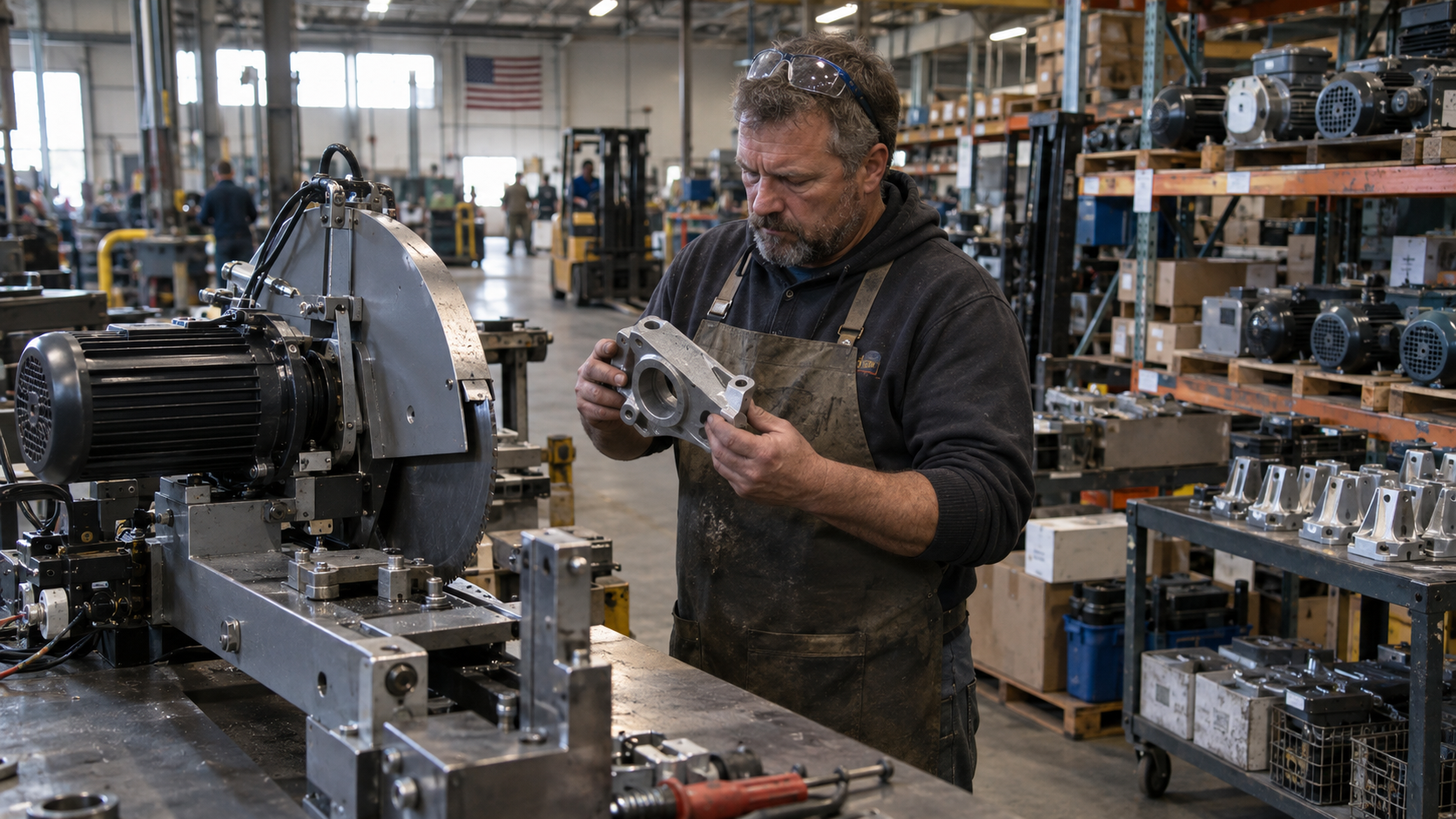
A small Iowa saw manufacturer watching a single motor bracket double in price captures a pressure playing out across the industrial economy, where tariffs, record fuel costs and a newly hawkish Federal Reserve are landing on companies at the same time.
Allen Eden runs a 25-person business in Britt, Iowa, called Original Saw Co., which makes industrial power saws for wood and metal work, and this summer he watched the price of a small bracket used in his saw motors more than double, to $87 from $42. His response has been to hold onto more inventory than usual, hedging against the possibility that the parts he needs will only get harder or more expensive to source. "It's awful," Eden said. "I'm just trying to keep more of the stuff around because I don't know if we can get it down the road."
Eden's experience captures a three-part squeeze now working through American manufacturing, transportation and retail simultaneously. Tariffs are raising the cost of imported materials and finished goods. Record diesel prices are raising the cost of both producing and moving those goods. And the Federal Reserve's decision to raise interest rates for the first time in three years is making it more expensive to finance the inventory and equipment that businesses need to keep running, all at the same moment. Dubravko Lakos-Bujas, JPMorgan's global head of strategy, wrote in a recent note that smaller companies, which typically rely on shorter-term borrowing, feel the effect of Fed rate increases more directly and more quickly than large corporations do, and that capital-intensive sectors including manufacturing, equipment suppliers, trucking fleets and commercial real estate are first in line to feel the combined pressure.
Gregory Daco, chief economist at EY-Parthenon, the consulting arm of Ernst & Young, described the dynamic bluntly: "The combination of higher rates and higher fuel prices means that sectors with heavy exposure to both are first in the line of fire," adding that manufacturing in particular is "disproportionately exposed" to fuel costs given how much material handling and transportation the sector depends on. Mark Costa, chief executive of industrial materials maker Eastman Chemical, said the pressure has left companies with no cushion left to absorb further cost increases, describing an environment in which "everyone had their back against the wall" and is "raising prices faster than I've ever seen in 20 years." Home Depot Chief Financial Officer Richard McPhail said the retailer's own unexpected exposure to energy and raw-material costs would fully offset the benefit of roughly $730 million in tariff refunds the company had been counting on, citing a mix of inflation, interest rates and fuel prices as sources of ongoing uncertainty.
Some companies have already restructured around the pressure rather than absorbing it. Lucerne International, a privately held auto parts maker based near Detroit, stopped domestic manufacturing operations and canceled a planned $50 million aluminum forging plant in Michigan, with Chief Executive Mary Buchzeiger saying the tariff environment has "torn holes" in the company's global supply chains and driven up costs significantly; the firm has since shifted its U.S. operations toward warehousing, distribution and tariff-mitigation services, which she said carry considerably better margins. Grupo Antolin, a Spanish auto parts supplier to Ford, General Motors, Volkswagen and Stellantis, filed for Chapter 15 bankruptcy protection in the United States in July, citing tariffs, higher raw-material and energy costs, and supply-chain disruption as the reasons for its restructuring. Across the top 100 global auto suppliers, earnings before interest and taxes growth fell to 4.2% last year, down from more than 6% in 2021, according to consulting firm Berylls by AlixPartners, with a similar slowdown among the largest automakers themselves.
Large, cash-rich companies with long-dated debt are considerably better insulated. JPMorgan's Lakos-Bujas, citing 80 years of historical data, estimates that most larger companies can absorb further increases in borrowing costs comfortably until the 10-year Treasury yield reaches roughly 6%, a full percentage point above where it stands today. Airlines have so far managed the fuel-cost side of the squeeze by passing costs directly to travelers, with fares up more than 23% year over year in August even as they trim less profitable routes, a pattern United Airlines Chief Financial Officer Mike Leskinen described as simply following where demand no longer justifies the fuel cost of flying a route. Corporate profit margins across the broader market remain near historic highs, supported by productivity gains and heavy investment in artificial intelligence, but Daco cautioned that the underlying pressures, the war affecting energy prices, tariffs, and the AI boom's own demand for electricity, chips, copper and land, are not being addressed by higher interest rates and could still produce a shock faster than markets currently expect.