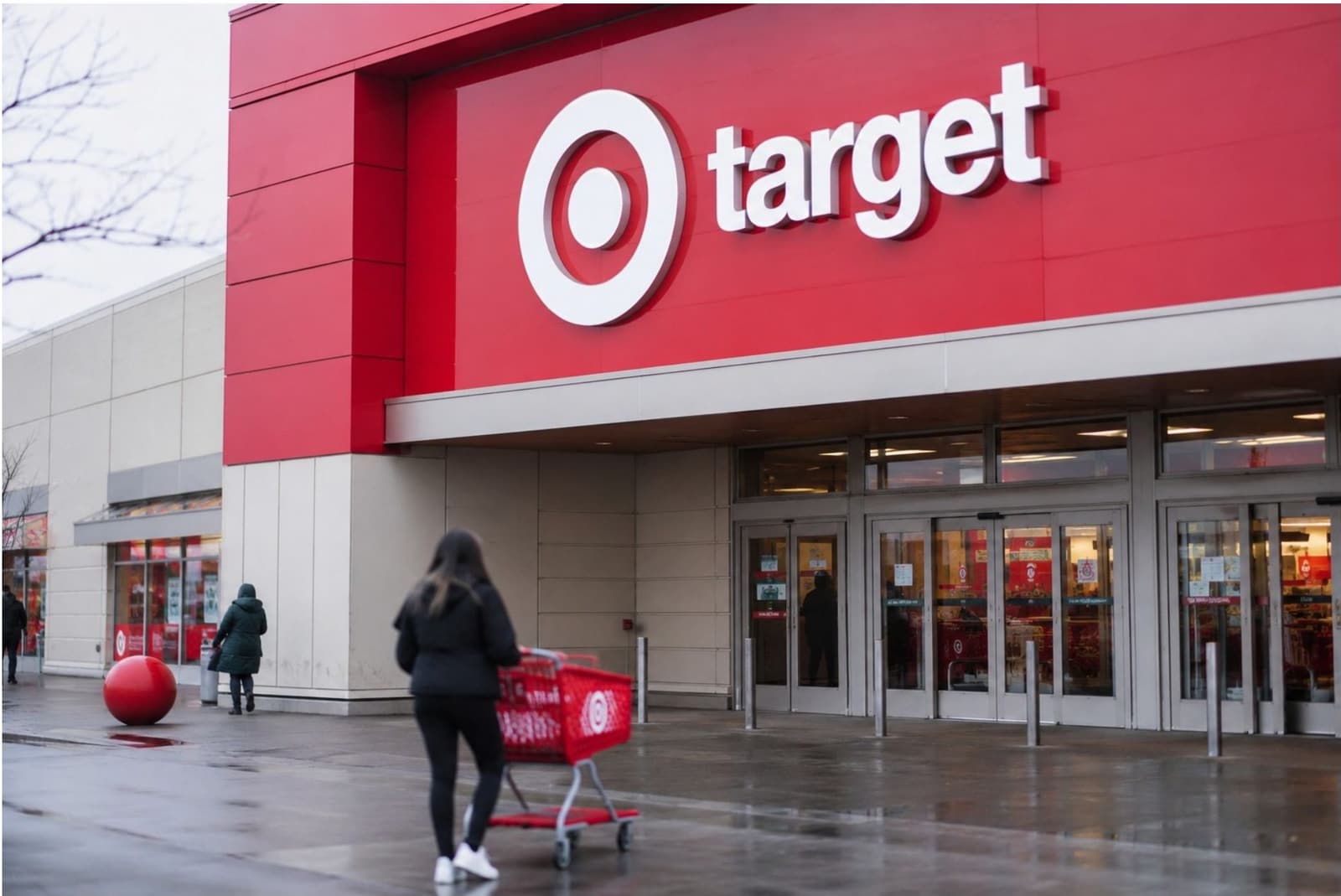
TGT delivered its strongest quarter in years, but the results did not fully settle the company's turnaround debate. They changed its center of gravity.
The investor question is no longer whether Target is still deteriorating after a prolonged discretionary slowdown and multiple years of weak execution. The question now is whether the retailer can convert early traffic stabilization into durable market-share recovery without structurally impairing margins.
That distinction explains the mixed stock reaction following the report. The quarter itself was clearly better than expected. Investors remain uncertain whether the improvement reflects a sustainable repositioning or a rebound against unusually weak prior-year comparisons.
Michael Fiddelke, who succeeded Brian Cornell as CEO in February 2026, delivered his first quarterly report as chief executive after Target had previously reported 13 consecutive quarters of weak or falling sales. The company also posted its largest comparable-sales increase since early 2022, according to WSJ framing of the results.
Target reported fiscal first-quarter net sales of $25.4 billion, up more than 6% year over year and ahead of consensus expectations near $24.6 billion. Adjusted EPS of $1.71 exceeded expectations around $1.46. Comparable sales rose 5.6%, driven primarily by a 4.4% increase in traffic, while average ticket increased 1.1%.
That traffic figure mattered more than the ticket increase.
Target's core problem during the last several years was not simply weaker basket size. It was fewer customer visits, especially in discretionary categories that historically differentiated the brand from Walmart and Amazon.
Management repeatedly framed the quarter as evidence that customers are reengaging with the brand across stores, digital channels and merchandise categories. But executives also avoided declaring victory.
Fiddelke cautioned that management would “not confuse progress with potential,” while CFO Jim Lee emphasized that the company still faces more difficult comparisons later this year.
Discretionary Categories Improved, But the Recovery Remains Uneven
The quarter showed broad-based improvement across Target's business, but the underlying category mix still reflects a consumer environment that remains selective rather than fully normalized.
Food and beverage sales rose roughly 6% year over year as the company expanded assortments with roughly 3,000 additional food items. Beauty continued outperforming, aided by prestige expansion and Target's planned Beauty Studio rollout to nearly 600 stores later this year.
Management also highlighted strong toy performance after Target pushed more items below the $10 price point, reflecting a more value-oriented merchandising strategy aimed at middle-income consumers facing higher fuel and living costs.
Essentials categories continue providing the company's most reliable traffic engine.
Discretionary categories improved, but less convincingly.
Home sales were only modestly above prior-year levels despite easier comparisons, while apparel improved but remained below 2024 levels on a two-year basis, according to management commentary. That distinction matters because discretionary recovery remains central to the structural bull thesis around Target.
Target historically differentiated itself through trend-driven apparel, home décor and impulse-driven discretionary purchases. The company lost credibility in those categories during the last several years as store conditions deteriorated, merchandising slowed and consumers increasingly shifted discretionary spending toward value-oriented competitors and off-price chains.
The quarter suggests discretionary deterioration has likely bottomed. It does not yet prove that Target has fully reclaimed category leadership.
Management acknowledged that consumer behavior remains cautious and highly selective. Executives cited value sensitivity, ongoing pressure from fuel and living costs, and continued prioritization of essentials spending across portions of the customer base.
Reuters also noted that Target's recent pricing investments, including price reductions on roughly 3,000 items, were partly designed to offset pressure from rising fuel costs tied to geopolitical disruptions and energy volatility.
Margin Recovery Improved, but Investors Are Focused on Sustainability
The most important analytical tension in the quarter was the relationship between traffic recovery and margin durability.
Target's turnaround is becoming operationally expensive.
Gross margin improved to 29.0%, benefiting from lower markdown activity, improved inventory positioning, supply-chain efficiencies and continued growth in higher-margin revenue streams like advertising and marketplace services.
Adjusted operating margin improved to 4.5% from 3.7% a year earlier.
At the same time, SG&A expenses rose as the company increased spending on store labor, inventory positioning, technology, fulfillment capabilities and merchandising initiatives.
That investment profile is deliberate.
Fiddelke's turnaround plan includes roughly $2 billion of incremental spending this year focused on improving in-stock levels, store conditions, fulfillment speed and merchandising responsiveness. The company also continues investing heavily in remodels, supply-chain modernization and labor allocation after years of customer complaints around messy stores, checkout delays and inconsistent inventory availability.
The market appears willing to tolerate near-term expense pressure if the investments produce sustained traffic gains and improved market-share trends.
What investors are not yet willing to underwrite is a structurally lower-margin Target.
That remains the core unresolved debate.
Management attempted to frame the quarter as evidence that improved execution can eventually generate operating leverage through higher sales density and lower markdown intensity. But analysts on the call continued pressing management on whether elevated SG&A investment may persist longer than expected.
Inventory commentary was notably more constructive than in prior years.
Management said inventory turns improved more than 10% year over year and emphasized that the company was “chasing” inventory after stronger-than-expected sales rather than aggressively liquidating excess product.
That marks a meaningful shift from earlier periods when elevated inventories and heavy markdowns materially pressured profitability.
Digital Execution and Roundel Are Becoming More Strategically Important
Target's omnichannel performance strengthened meaningfully during the quarter.
Digital comparable sales rose 8.9%, while same-day delivery increased more than 27%. Stores fulfilled roughly 98% of total merchandise sales, reinforcing Target's store-based fulfillment model.
The company's fulfillment economics are becoming increasingly important to the broader turnaround thesis.
Target is trying to defend relevance against:
- Walmart's scale and grocery price leadership
- Amazon's convenience and logistics dominance
- Costco's value positioning
- off-price retailers' treasure-hunt discretionary appeal
The company increasingly needs digital convenience and same-day fulfillment to complement, rather than replace, its differentiated merchandising strategy.
At the same time, higher-margin non-merchandise businesses are becoming more important to overall profitability.
Advertising revenue through Roundel continued growing rapidly, while marketplace and membership initiatives also contributed to margin expansion. Non-merchandise revenue rose nearly 25% year over year.
Those businesses are still too small to fundamentally redefine Target's earnings model. But they are becoming increasingly important margin offsets as the company reinvests heavily in stores, labor and pricing.
Capital allocation also reflected that strategic posture.
Target spent roughly $1 billion on capex during the quarter, up sharply year over year, while repurchasing no stock despite maintaining significant authorization capacity. The company continues prioritizing operational reinvestment over financial engineering.
The Quarter Supports a Cyclical Recovery Thesis More Than a Full Structural Reset
The quarter materially improved confidence that Target's operational decline is stabilizing.
Traffic improved. Inventory normalized. Digital trends accelerated. Category breadth strengthened. Margin pressure eased despite ongoing investments.
Those are meaningful developments after several years of deteriorating performance.
But the quarter stopped short of fully validating a structural recovery thesis.
Investors still need evidence that:
- discretionary categories can sustainably outperform
- traffic gains persist beyond easy comparisons and tax-refund timing benefits
- store investments generate durable productivity improvement
- Target can defend margins while simultaneously investing in price, labor and fulfillment
- the company can reclaim differentiation without sacrificing profitability
Management itself implicitly acknowledged that tension by raising sales guidance while only moving earnings expectations toward the higher end of the prior range rather than materially above it.
The debate around Target is no longer whether the company remains in decline.
It is whether the retailer can convert early stabilization into a durable competitive repositioning against Walmart, Amazon, Costco and off-price competitors in an increasingly value-conscious consumer environment.