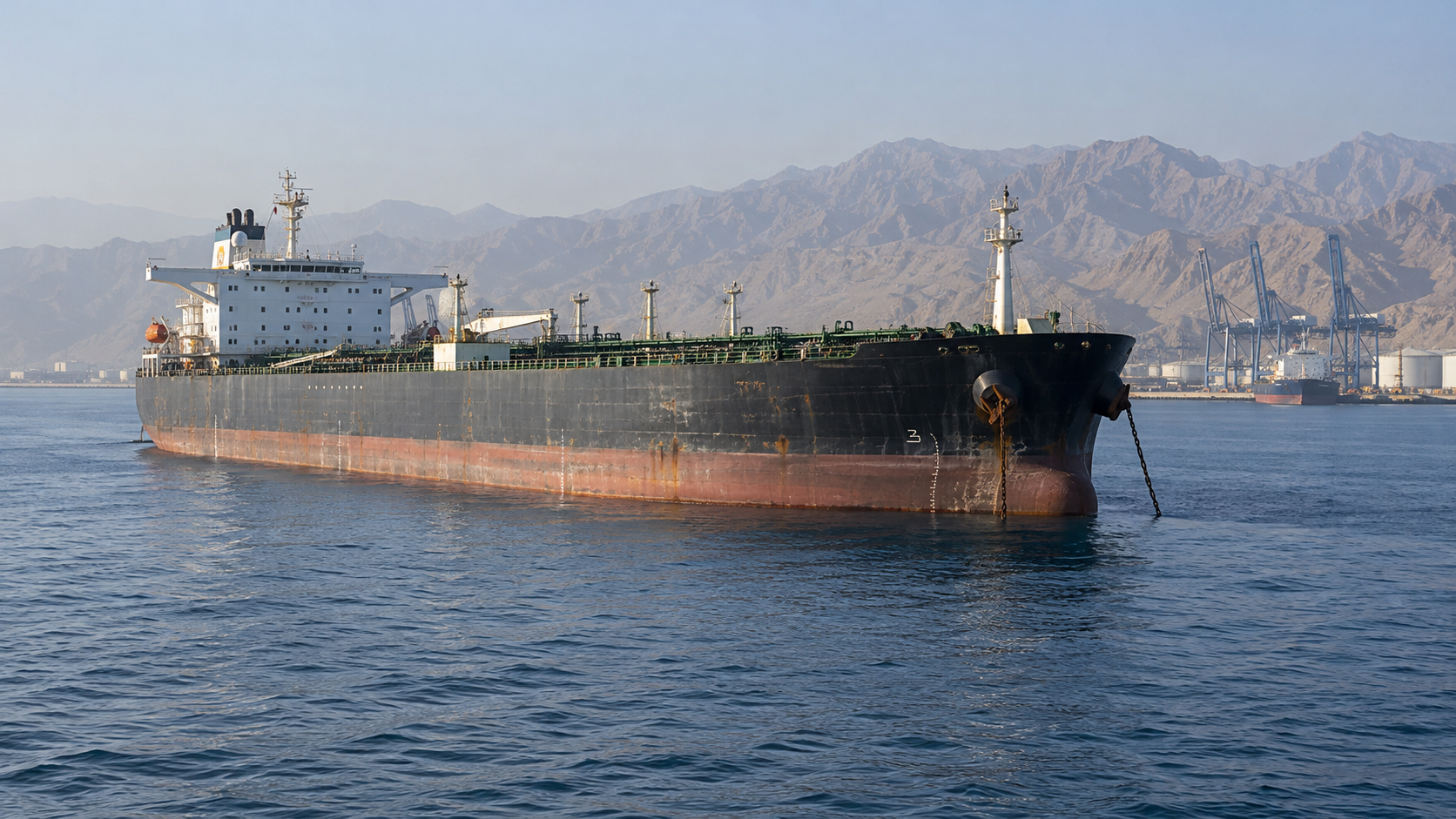
A drone struck a tanker off Oman's Sohar anchorage, outside the strait, and two of its Indian crew members are missing, while Tehran called the U.S. reply on reopening Hormuz "insufficient." Goldman Sachs now estimates the risk premium in Brent at just over $20 a barrel.
The risk premium in oil has spent months resting on one narrow stretch of water. Over the weekend it found new places to sit.
The U.K. Maritime Trade Operations center reclassified an incident at the Sohar anchorage on Oman's coast as an attack, after confirming that a tanker there had been struck by a drone on Sunday. India's shipping minister said nine of the 11 Indian seafarers aboard the vessel, the Nicaragua-flagged MT Petro Dolphin, had been rescued and two were missing. Sohar lies on the Gulf of Oman, outside the Strait of Hormuz. A separate tanker was struck by an unidentified projectile on Sunday while transiting the strait, causing a fire on board; its crew was reported safe.
Diplomacy stalls
The attacks coincided with a setback on the diplomatic track. Rezaee, secretary of Iran's Supreme National Security Council, said the U.S. response to Tehran's conditions for reopening the strait, passed through Qatari intermediaries, was "insufficient." Washington had "accepted some of our conditions, while others remain unclear," he said, and the strait would not reopen to the United States until they were met. Iran, he added, is "no longer in the process of responding."
Foreign Minister Abbas Araghchi had struck a harder note earlier this month, telling diplomats in Tehran on Oct. 4: "If they again move towards military solutions, we are more prepared than before." On Sunday he called his Saudi counterpart, Faisal bin Farhan, and said Tehran was ready to help facilitate dialogue between Saudi Arabia and Yemen.
A second front at Saudi airports
Saudi Arabia's main airport in Riyadh was hit for a second straight day on Sunday. A projectile struck a passenger terminal, killing one person and injuring 11, after a Saturday attack that Saudi authorities said killed 12. Yemen's Houthi movement claimed the attacks, and the Saudi-led coalition called Saturday's strike a war crime and promised a "decisive" response. The U.S. mission in Saudi Arabia urged "extreme caution" at all of the country's major airports and said the airport in Dammam was also targeted on Oct. 11. Asked whether the U.S. would join Saudi strikes, President Trump said: "We may. We're going to look at it." No decision has been announced.
How much is priced
In a note reported on Monday, Goldman Sachs lifted its December Brent forecast by $5, to $90 a barrel, and put the risk premium in today's price at a little over $20. It expects U.S. crude, which trades at an unusually wide discount to Brent because of high trans-Atlantic shipping costs, to average $81 in December and $73 in 2027.
Brent traded near $105 early Monday, still nearly 45% above its level before the war began. Goldman's December forecast sits about $15 below that, which implies the bank expects a good part of the premium to come out by year-end even after raising its number.
Gulf crude exports had returned to about prewar levels in September, according to ship-tracking data from Kpler. Attacks that reach anchorages off Oman and airports in Saudi Arabia's oil region test whether that recovery can continue.
Two readings
One reading is that the conflict is widening geographically while the diplomatic channel that supported September's export recovery has gone quiet. Attacks are no longer confined to the strait, Iran says it has stopped responding and the U.S. is weighing whether to enter the Saudi-Houthi fight.
The other is that the strait remains open in practice. Iran says the U.S. accepted part of its terms, Mr. Araghchi is talking to Riyadh, no Saudi energy facility has been confirmed hit, and a $20 premium already prices a great deal of risk.
What to watch
Any U.S. decision on Houthi targets, the coalition's promised response, transit counts through Hormuz and further warnings from maritime authorities will show which way the premium moves. Tanker owners and insurers will be the first to feel it.