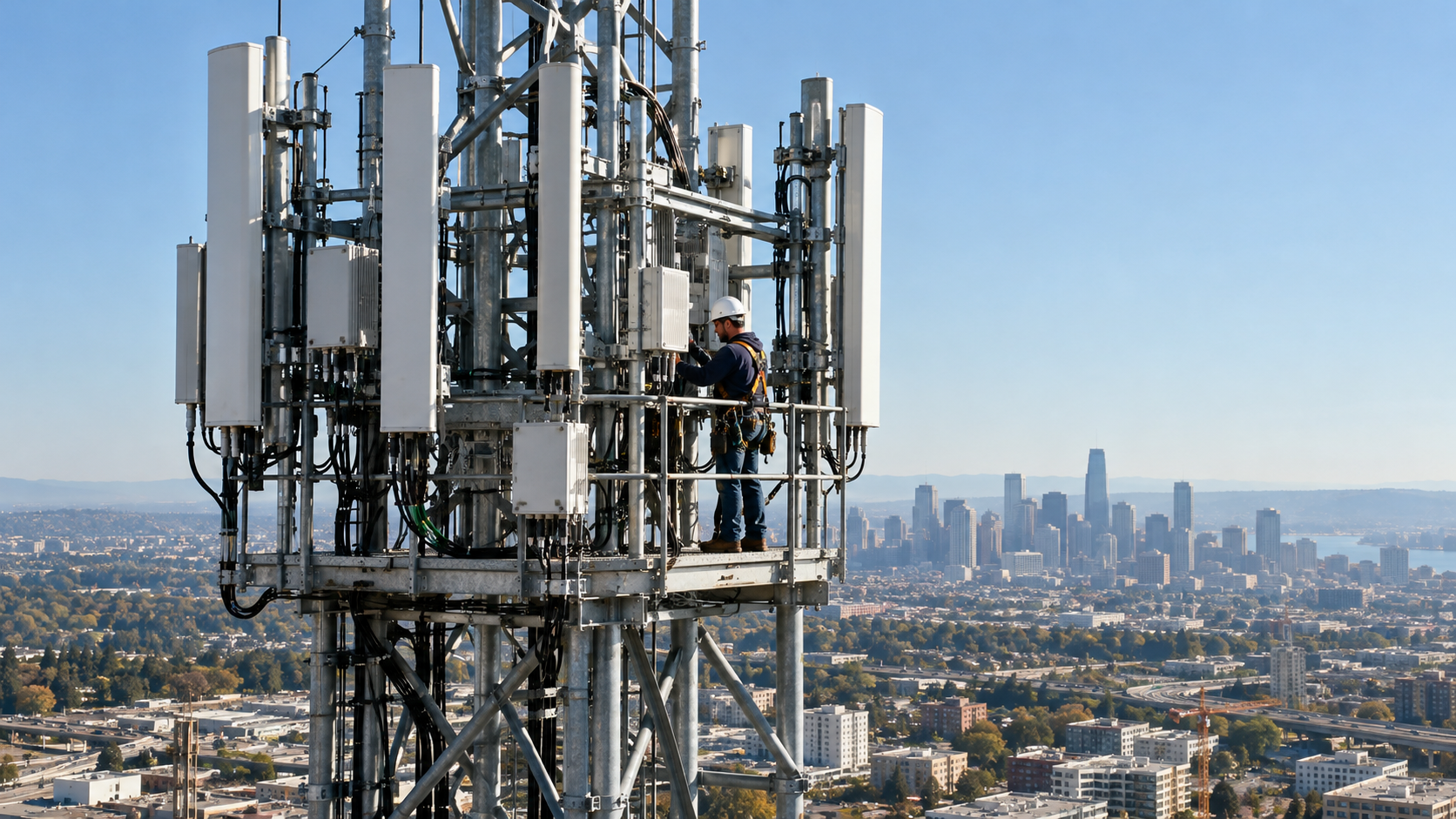
The deal with Grain Management is subject to FCC approval and no price was disclosed; people familiar with it put the cost near $8 billion in cash. AT&T, Verizon and T-Mobile traded about 7% lower early Friday while tower stocks rose.
The same block of airwaves has now changed hands twice in two months, and the second deal has done far more to the stock market than the first.
On Thursday after the close, Grain Management, a private investment firm, said it had reached a definitive agreement for SpaceX to acquire 100% of its nationwide 800 MHz spectrum portfolio. Grain bought that portfolio from T-Mobile in a deal that closed on Aug 11, 2026, paying $2.9 billion in cash plus all of its own 600 MHz licenses. The SpaceX transaction requires approval from the Federal Communications Commission and other customary closing conditions.
Neither company disclosed a price. People familiar with the deal have put it at about $8 billion in cash.
What SpaceX says it is getting
SpaceX described the portfolio as "up to 14 megahertz of paired spectrum in the 800 MHz band." Its existing 2 GHz spectrum, it said, "will provide high-bandwidth capacity in the United States, this new low-band spectrum will provide a coverage layer that ensures Starlink Mobile's signal penetrates through obstacles, such as walls." Most existing phones already support the band. The company called Starlink Mobile "the first network operator to deploy both satellite and terrestrial spectrum."
The announcement came a day after the FCC cleared SpaceX to deploy a 15,000-satellite constellation for Starlink Mobile and said it would vote on a proposal to auction 25 megahertz of spectrum for satellite-to-phone service.
The reaction
AT&T, Verizon and T-Mobile had all closed higher on Thursday, up 1.7%, 1.3% and 2.2%. They fell after hours as the deal was announced. At about 5:20 a.m. Eastern on Friday, AT&T traded at $23.04, down 7.4%, Verizon at $43.20, down 6.8%, and T-Mobile at $159.48, down 6.9%, in thin premarket trading. At those prices the three companies were worth about $38.5 billion less than at Thursday's close.
In Frankfurt, Deutsche Telekom, the parent of T-Mobile US, fell 7.3%.
SpaceX shares traded at $166.85, up about 3.9%, after falling 4.2% during Thursday's regular session before the announcement. Tower owners moved the other way from the carriers: American Tower traded about 5.9% higher and SBA Communications about 4.8% higher in early trades of a few hundred shares or fewer.
The arithmetic
If the reported $8 billion price is right, SpaceX is paying about 2.8 times the cash T-Mobile received two months ago. The true markup is smaller, because T-Mobile also got Grain's 600 MHz licenses, whose value was not disclosed. The carriers' combined loss of market value in early trading is close to five times the reported price.
What the carriers say
Verizon dismissed the threat. "This company can have tons of spectrum available, but if they do not have the network to use it, it doesn't matter. It's just empty airwaves," spokesman Rich Young said.
FCC Chairman Brendan Carr welcomed the deal. "We are going to see more investment, more opportunities for a range of providers," he said.
Analysts at William Blair said the incumbents "have been vocal in expressing skepticism that SpaceX's network will be able to match the quality of their networks," adding that they expect SpaceX "to offer a very compelling Starlink broadband and Starlink Mobile bundle."
The three carriers formally launched a joint venture for satellite-to-phone service on Oct 1, 2026, with Paul Roth as interim chief executive.
Opposing readings
One reading is that a credible fourth national competitor is taking shape. SpaceX now has satellite authority, capacity spectrum and nationwide low-band spectrum that most handsets support, the regulator is publicly supportive, and the market's verdict was uniform across all three carriers.
A second reading is that investors are pricing a network that does not exist. The license transfer is pending, SpaceX disclosed no rollout plan, partners or service pricing, up to 14 MHz is a modest block, and the company best placed to value it sold it in August. The rise in tower stocks points to the cost of building a ground network as much as to the threat of one.
What comes next
Friday's regular session will show whether the carriers' declines hold against the broader market. A disclosed price from SpaceX, the FCC filing for the license transfer and the vote on the satellite spectrum auction are the next formal steps. The carriers' third-quarter reports later this month will be the first chance for management teams to put numbers on the competitive question.