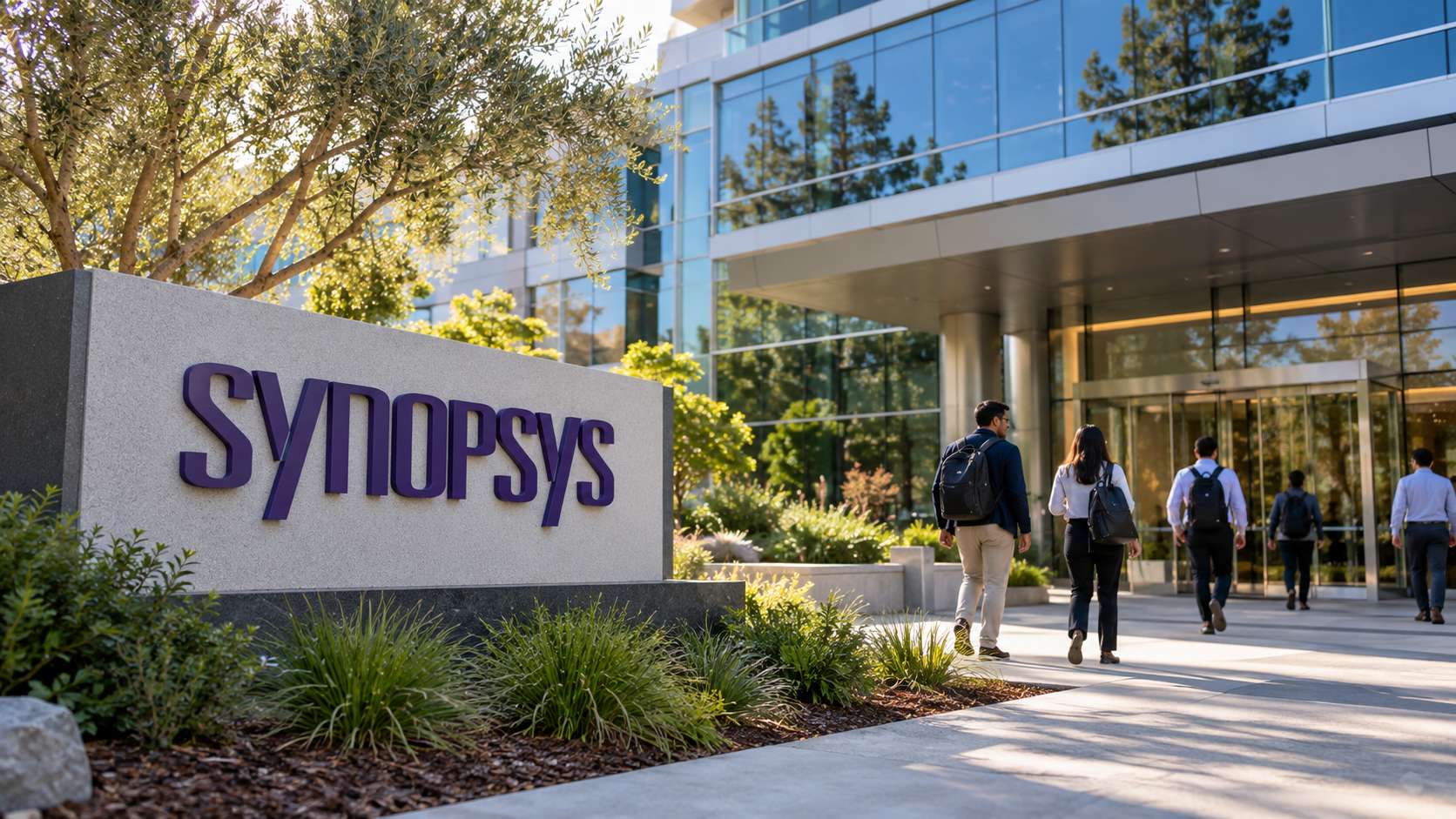
The chip-design software maker guided fiscal 2027 revenue to about $11.15 billion, set a 50% margin objective for 2030 and moved part of its IP business to royalties. On guided earnings, the stock trades at about 26 times adjusted profit and 59 times GAAP profit.
The announcement that changed Synopsys's business model went out at 9 a.m. on Wednesday. The stock did not react until the afternoon.
At that hour, Synopsys said it had signed a multiyear agreement with Amazon worth more than $1 billion, under which its silicon intellectual-property business would move toward "a license-plus-royalty business model," with Amazon as the lead customer. Shares traded between about $416 and $429 through the morning, close to Tuesday's $415.09 close.
The break came during the company's investor day presentations, which began at 1 p.m. in New York. The stock reached $445.40 in the 2 p.m. half-hour and closed at $434.94, up 4.8%. After the 4:05 p.m. release of the company's financial model, it opened Thursday at $467.85 and was trading near $491.55 by about 2 p.m., up 13%. Over two sessions the gain is about 18.4%, or roughly $14.6 billion of market value.
The numbers
For fiscal 2027, which ends in October 2027, Synopsys guided revenue of $11.10 billion to $11.20 billion, about 15% growth at the midpoint. Analysts had expected $10.81 billion on average. Adjusted earnings are guided at $19.04 to $19.12 a share, against expectations of $17.81, and GAAP earnings at $8.16 to $8.61. The company projects free cash flow of about $3.1 billion.
For fiscal 2026 through 2030, its objectives call for revenue growth of about 15% a year, with design automation at 13% or more, simulation and analysis at 10% or more and design IP at 17% or more. It targets an adjusted operating margin of about 50% by 2030, up from a prior goal in the mid-40s, and growth in the mid-20s percent for adjusted earnings per share and free cash flow.
Synopsys said it intends to repurchase about $1 billion of stock "over the coming months, subject to market conditions," and plans to return up to half of free cash flow through buybacks. "Our updated financial framework reflects confidence in both our growth trajectory and our ability to scale efficiently," said Chief Financial Officer Shelagh Glaser.
The same day, Synopsys and OpenAI announced GPT-Synopsys, a chip-design model OpenAI will build using licensed Synopsys tools. The agreement includes a revenue-sharing arrangement. The companies kept the financial terms private.
From seats to volumes
The Amazon contract is the structural change. Design software is sold largely as licenses to engineers. A royalty ties part of Synopsys's revenue to how many chips customers actually produce, which can extend the life of each design win while making revenue more sensitive to chip volumes.
The disclosed size is modest relative to the company. "More than $1 billion" spread over a multiyear term sits against guided annual revenue of about $11.15 billion.
Two kinds of earnings
The gap between adjusted and GAAP figures is wide. Guided GAAP operating margin for fiscal 2027 is about 20.7%, against about 44.0% adjusted. The difference is mostly $1.54 billion to $1.55 billion of amortization of acquired intangible assets and $0.96 billion to $0.98 billion of stock-based compensation. At $491.55, the stock trades at about 25.8 times the midpoint of adjusted earnings guidance and about 58.6 times the GAAP midpoint. The planned buyback equals about 1.1% of the company's market value.
Peers and the tape
Cadence Design Systems, the other major listed design-software vendor, rose 5.5% to about $348. The S&P 500 software index gained 0.8% to its highest since November, helped by Accenture's results. Synopsys's move is about 7.5 points larger than Cadence's by simple subtraction.
Analysts at Berenberg said the event "provided significantly more than the market expected." Rosenblatt raised its target to $620 from $575, and KeyBanc to $605 from $600. A week before the event, BNP Paribas upgraded the stock only to Neutral, with a $420 target, and questioned whether Ansys's low double-digit growth could last. Even after the rally, the stock is below its 52-week high of $539.48.
Two readings
One reading is that Synopsys is moving from selling tools toward sharing in its customers' production, through royalties and revenue sharing, which would lengthen and improve the quality of its growth beyond what the 2027 guide shows.
A second reading is that an 18% two-day gain is paying for a guide built mostly on the existing business, plus headline deals whose economics the companies have kept private.
The next disclosure
The fourth-quarter report, expected in early December, will be the first measured against the new framework. Any disclosure of the Amazon contract's term or royalty rate, the first repurchases under the $1 billion plan, and additional royalty customers would each give investors a way to price the new model.