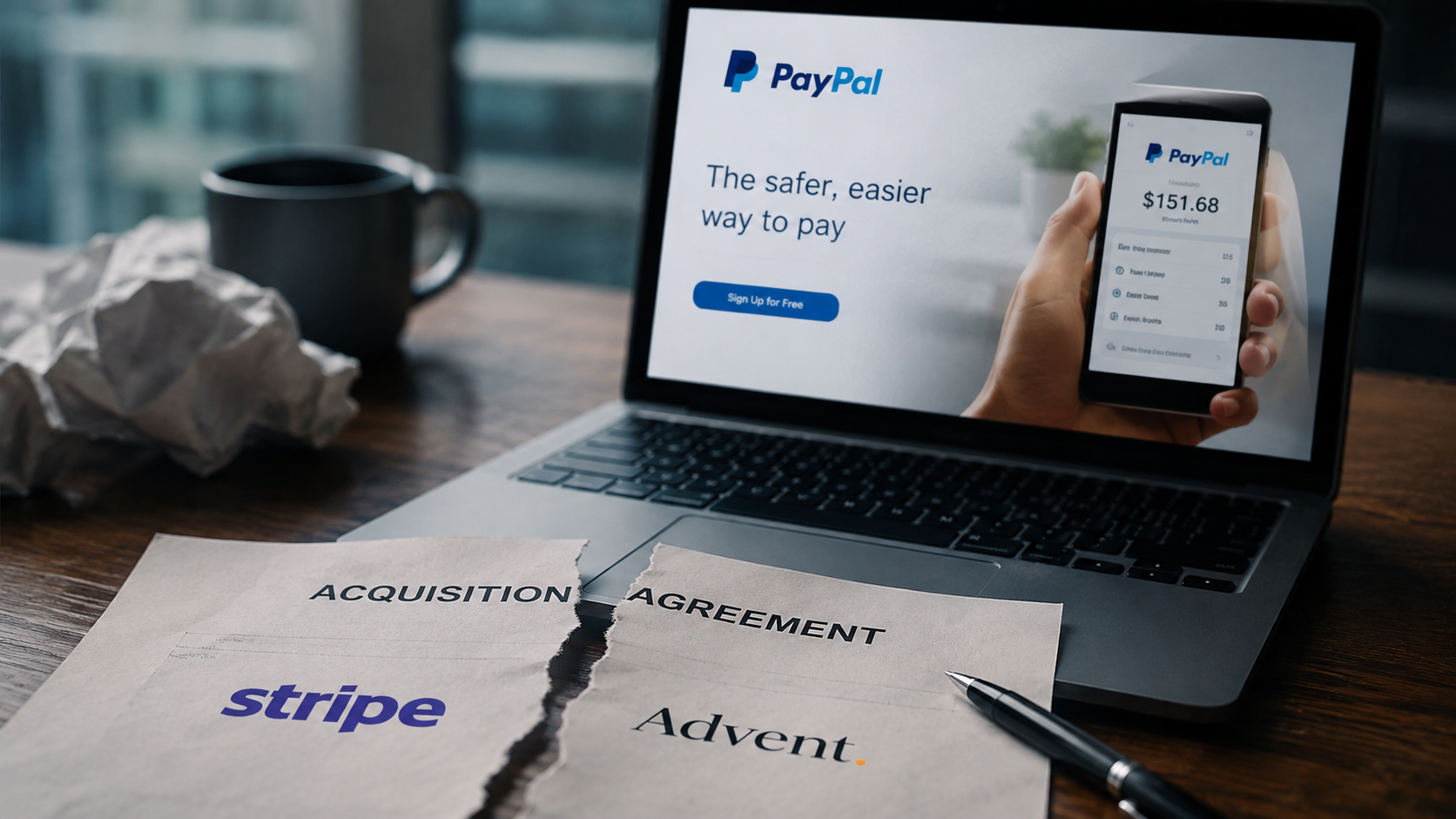
PayPal shares fell about 12 percent after a reported buyout pursuit collapsed, and the reporting on what killed the deal is split between a price dispute and a price dispute compounded by regulatory friction.
A consortium including Stripe and the private equity firm Advent International has abandoned its pursuit of PayPal Holdings (PYPL), according to people familiar with the matter. The group had offered $60.50 a share, valuing the company near $53 billion, an approach first reported in mid-July. Neither PayPal, Stripe nor Advent has issued an on-the-record statement confirming the collapse or explaining it, and the reporting traces to a single account relayed across many outlets rather than multiple independently sourced ones.
PayPal shares fell about 12 percent the day the abandonment became public, trading down to the mid-$50s from a prior close near $61.50, one of the stock's sharper single-day declines this year on a tape that was otherwise little changed.
The reason for the collapse is where the available reporting splits. One account describes a straightforward valuation dispute: PayPal's board wanted a higher price than the consortium was willing to pay, and the bidders retracted rather than raise their offer. A separate account describes the same valuation gap alongside a second, independent obstacle, regulatory friction that the two sides also could not resolve. Those are not the same claim. A deal that died on price alone could in principle be revived later at a higher number. A deal that also ran into regulatory friction would carry an obstacle that a higher price would not necessarily remove.
Neither account has been confirmed by any of the parties involved, and this article does not adopt either one as the settled explanation. What is better corroborated is the reaction elsewhere in the payments sector: shares of buy-now-pay-later companies including Affirm (AFRM), Klarna and Sezzle all rose the same day, a move consistent with relief that a large, PayPal-scale consolidator was not about to enter their market through this specific transaction. Affirm's own results were reported the same week, which complicates using its share-price move as a clean read on the PayPal news alone, but the broader group's reaction points in a single, more legible direction than the still-disputed cause of the deal's collapse.
What would resolve the open question is something neither side has yet provided: an on-the-record statement from any of the three companies, or a second, independently sourced account of the actual reason the deal fell apart. Until one arrives, the market's roughly 12 percent reaction in PayPal shares is pricing out a near-term revival of the deal without investors actually knowing which of the two competing explanations, or some combination of both, is the real one.