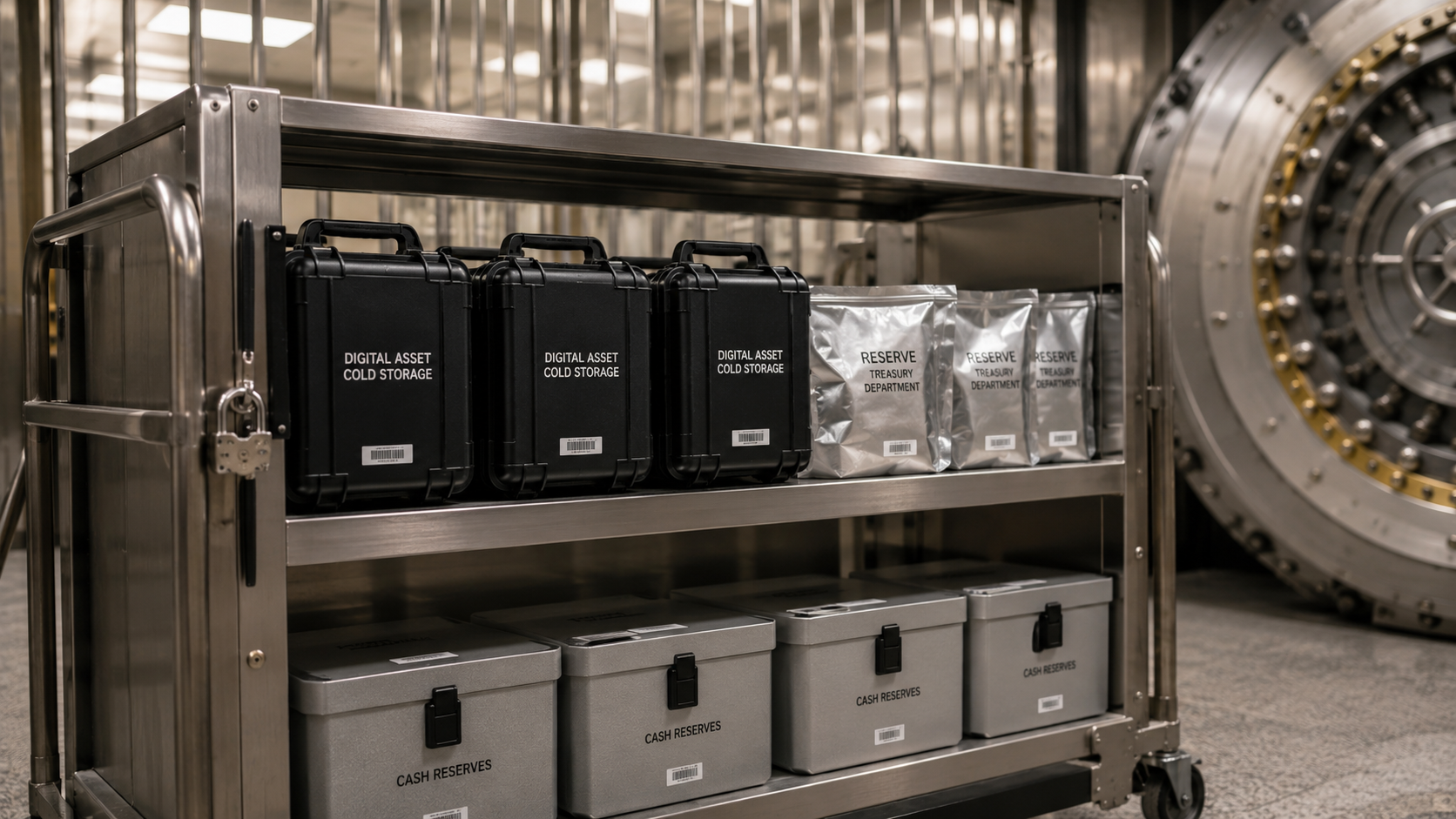
Strategy told the market something unusual in an 8-K filed Monday: during the week Bitcoin ran from the high-$60,000s to nearly $80,000, the largest corporate holder of the asset didn't buy a single coin. It didn't sell any either. Between August 17 and August 23, the company (MSTR) sold 18.26 million of its own shares for roughly $2 billion, and put none of it into Bitcoin.
Strategy has spent years positioning itself as a near-continuous buyer of Bitcoin, adding through rallies and drawdowns alike. This was one of Bitcoin's strongest stretches in months. The company sat it out entirely while diluting shareholders to raise cash.
Where the $2 billion actually went
The filing breaks the proceeds into three pieces, and none of them is a Bitcoin purchase. Strategy used $136.4 million to repurchase its STRC preferred stock. It added $300 million to its existing USD reserve, which now stands at $5.1 billion. The remaining $1.59 billion, by far the largest share, went into a newly created pool the filing calls "USD Cash," earmarked for "future deployment for general Bitcoin Treasury Company purposes." That language is deliberately open-ended: it could fund Bitcoin purchases later, or it could cover preferred dividends, debt service, or further securities repurchases. The company did not specify.
Strategy's holdings sit unchanged at 840,447 BTC, about 4% of all bitcoin that will ever exist and worth roughly $65.8 billion at current prices. The stockpile didn't shrink. It also didn't grow during the exact week it had the most opportunity, and the most market attention, to grow it.
This is a pause in new purchases, not a sale of Bitcoin and not an exit from the treasury strategy. The filing supports only the first of those three.
The rally that made the timing conspicuous
MSTR shares closed Friday, August 21, at $119.25, up 6.1% on the day. That move traces mechanically to Bitcoin's own rally, since Strategy's stock reprices with the mark-to-market value of its treasury holdings, not to anything in this filing, which stayed private until Monday's premarket release. The market has not yet had a chance to react to the disclosure itself.
The same Friday session, Coinbase (COIN) rose 8.2% and Robinhood (HOOD) gained 13.7%, part of a broader lift across crypto-linked equities. This was not a week when Bitcoin needed rescuing or a treasury company might plausibly conserve cash out of price caution. It was a week the asset went up hard, and the buyer that built its narrative around buying strength did not participate.
Why this reads as balance-sheet management, not lost conviction
Bernstein's research, relayed through The Block, frames the cash build in terms of coverage rather than sentiment: the $5.1 billion USD reserve and the new cash pool give Strategy roughly 2.8 years of coverage for its STRC preferred dividend obligations. Bernstein's interpretation is that Strategy resumes buying once STRC approaches par value of $100. That is one firm's read, not a company disclosure, but it points to a company servicing its own capital structure rather than a bearish view on Bitcoin.
Nothing in the filing suggests Strategy is preparing to sell Bitcoin, and nothing here supports a broader story about corporate treasuries losing their appetite. Strive, a competing Bitcoin-treasury vehicle, bought an additional 1,110 BTC in the same window, lifting its total to 21,356 BTC. One major buyer paused. Another kept buying, which undercuts any claim that this is a sector-wide retreat from the corporate-treasury bid.
What changes for the treasury-demand thesis
The bull case for Bitcoin has leaned partly on companies like Strategy acting as a structural, non-discretionary source of demand: buyers who don't stop when prices move against the near-term trade. This week complicates that framing without breaking it. Strategy didn't sell Bitcoin. It didn't abandon the model. It also didn't buy into the best rally in months, routing $2 billion instead toward preferred-stock coverage and an unallocated cash pool.
STRC already trades below its $100 par value, and Bernstein's own framework ties Strategy's return to buying to that preferred stock closing the gap toward par. STRC's price against that $100 line is the threshold that determines whether the $1.59 billion cash pool becomes Bitcoin purchases or stays parked in preferred-stock coverage.