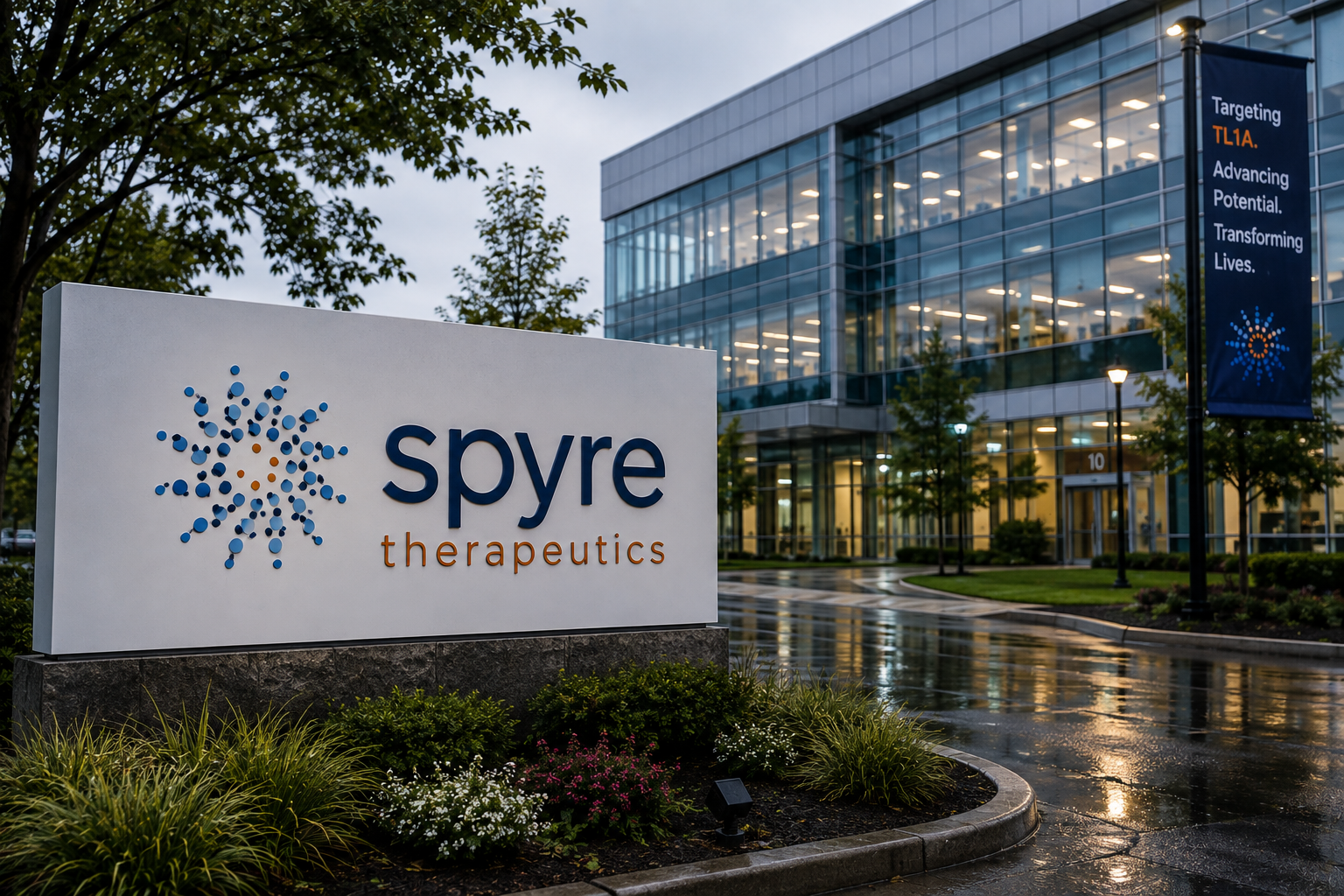
SPY072 hit statistical significance against placebo on its primary endpoint in a rheumatoid arthritis sub-study. Spyre says the result still fell short of its own bar for advancing the drug alone. Shares fell nearly 14%.
Spyre Therapeutics disclosed topline Week-12 results Monday from the rheumatoid arthritis sub-study of its Phase 2 SKYWAY trial testing SPY072, an anti-TL1A monoclonal antibody, at two doses against placebo. The low dose reached statistical significance on the primary endpoint, a DAS28-CRP score improvement of negative 1.9 versus negative 1.3 for placebo, and nominal significance on the exploratory ACR50 measure. The high dose reached nominal significance on the secondary ACR20 measure. Both doses separated numerically from placebo on every endpoint disclosed.
Spyre said the data "did not meet the Company's internal bar to prioritize advancement of SPY072 as a monotherapy" in rheumatoid arthritis, and is instead repositioning the results as proof-of-mechanism evidence supporting other autoimmune indications and combination-therapy approaches.
Shares fell from $107.36 to an intraday low of $90.60, last trading near $92.39, down roughly 14%, on volume well above typical levels. The stock had rallied approximately 45% over the trailing three months into a 52-week high set just days before this readout.
The placebo-adjusted numbers tell a more specific story than "miss." The low dose beat placebo by 0.6 points on the primary DAS28-CRP endpoint, by 15 points on ACR20, and by 19 points on ACR50. The high dose beat placebo by just 0.2 points on the primary endpoint, a materially smaller margin, and the fact that the lower dose drove the stronger result is an atypical pattern worth flagging.
Spyre has three more binary readouts ahead on the same TL1A platform: ulcerative colitis data expected in September 2026, psoriatic arthritis and axial spondyloarthritis data expected in the fourth quarter, and a hidradenitis suppurativa combination study due in late 2027 or early 2028. The company's cash position, sufficient by its own account into the second half of 2029, removes near-term financing pressure regardless of how this readout is read.
Whether Wednesday's roughly $1.3 billion market-value decline is proportionate to a result confined to one dose arm within one indication, inside a four-catalyst platform, is the question September's ulcerative colitis readout will help answer.