
The firm leading it also helps Nvidia finance its buyers. The buyer is losing money.
$40 billion
What SpaceX is in talks to borrow for Nvidia chips. It would be among the biggest debt deals yet for the AI build.
The S&P 500 closed at a record, its first since Aug. 13, as the 10-year yield eased to about 5.27%.
Kalshi's October rate-hike contract slipped to about 17 cents. Late Tuesday, oil rose almost 1% after settling about flat, and bitcoin slipped below $85,000. Constellation Brands beat forecasts, cut its margin outlook and fell about 4.5% after hours. Asian stocks fell early Wednesday.
PMD LENS
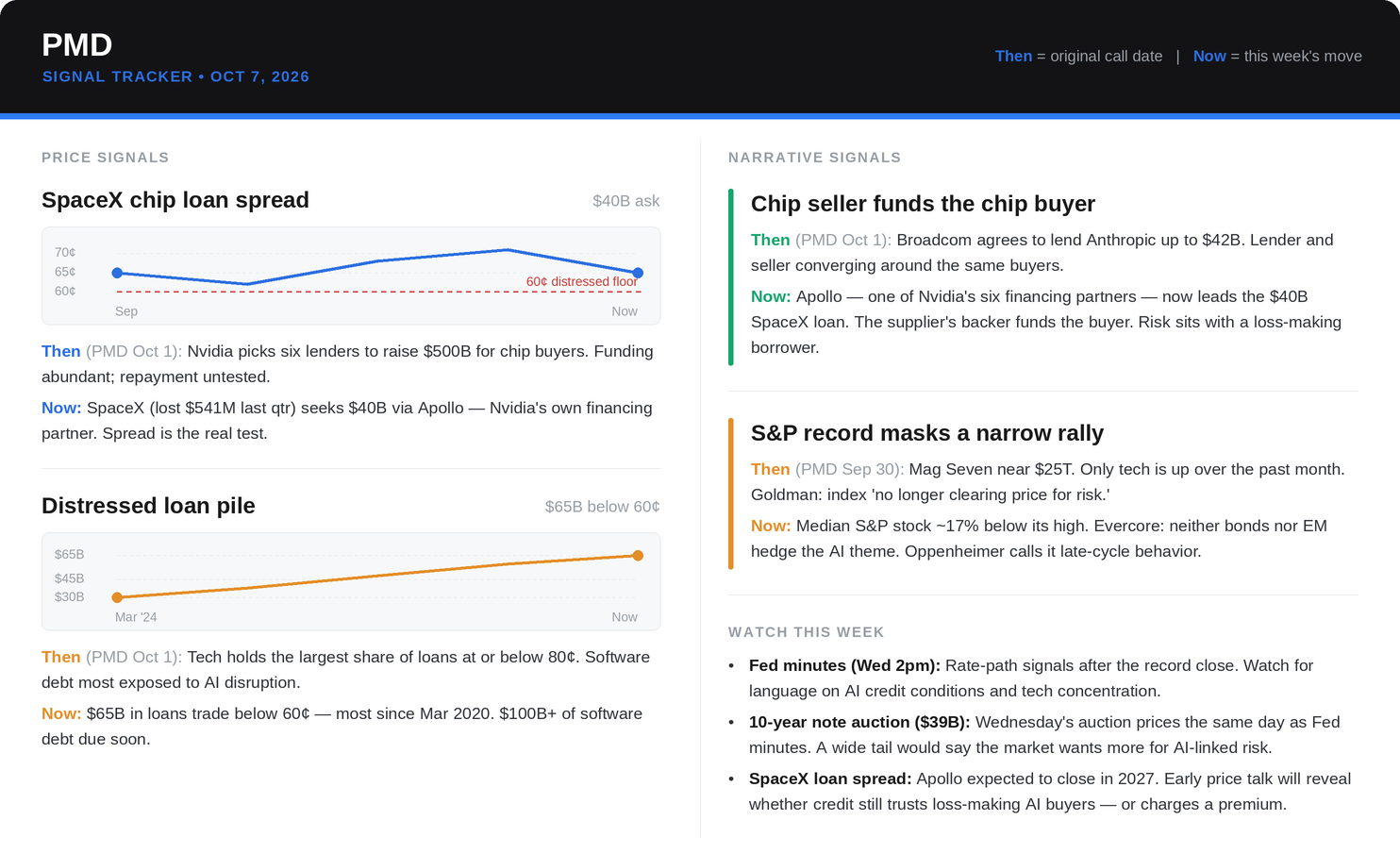
Last week PMD found Nvidia could back up to $500 billion of its buyers' loans. Then Broadcom agreed to lend Anthropic up to $42 billion. Today a chip buyer asks for $40 billion, and the question shifts from who lends to who repays.

The $16 Trillion Rare Earth Discovery
The Guardian calls it "the beginning of the biggest gold rush in history"... and one stock under $5 owns exclusive rights to harvest these rare earths.
Elon Musk and his companies need these minerals before a January 1 Pentagon deadline.
SpaceX Is in Talks to Borrow $40 Billion for Nvidia Chips. The Firm Leading It Also Helps Nvidia Finance Its Buyers.
SpaceX (SPCX)is seeking $40 billion of debt to buy Nvidia chips, people familiar said. Most would be investment grade. Apollo (APO) is leading, with a close expected in 2027, a report said. Talks are early and could end without a deal.
If it closes, Nvidia's own financing partner would fund a big Nvidia order. Apollo is one of six firms Nvidia picked in August to raise more than $500 billion for its buyers. That is the plan PMD covered last week. Whether this loan counts toward it was not reported.
That leaves repayment on the buyer. SpaceX lost $541 million in the quarter through June. Investor Arthur Hayes says SpaceX, OpenAI and Anthropic don't make money. He sees the test coming in late 2027 or 2028. That is when new data centers arrive and the bills come due.
The pattern reaches past one deal. Separately, Broadcom's banks began raising $60 billion of chip loans, people familiar said. Anthropic is among those it would help. Blackstone, another of Nvidia's six, is co-leading a pre-IPO raise of up to $4 billion for Lambda. Lambda rents out Nvidia chips. Its backlog more than tripled in three months, to $50 billion. One Anthropic deal drove most of it, a letter to investors said. That ties much of Lambda's value to one buyer's ability to pay.
Credit is already sorting borrowers. Loans trading below 60 cents on the dollar total $65 billion, JPMorgan strategists say. That is the most since March 2020. Tech holds the largest share of loans at or below 80 cents. Software, which investors fear AI will disrupt, has more than $100 billion of debt coming due.
The Chip Seller's Partner Would Fund the Chip Buyer
The risk would sit with a buyer still losing money, while lenders already punish the firms AI threatens. SpaceX's mostly investment-grade debt sits far above that distressed tail, so the deal may clear. Its price is the real test. A tight spread would say credit still trusts AI's buyers. A wide one would say the money is there, but dearer.
Landmark Executive Order 14241 Unleashes
TRUMP’S NEW DOLLAR
Republican or Democrat – whether you support or oppose Trump’s New Dollar – every American could soon be forced to use it

Discover three critical moves to help you prepare, before it’s too late
SIGNAL 1: The S&P 500 Closed at a Record. Its Median Stock Was Recently About 17% Below Its High.
The record leaned on the Magnificent Seven, now worth nearly $25 trillion. The median S&P stock was recently about 17% below its high, one research firm found. Over the past month, only tech is up.
It is "no longer behaving like the clearing price for risk," a Goldman Sachs strategist wrote. Evercore ISI says neither bonds nor emerging-market stocks now hedge the AI theme. Its answer is stocks that move against the index, now a record count. An Oppenheimer technician calls the split "late-cycle behavior," but says "the right things are working."
The Record Is Seven Stocks Wearing a Trench Coat
An S&P fund is now largely a bet on AI, the same build the In Focus shows borrowing heavily. If that money gets dearer, the index has less support than its record suggests. Balance has to come from outside the benchmark.
SIGNAL 2: Chinese Makers of Fentanyl Ingredients Now Sell Bootleg Peptides to Americans.
At least 50 firms that sold fentanyl ingredients now sell peptides, analytics firm TRM Labs says. Two makers indicted in the U.S. in 2023 now advertise weight-loss drugs. One offers semaglutide, the drug in Ozempic. The other offers an Eli Lilly drug not yet approved. Crypto purchases of gray-market peptides now top $10 million a month, up from $200,000, Chainalysis says.
For drugmakers, that is a rival selling far cheaper with no approval. Lilly's next weight-loss drug is offered in bootleg form before regulators have ruled on it. For buyers, quality rests on the seller's word.
The Fentanyl Suppliers Found a New Product: Bootleg GLP-1s
Police pressure on fentanyl ingredients pushed some makers into peptides, Chainalysis says. Enforcement moved the trade rather than ended it. As long as approved drugs cost far more, the bootleg trade likely keeps its buyers.
SIGNAL 4: Websites Are Shutting Out AI Agents. Amazon Blocked Meta's Muse.
Amazon has blocked Meta's Muse agent from its store. Users report blocks at Yelp, eBay, Zillow and airlines. Even partner Walmart's human check trips the agent, by accident, Walmart says.
So an agent is only as useful as the sites that let it in, and some want payment. Yelp admits agents only if they license its data. Cloudflare, which guards many sites, runs a market where AI bots pay for data. Meta, Walmart and others are drafting an agent-shopping standard.
The Agents Can Plan. Many Can't Check Out.
The agents credited with AMD's record need sites to let them buy. That hands the biggest sites, and the firms that guard them, the power to set terms. If access comes with fees or slow deals, agent use, and the chip demand tied to it, could grow more slowly.
AI CEO Issues Code Red: Prepare for Meltdown
The CEO of this AI company (click here to get the name, 100% free) just issued a CODE RED in an internal memo…
Warning his employees that they’re dealing with a critical situation.
Another company executive even implied they might need a government bailout.
And now Jim Rickards is predicting this company is about to go bust, in a full-blown AI meltdown that could be 10 times bigger than Lehman Brothers.
- Wednesday: $39 billion of 10-year notes. Fed minutes at 2 p.m.
- Thursday: $22 billion of 30-year bonds.
- Oct. 14: September consumer prices.
Ask who carries the risk in an AI loan. If the lender also funds the seller's buyers, price the debt on the borrower's cash, not the supplier's backing.
The chip sellers stepped in as lenders and backers. Now an Nvidia financing partner leads talks on a $40 billion chip loan to a loss-making buyer. Funding is still there. What it costs is the question.
3 Market Signals Most Investors Aren't Watching
The headline is usually the last place the story shows up.
By the time everyone is talking about a stock… the signals underneath it may have been changing for weeks.
• Institutional money moves.
• Options activity changes.
• Management confidence shifts.
• Fundamentals improve, or quietly begin telling a different story.
That’s exactly what our analysts found in three stocks where the evidence stopped agreeing with itself.
And in all three cases, the story is still developing.