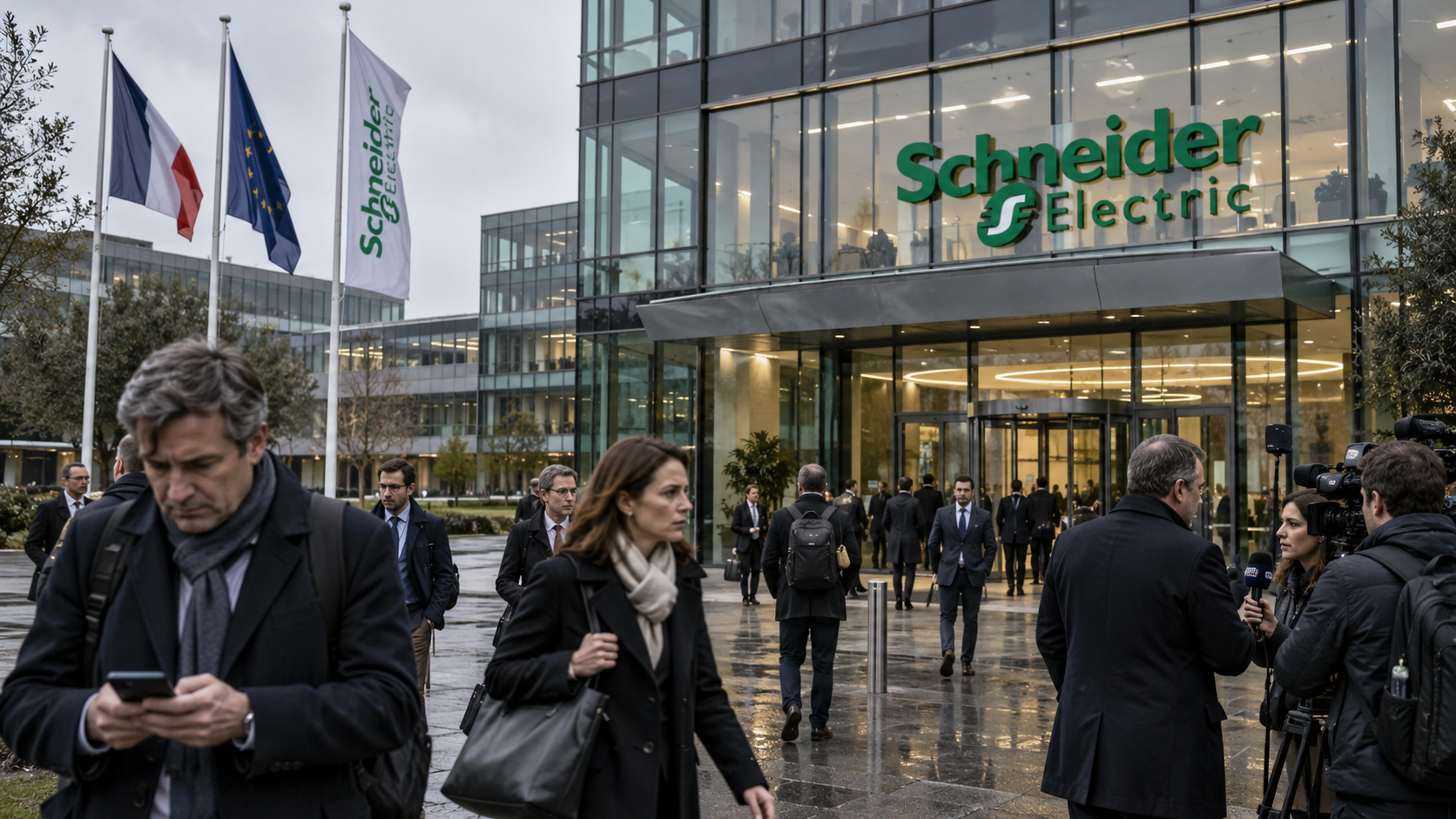
The French group will raise up to €6 billion of new equity, borrow up to €17 billion and suspend repurchases in 2027 and 2028. Investors wiped roughly €15 billion off its market value before lunch in Paris.
Schneider Electric's purchase of PTC is a software deal on the target's side of the table. On the buyer's side, it is a capital allocation reset, and Schneider shareholders priced it as one.
The shares fell 8.98% to €275.80 by late morning in Paris on Monday, from Friday's close of €303.00, after opening at €280.00. The CAC 40 was down 0.94% at the same point, so Schneider underperformed its home index by about 8 percentage points. Applying the decline to the company's market value implies a loss of roughly €15.3 billion in a single morning, of the same order as the €20.1 billion Schneider has agreed to pay for PTC's equity.
How the bill gets paid
The cash consideration of about €22 billion is covered by a bridge loan that Morgan Stanley and Société Générale have fully committed. Schneider plans to refinance it with about €5 billion to €6 billion of new shares, sold through an accelerated bookbuild under authority already granted at its annual meeting, and about €16 billion to €17 billion of new debt.
The equity component equals roughly 3% to 4% of Schneider's market value at Monday's price, a modest dilution on paper that will depend on where the bookbuild prices. The debt component is the larger commitment and arrives as European credit markets absorb heavy sovereign supply.
Shareholder returns take the other hit. Schneider still intends to complete €600 million of buybacks in 2026 and to finish its €2.5 billion to €3.5 billion program by the end of 2030. In between, repurchases pause entirely in 2027 and 2028, and the remaining program is compressed into the final two years.
What the earnings math promises
Schneider says the deal will be accretive by a low single-digit percentage to adjusted earnings per share, before purchase price accounting, in the first full year after closing, rising to mid to high single digits once synergies are fully realized. Return on capital employed is expected to exceed the cost of capital by the fifth year after closing, including full run-rate synergies.
The synergy targets are €250 million of annual cost savings by year three and about €800 million of revenue synergies. Schneider values the deal at 21 times PTC's estimated 2027 adjusted EBITA, falling to 13 times including full run-rate synergies.
Those two multiples allow a check on the ambition. An enterprise value of €21.1 billion at 21 times implies about €1.0 billion of 2027 adjusted EBITA. At 13 times, the same enterprise value implies about €1.6 billion. The synergy package, in other words, is expected to add roughly €0.6 billion a year of operating profit, about 60% on top of PTC's standalone base. Cost savings account for €250 million of that; the rest has to come from selling more software through Schneider's industrial channels.
Chief Executive Olivier Blum framed the combination in strategic terms. "Together, we are creating the industry's most complete Software & AI powerhouse," he said.
An earlier look at the quarter
Schneider has also moved its third-quarter revenue release forward to Oct. 16, giving investors an early read on the base business before the bookbuild and the debt issuance proceed.
What to watch: The pricing of the accelerated bookbuild relative to Monday's €275.80, the size and coupon of the new bonds, and the Oct. 16 revenue release. A bookbuild priced at a deep discount would extend the sell-off; a tight one would suggest the market has already absorbed most of the dilution.