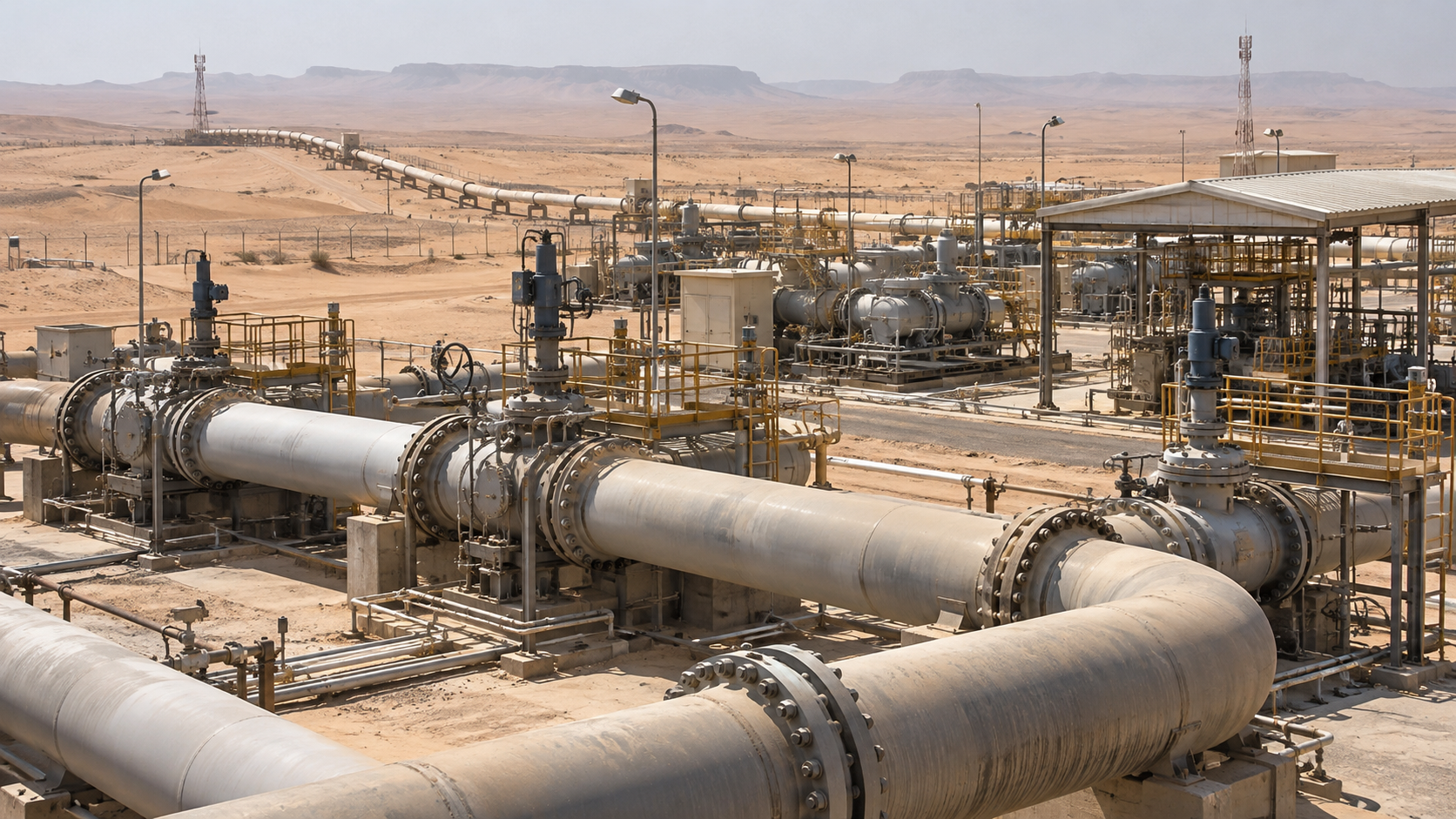
The East-West line to the Red Sea was moving about 5.8 million barrels a day as of Oct. 6, against about 17.1 million that crossed the strait daily before the war. Only about 4.5 million of that is available for export, and Brent climbed to a two-week high on Monday.
Saudi Arabia's answer to the disruption of the Gulf's main shipping lane is a pipeline across the desert. On the latest figures, it can do between a quarter and a third of the job.
Energy Minister Prince Abdulaziz bin Salman said on Oct. 6 that the East-West pipeline, which runs from the kingdom's eastern oil fields to export terminals on the Red Sea, was moving about 5.8 million barrels a day. Part of that supplies refineries on the Red Sea coast, and industry sources put the volume available for export at about 4.5 million barrels a day.
Against the prewar strait
Before the war, about 17.1 million barrels a day passed through the Strait of Hormuz, by the count of the tanker tracker Kpler, which excludes Iranian cargoes. The pipeline's total flow equals roughly 34% of that prewar traffic. The exportable portion equals about 26%.
The pipeline also carries only Saudi oil, while the strait served every Gulf producer. Counted in full, the line leaves about 11.3 million barrels a day of prewar strait traffic without a substitute through Saudi territory. On the export figure, the gap is about 12.6 million.
Crude's path on Monday
Brent began the week by falling. It dropped to $102.39 a barrel in early Asian trading after President Trump announced an "energy ceasefire" between Russia and Ukraine, a move Moscow did not confirm. Stephen Innes of SPI Asset Management said at that stage that "the market is no longer paying full geopolitical premium on every headline."
By about 1:45 p.m. Eastern, Brent was near $106.80, up about 2% from Friday's $104.72 close and close to a session high of $107.23, its highest level in two weeks. U.S. crude traded near $93.80. Heating oil, the U.S. diesel benchmark, was little changed near $4.73 a gallon.
Riyadh
Saudi Arabia's aviation authority says strikes on the kingdom's airports from Oct. 6 to Oct. 11 killed 20 people and injured 356. Iran-backed Houthi forces in Yemen have claimed them. The deadliest, on Riyadh's main airport on Saturday, killed 13 people. The toll rose from an initial 12 when an Indian national injured in the attack died. A strike on Sunday killed one and injured 11.
"The word 'fear' in the Saudi dictionary does not exist," Prince Abdulaziz told an energy conference in the capital. Mr. Trump said Saturday the U.S. "may" join Saudi retaliation against the Houthis.
Energy shares
By early afternoon the Energy Select Sector SPDR Fund had touched an intraday record and was up about 1.4%. Exxon Mobil rose about 1.8% and Chevron about 1.6%. Frontline, which owns crude tankers, gained nearly 5%.
Market implications
One reading is that the physical shortfall is large enough to keep Brent above $100 regardless of diplomatic headlines. The bypass replaces at most a third of prewar strait flow, about a quarter on the export figure, and attacks on Saudi infrastructure are continuing.
A second reading is that the market is trading headlines more than barrels. Brent fell on a ceasefire announcement Moscow did not confirm, then recovered after a weekend of airport strikes and doubts over the energy truce, with no confirmed damage to oil facilities.
What to watch
Any increase in East-West pipeline volumes, updated tanker counts through Hormuz and a U.S. decision on joining Saudi strikes will show which reading holds. The International Energy Agency's governing board meets Thursday.