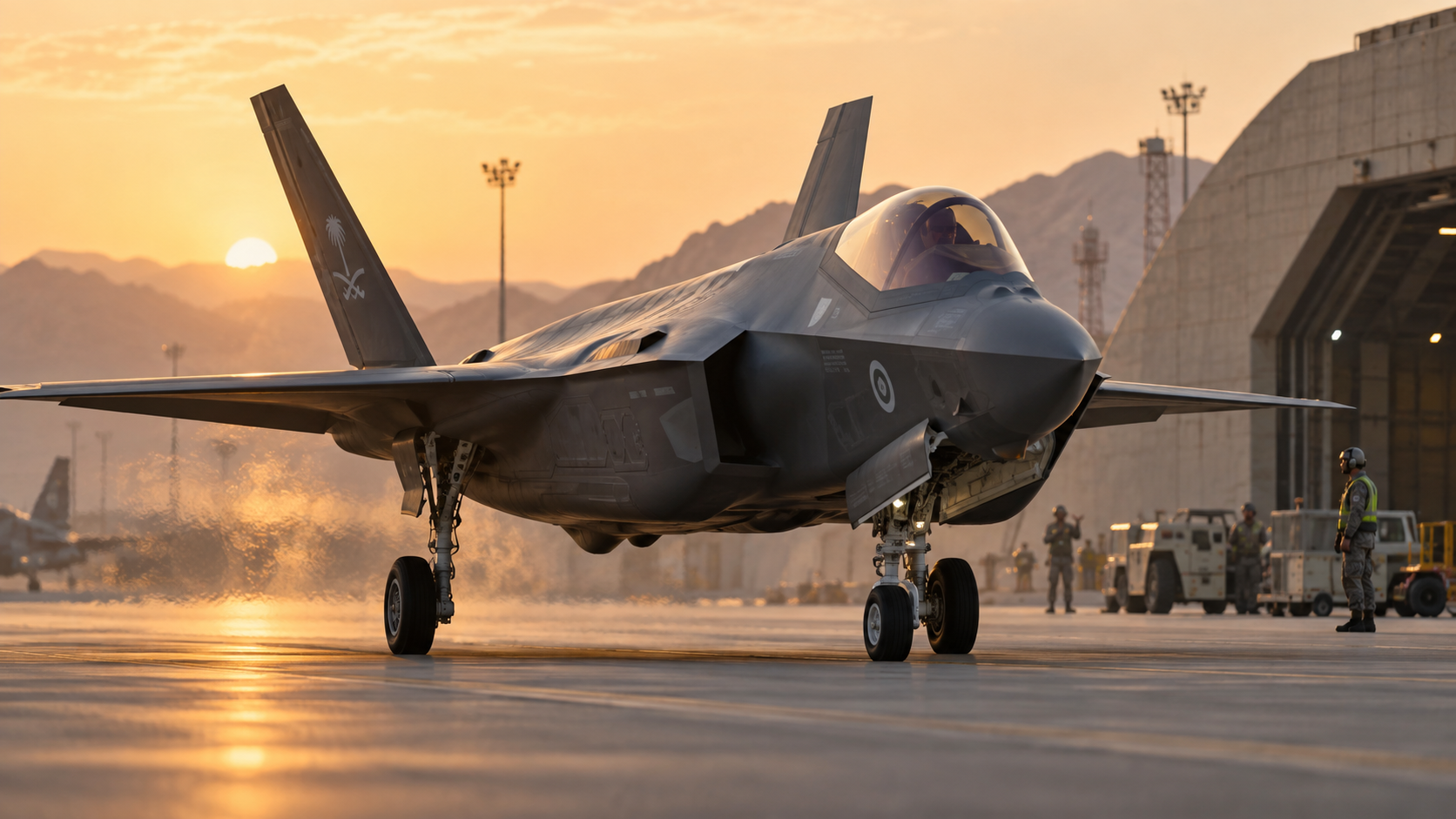
The State Department's approval of a proposed 48-jet sale to Riyadh arrives as Houthi forces escalate pressure on a critical oil chokepoint, raising the stakes for Lockheed Martin and the broader defense sector.
The U.S. State Department has approved a proposed $24.3 billion sale of 48 F-35 fighter jets to Saudi Arabia, along with 49 Pratt & Whitney engines and additional parts, naming Lockheed Martin as prime contractor. The timing is not incidental. Iran-backed Houthi forces in Yemen have escalated attacks on Saudi Arabia in recent months and have sought to assert control over the Bab el-Mandeb Strait, one of the world's most strategically important oil shipping corridors. For Riyadh, the jets represent a direct response to a security environment that has deteriorated in its immediate neighborhood.
For Lockheed Martin, the proposed sale is a potential addition to an already substantial order backlog for the F-35 program, the company's flagship fighter jet and one of the largest defense programs in the world. A deal of this size, spanning both airframes and the engines that power them, would extend the F-35's international footprint at a moment when demand for advanced fighter aircraft among U.S. allies remains elevated. The broader defense sector stands to benefit as well, since a sale of this scale typically draws in a wide supply chain of subcontractors beyond the prime contractor itself.
The State Department framed the sale as consistent with longstanding U.S. policy, saying it would support American security objectives by strengthening a "major non-NATO ally" and stating explicitly that the sale would not alter the region's overall military balance. That language is a direct reference to Washington's decades-old commitment to preserving Israel's military edge over regional rivals, a commitment that shapes nearly every major U.S. arms sale to Gulf states.
The deal is not yet finalized. Congress now has 30 days to review the sale and could attempt to block it. Illinois Democratic Representative Raja Krishnamoorthi has already raised concerns, arguing the transaction could put advanced U.S. military technology within reach of China given Saudi Arabia's deepening economic and technology ties to Beijing. That objection points to a tension that has followed several recent Gulf arms deals: balancing alliance commitments against the risk of technology transfer to strategic competitors.
The proposed F-35 sale also builds on a much larger foundation. It follows a roughly $600 billion package of investment commitments between the United States and Saudi Arabia announced last year, which included a defense sales component worth close to $142 billion. Investors watching Lockheed Martin and its defense peers will be tracking how the congressional review unfolds over the coming weeks, and whether the deal ultimately proceeds intact, is modified, or becomes another flashpoint in the broader debate over U.S. arms exports to the Gulf.