

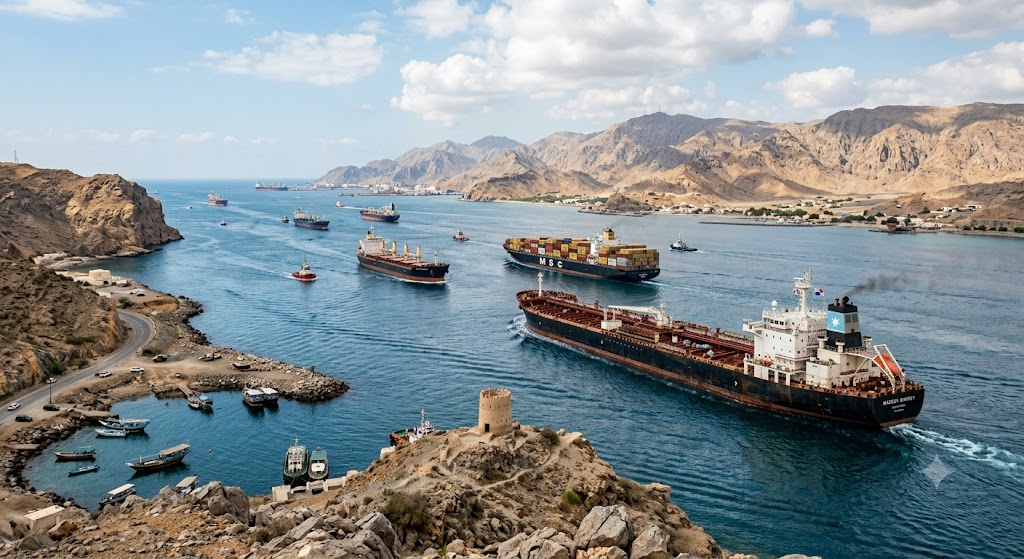
Saudi Arabia spent decades and billions of dollars building redundancy into its oil export network. Multiple terminals. Multiple coasts. A 746-mile pipeline across the Arabian Peninsula for exactly this scenario. It worked, until drones from Iraq proved that no infrastructure is beyond reach. Now the world's biggest oil exporter is running out of ways to get its crude to market, and the Fed is walking into a rate decision with $102 oil and a 5% Treasury yield. Sometimes the most interesting stories in markets start 6,000 miles from Wall Street.
But before we get to that, let's take a quick look at the markets and what matters today…
3 Movers in 3 Minutes
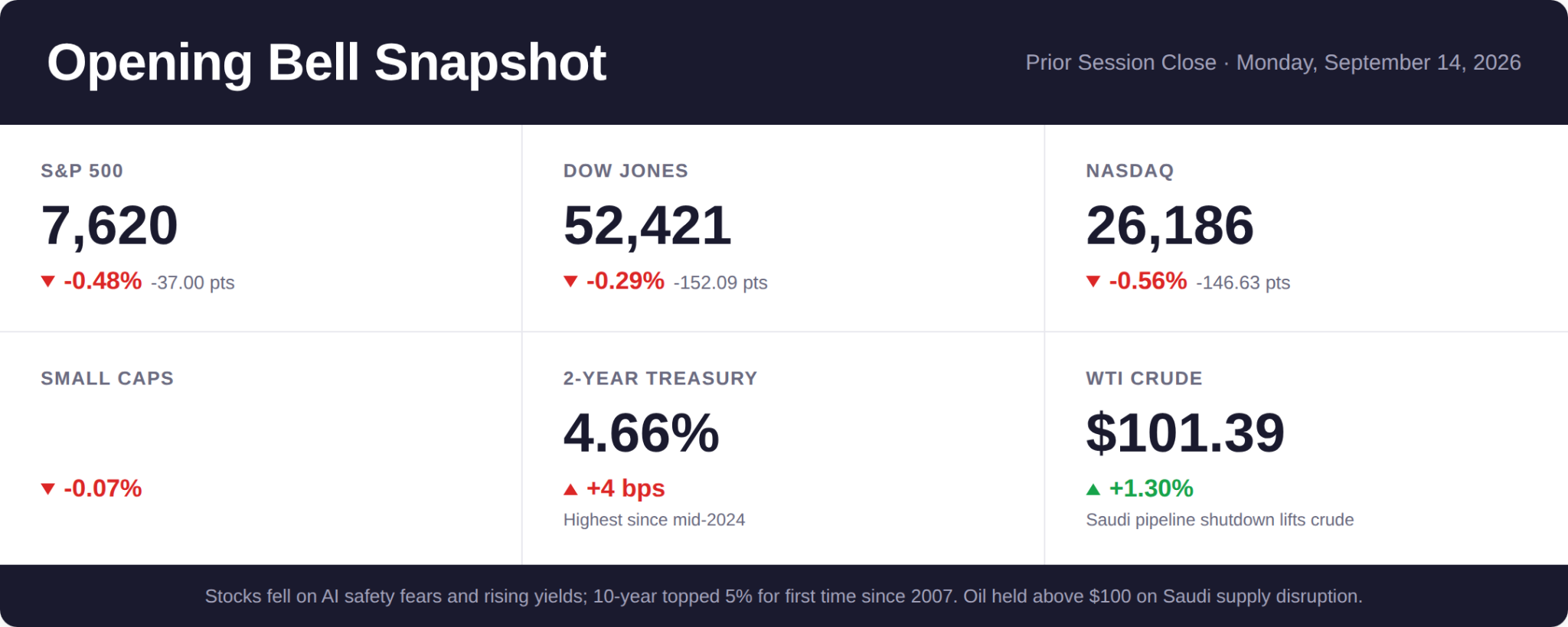
1. Chips take the hardest hit from AI safety reckoning. The Philadelphia Semiconductor Index plunged 5.9% on Monday after Anthropic CEO Dario Amodei's weekend call for an AI development slowdown drew endorsements from OpenAI's Sam Altman and xAI's Elon Musk. NVIDIA Corporation (NVDA) fell 3.3% and Intel Corporation (INTC) dropped 5.6%. The broader Nasdaq slipped 0.56%, but the damage was concentrated in semiconductors, which have been Wall Street's most crowded trade all year. Salesforce Inc. (CRM) bucked the trend, rising 4.7% as investors rotated into software names insulated from the hardware-capex debate.
2. Oil holds above $100 as Saudi Arabia's pipeline shutdown tightens supply. WTI crude settled at $101.3, up 1.3%, after briefly touching $105 intraday. Brent crude closed at $105.68. Saudi Arabia's East-West Pipeline, the kingdom's main bypass route around the Strait of Hormuz, remained offline following drone strikes from Iraqi territory on September 10. Traders at Kpler estimate the market could lose 120 million barrels if the pipeline stays closed for a month. Exxon Mobil Corporation (XOM) and Chevron Corporation (CVX) both traded near 52-week highs.
3. 10-year Treasury yield breaches 5% for the first time since 2007. The yield on the benchmark 10-year note topped 5% intraday Monday, its highest closing level since 2007. The 2-year yield rose to 4.66%, its highest since mid-2024, as markets priced in an 85-90% probability of a 25 basis-point rate hike at Wednesday's FOMC decision. Rising oil prices and sticky inflation above the Fed's 2% target are compressing the Fed's room to manoeuvre. The iShares 20+ Year Treasury Bond ETF (TLT) has now fallen more than 18% year-to-date.
3 Signals for Today
FOMC Day 1 begins. The Federal Reserve kicks off its two-day policy meeting today, with the rate decision, Summary of Economic Projections, and dot plot all arriving Wednesday at 2:00 PM ET. Chair Kevin Warsh's press conference follows at 2:30 PM. Markets see an 83-90% chance of a 25 bps hike, the first since 2023.
August Retail Sales arrive Wednesday morning. The Census Bureau releases Advance Monthly Retail Sales at 8:30 AM ET on Wednesday, landing just hours before the FOMC decision. A strong print would reinforce the case for tightening; a miss could complicate the Fed's messaging on growth resilience.
Saudi-Iran oil diplomacy stalls. Oman's foreign minister announced Sunday that the planned regional meeting between Gulf states and Iran has been postponed indefinitely. Any surprise progress on restarting oil flows through the Strait of Hormuz would move crude sharply, while continued deadlock keeps the supply squeeze intact and energy-driven inflation elevated heading into the Fed's decision.
Nuclear Stocks Are Surging — These 7 Lead the Pack
Nuclear stocks aren’t creeping higher — they’re breaking higher in waves.
Multiple names posted 40%+ gains last year as uranium prices climbed and plans emerged for hundreds of new reactors over the coming decades.
Producers are benefiting from rising uranium prices, while service providers are locking in long-term contracts and infrastructure spending adds another layer of demand.
Our analysts identified the companies positioned to benefit from multiple angles in a FREE report: 7 Top Nuclear Stocks to Buy Now.
And with that out of the way, let's get to today's big story: the moment Saudi Arabia's oil escape routes all failed at once.
The Sip
The 746-Mile Backup Plan
When Iran effectively shut the Strait of Hormuz in the early weeks of the U.S.-Iran war this past February, the world held its breath. About 15 million barrels of crude passed through that narrow waterway every day. It was the single most important corridor in global energy.
But the panic was surprisingly brief.
Saudi Arabia had a contingency. A 746-mile pipeline stretching from the kingdom's eastern oilfields all the way across the Arabian Peninsula to Yanbu, a port on the Red Sea. The East-West Crude Oil Pipeline, also called Petroline, had existed for decades. Its purpose was simple: if Hormuz ever closed, Saudi oil could still reach the world.
By late March, Saudi Aramco confirmed the pipeline was pumping at full capacity, pushing 7 million barrels per day westward. About 5 million of those barrels were loaded onto tankers at Yanbu for export. Another 2 million fed Saudi refineries on the west coast.
It was not a perfect substitute. Before the war, Hormuz handled 15 million barrels daily. The pipeline could only manage half that. But it was enough to prevent the catastrophic supply shock markets had feared. Oil prices stabilised. Traders relaxed. The system, it seemed, had enough redundancy to absorb the blow.
When Drones Found the Weak Spot
That confidence shattered on September 10.
Multiple drone strikes, launched from Iraqi territory, hit pumping stations along the East-West Pipeline in the Riyadh and Medina provinces. The Saudi Ministry of Energy announced the pipeline's closure the following day, calling it a "precautionary measure." Satellite imagery told a different story. Fires burned at pumping stations. Infrastructure was damaged. Several workers were injured.
No group claimed responsibility. But U.S. officials pointed to Iran-backed militias operating inside Iraq, the same proxy forces that had launched drone attacks on Saudi energy infrastructure in July. Iraq's Prime Minister Ali al-Zaidi condemned the attack and dismissed the regional military commander, but the damage was done.
Industry sources told Reuters that repairs could take five to six weeks. Others suggested partial operations might restart sooner. Either way, the world's most important bypass route was offline. And the timing could not have been worse.
Three Exits, All Blocked
Here is what makes the current situation historically unprecedented.
The Strait of Hormuz, through which a third of all globally traded crude oil once flowed, has been effectively closed since the war began. Saudi Aramco built its entire contingency around the East-West Pipeline as Plan B. That pipeline is now shut.
And Plan C? The Red Sea and the Bab al-Mandeb strait, the narrow waterway connecting the Red Sea to the Gulf of Aden, was the remaining alternative route. But in July, Yemen's Houthis declared a maritime embargo against Saudi Arabia and have been tightening their grip on tanker traffic through the strait. Recent reports indicate they have captured key positions near the mouth of the waterway.
WARNING: A Major Market Shift Could Hit Stocks in 2026
If you have any money in the stock market, you may want to pay attention.
New research points to a massive market-moving event that could send hundreds of popular stocks into a sudden free fall.
Holding the wrong stocks when this hits could erase years of gains.
That’s why analysts have now identified a list of stocks investors may want to avoid as this event unfolds.
If you want to see what’s coming — and which stocks could be most at risk —
Three escape routes. All compromised simultaneously.
The International Energy Agency said Saudi crude supply has fallen to its lowest level in more than three decades. Global oil supply is projected to drop by 5.7 million barrels per day in 2026, roughly 6% of global output. Traders at Kpler warned that if the pipeline stays offline for a month, the market could lose 120 million barrels. Reuters reported that Saudi Arabia could run out of oil stocks at Red Sea export terminals within days.
Brent crude briefly touched $110 on Monday before settling near $106. WTI closed at $101.39.
Why This Matters for Your Money
The pipeline story might feel distant. But the line from a damaged pumping station in the Saudi desert to your cost of living is shorter than you think.
Crude oil above $100 feeds directly into gasoline prices, shipping costs, and input costs for everything from plastics to food packaging. The August CPI reading already showed U.S. headline inflation at 3.4% year-over-year, well above the Fed's 2% target. With oil supply now tightening further, the next set of inflation prints is almost certain to stay elevated.
That is exactly why the Fed is widely expected to hike rates by 25 basis points on Wednesday, bringing the federal funds rate to a range of 3.75% to 4.00%. It would be the first rate increase since 2023. The 10-year Treasury yield already topped 5% on Monday for the first time since 2007. The 2-year yield sits at 4.66%.
The uncomfortable truth is that the Fed is raising rates to fight inflation it cannot control. Monetary policy can cool demand. It cannot reopen a pipeline in the Arabian Desert or clear Iranian mines from a strait. J.P. Morgan's strategists recently noted that the combination of supply-chain shocks from the Iran conflict and investor doubts about Fed credibility after July's hold decision "lowered the bar for a September hike."
Saudi Arabia, for its part, is now trying to boost shipments back through the contested Strait of Hormuz, the very route the pipeline was built to avoid. It is the geopolitical equivalent of running back into the burning building because the fire escape collapsed.
And the ripple effects extend well beyond energy. The S&P 500 energy sector is up 43% year-to-date. Consumer discretionary, weighed down by fuel-driven cost pressures and rising rates, is down 2.3%. That divergence tells you everything about where the market thinks the pain is concentrated. Homebuyers face mortgage rates tracking the 10-year above 5%. Corporate CFOs looking to issue debt are staring at borrowing costs not seen in nearly two decades. The cost of capital is rising everywhere, and it all traces back, in part, to a 746-mile pipe that went quiet in the desert.
"A Dangerous Financial Plan Unfolding in D.C. Could Cost You 40% of Your Wealth"
Former Goldman Sachs executive who traded through Black Monday warns this plan is all written down in black and white, spearheaded by a financial insider who infiltrated the Federal Reserve... It's gone "viral" in the hedge fund circles… and yet practically nobody on Main Street understands this financial shock playing out across America. He lays out all the evidence... plus a detailed roadmap for exactly what to do. (And it doesn't require shorting... options... or perfectly "timing the market.")
You must see this critical market briefing today.
This ad is sent on behalf of Stansberry Research, 1125 N Charles St, Baltimore, MD 21201. If you would like to optout from receiving offers from Stansberry Research please click here.
The MarketSipsTakeaway
The biggest risk in any system is the assumption that the backup plan will work. Saudi Arabia spent decades building redundancy into its oil infrastructure. Multiple terminals, multiple coasts, a pipeline designed for exactly this moment. It was not enough. When the Strait of Hormuz, the East-West Pipeline, and the Red Sea corridor all came under pressure at the same time, the world's most carefully engineered oil escape network failed simultaneously. The market is now pricing that reality at $102 per barrel, and the Fed is walking into its most consequential rate decision in years with an inflation driver it has no tools to fix. Watch Wednesday's dot plot closely. If the Fed signals more hikes beyond September, it means they see what the oil market already sees: this supply crunch is not going away soon.
Until then, sip slowly!
The Market Sip Desk
Reply prompt: What's the bigger risk: sticky oil or an aggressive Fed?
FREE FINANCIALMARKETS.COM ALERTS
The Next Market Move Could Start With One Alert
Get breaking market developments, trade ideas, analyst signals and upcoming catalysts sent directly to your phone.
Markets move quickly. Now your information can too.
Tickers: UI MS NVDA INTC CRM WTI XOM CVX FOMC TLT PM ET CPI MD COM START POLL