

A cruise company spends $3 billion on resorts and watches its stock drop 7% in a single afternoon. That reaction tells you something important. Not about the deal itself, but about what Wall Street thinks cruise companies are allowed to be. Turns out, the answer is: boats. Only boats.
But before we get to that, let's take a quick look at the markets and what matters today…
3 Movers in 3 Minutes
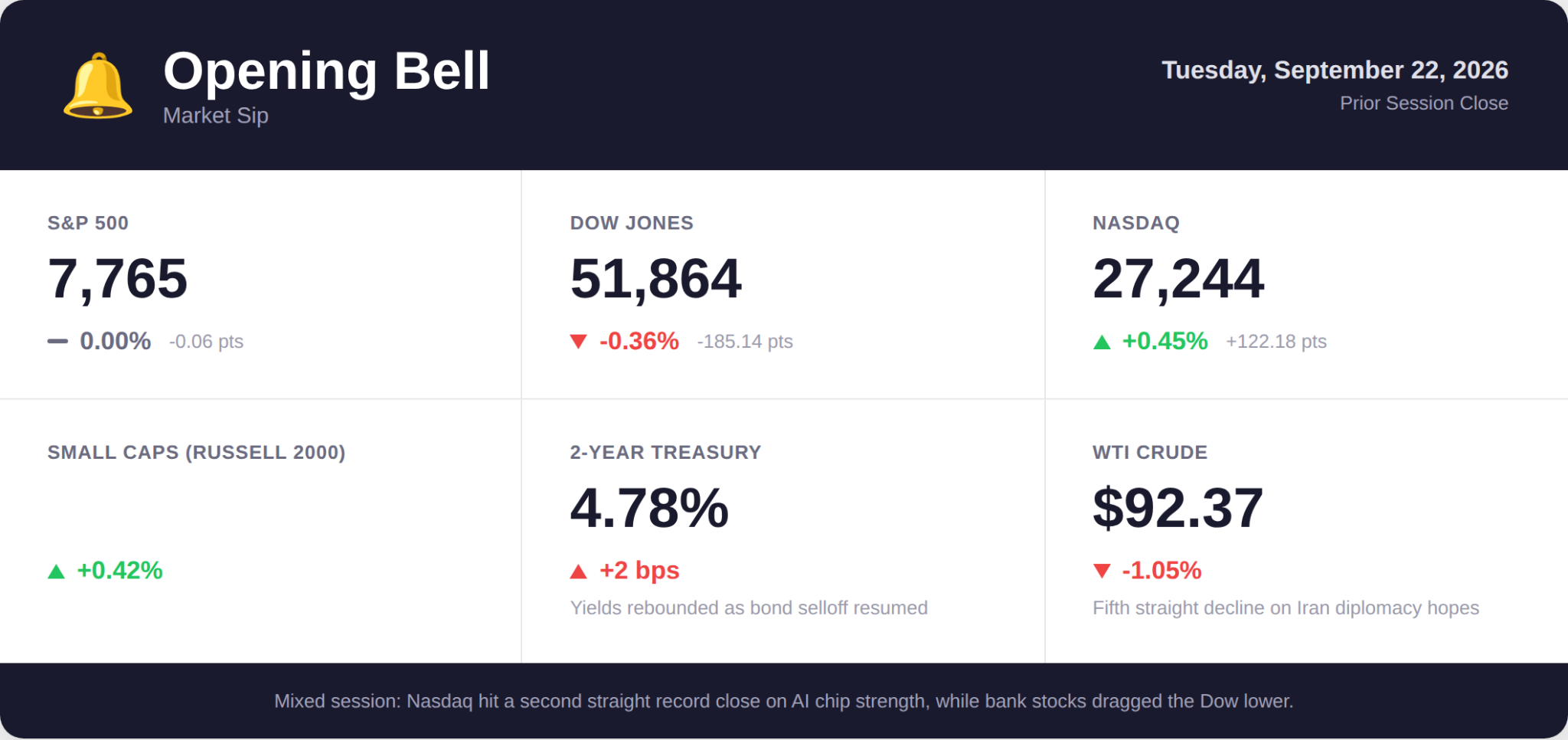
- Royal Caribbean takes its biggest bet ashore. Royal Caribbean (RCL) dropped nearly 7% after reports emerged that it is nearing a $3 billion deal to acquire a controlling stake in Sandals Resorts International, valuing the Caribbean resort chain at roughly $6 billion. If completed, it would be the largest acquisition in RCL's history and a sharp pivot from ocean liners to dry land. Investors were not impressed.
- Nasdaq closes at a second straight record while the Dow drops 185 points. The divergence between large-cap tech and traditional industrials grew wider on Tuesday. The Nasdaq finished at 27,244, its second consecutive all-time close, lifted by Meta (META) and chipmakers. Meanwhile, Cisco (CSCO) fell 4.5% and JPMorgan (JPM) dropped 3.4%, dragging the Dow lower.
- Oil drops for a fifth straight session as Iran signals flexibility. WTI crude slipped below $91 and Brent settled around $99 as reports surfaced that Iran had proposed reopening the Strait of Hormuz within seven days if the U.S. eases its port blockade. President Trump called the latest talks "very good" from the floor of the UN General Assembly.
3 Signals for Today
Flash PMIs for September drop at 9:45 AM ET, the first real-time read on whether manufacturing is still contracting and whether services momentum held up after the Fed hike.
General Mills (GIS), Cintas (CTAS), and Paychex (PAYX) all report before the open, covering grocery shelf pricing, corporate services demand, and small business payroll health in a single morning.
The Trump-Xi summit is expected later this week, with trade officials reportedly making headway on AI-related agreements following the Bessent-He Lifeng talks in Manhattan, setting the stage for potential tariff recalibrations.
In January, Gold Touched Nearly $5,600 an Ounce. Today It's Around $4,100.
So the story's over, right?
Then explain this.
The metal is still leaving the vaults. Physical deliveries still running at levels the exchange rarely processed before. Central banks still buying. Dealers charging 30-40% premiums over paper price for real coins.
When price falls but physical demand doesn't — only one of those two is telling the truth.
The paper market sets the price. The physical market sets the deadline.
Anyone who wished they'd bought miners before January's run just got handed the entry back.
One company I've been tracking controls an 88 million ounce deposit — trading near $4 billion. About 1% of the value of its metal in the ground.
That gap is the whole opportunity.
And with that out of the way, let's get to today's big story: a cruise company that just paid $3 billion to step onto dry land.
The Sip
The boy who sold fish to hotels
In the early 1950s, a boy on Jamaica's north coast would paddle a small canoe into the Caribbean, catch fish, and sell them to local hotels. He was twelve years old. His name was Gordon "Butch" Stewart. He gave the leftover fish to his neighbours.
Three decades later, in 1981, Stewart bought a rundown hotel in Montego Bay for a price nobody else would pay. He turned it into the first Sandals resort, a couples-only, all-inclusive property where you paid once and everything was covered. The drinks. The water sports. The tips. The idea sounded ridiculous at the time. Luxury travellers wanted choice, not packages. Budget travellers wanted cheap, not curated.
Stewart ignored both camps. He bet on a third instinct: that people on vacation do not want to think about money at all.
By the time he died in January 2021, Sandals had grown into the world's most awarded all-inclusive resort brand, with more than a dozen properties scattered across Jamaica, Saint Lucia, Barbados, the Bahamas, Antigua, and beyond. It had become Jamaica's largest private-sector employer and the country's biggest non-governmental foreign exchange earner. All from one insight about how people feel on holiday.
Which brings us to Tuesday.
Three billion dollars to step ashore
According to reports, Royal Caribbean is in advanced talks to acquire a 50% controlling stake in Sandals Resorts International for approximately $3 billion. The deal would value the resort chain at roughly $6 billion, making it the largest acquisition Royal Caribbean has ever attempted.
Under the proposed structure, the Stewart family would retain equity holdings while Royal Caribbean becomes the controlling shareholder, with options to acquire full ownership over time. Talks are ongoing and could still collapse.
The market reaction was swift and brutal. RCL shares fell nearly 7%, their worst single-day performance in six months. Analysts pointed to execution risk, balance sheet leverage, and the obvious question: why would a cruise company want to run hotels?
It is a fair question. But it misses the bigger one.
The vacation wallet
Here is what most investors see: Royal Caribbean operates cruise ships. Sandals operates beach resorts. These are different businesses. Buying one to bolt onto the other is a conglomerate move, the kind Wall Street has punished for decades.
But here is what Royal Caribbean sees: the customer is the same person.
The American who books a seven-night Sandals honeymoon in Saint Lucia is, statistically, the same person who books a seven-night Royal Caribbean cruise two years later. Or the reverse. They are not choosing between boats and hotels. They are choosing how to spend a finite number of vacation days per year.
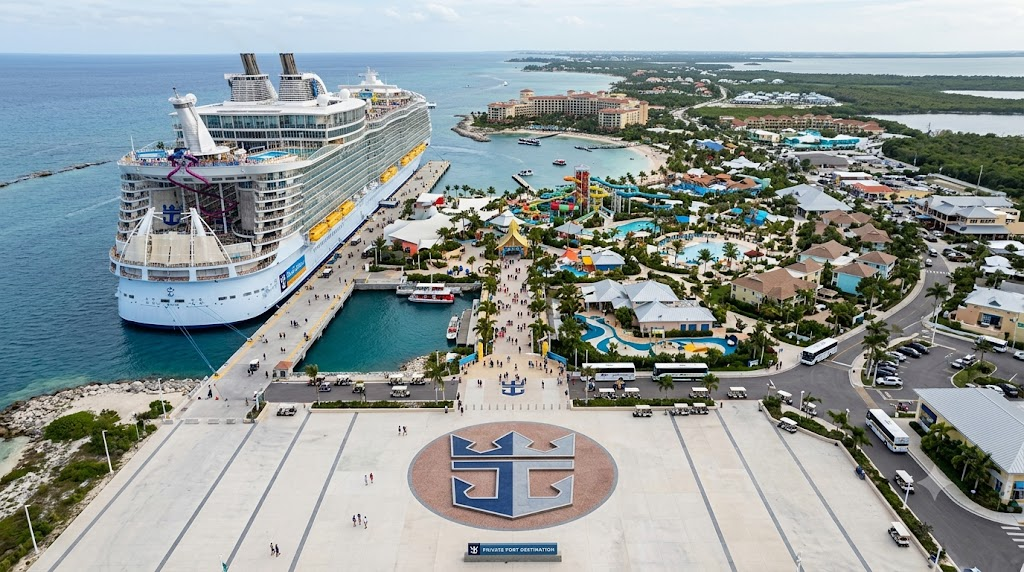
Royal Caribbean has been creeping toward this realisation for years. In 2019, it spent $250 million transforming CocoCay, a private island in the Bahamas, into a full-scale beach destination called Perfect Day. The economics were staggering. According to one analysis, CocoCay generated roughly $545 million in incremental gross profit, a payback period of less than six months on a $250 million investment. The company's CEO Jason Liberty has since called it a "commercial flywheel" and announced plans to expand from two to eight exclusive land-based destinations by 2028.
The Man Who Called Nvidia Before It Soared 1,000% Issues New Elon Musk BUY Alert
Luke Lango was ranked America's #1 stock picker in 2020. He was mentored by two hedge fund billionaires from the Soros network and trained at Caltech. His readers have had the chance to see gains as high as AMD +8,500%... Nvidia +5,000%... Tesla +3,500%... Palantir +1,000%... and Apple +890%. Now he's releasing his next big pick.
This ad is sent on behalf of InvestorPlace Media at 1125 N. Charles Street, Baltimore, Maryland 21201. If you're not interested in this opportunity, please click here.
Sandals would turbocharge that trajectory overnight. Instead of building beach destinations from scratch, Royal Caribbean would acquire 20 established resorts across the Caribbean, each with decades of brand equity, loyal repeat guests, and a distribution channel that reaches a customer base the cruise line has been trying to capture through marketing alone.
Why the market hates it anyway
The scepticism is not irrational. Royal Caribbean's stock is already down roughly 25% over the past year after it trimmed revenue growth forecasts on softer European sailing demand. Adding $3 billion in acquisition spending on top of $5 billion in annual capex and $3.2 billion in debt maturing this year looks aggressive.
There is also a structural concern. Cruise ships and resorts are both capital-intensive, weather-dependent, and vulnerable to geopolitical disruption. Buying Sandals does not diversify risk. It doubles it. A hurricane season that damages both ships' itineraries and resort properties simultaneously is not a hypothetical. It is the Caribbean.
And then there is the integration question. Running a 250,000-ton floating city with 5,000 passengers is a fundamentally different operational challenge from running a boutique 250-room resort with a private butler service. The cultures are different. The margins are different. The customers may overlap, but the delivery models do not.
Wall Street has seen this movie before. When Marriott acquired Starwood in 2016, it took years to integrate the loyalty programmes, the technology platforms, and the brand identities. And those were two hotel companies. Royal Caribbean would be stitching together a cruise line and a resort brand, two industries that have historically operated in parallel but never truly merged.
What this is really about
But zoom out, and something bigger comes into focus.
The leisure economy is consolidating around a simple idea: companies that capture the largest share of a customer's vacation spending will win. Not the companies with the biggest ships. Not the companies with the best rooms. The companies that own the most minutes of a traveller's time.
Disney figured this out decades ago. Theme parks, hotels, cruise ships, streaming. Each product feeds the next. The child who watches Frozen buys a ticket to Disney World, which leads to a Disney Cruise Line booking, which leads to a Disney+ subscription that keeps the cycle going. The product is not entertainment. The product is the relationship.
Royal Caribbean is making a version of the same bet. If Sandals' honeymooners can be funnelled toward a Royal Caribbean cruise, and if Royal Caribbean cruisers can be upsold into a Sandals resort stay, the combined entity does not just cross-sell. It captures a disproportionate share of the most valuable consumer category in the economy: the affluent traveller who has already decided to spend.
Whether the market is right to punish this deal today is almost beside the point. The real signal is strategic. A cruise company just declared that the ocean is not big enough.
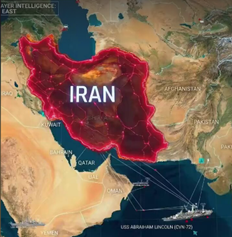
The REAL Reason Trump Is Invading Iran
For a moment…
Forget about Trump’s ties to Israel.
Forget about reports of Iran’s nuclear program.
Because my research has led me to believe we’re risking World War 3 with Iran for a completely different reason.
Click here to find out what it is.
If you have even a single dollar invested in the U.S. stock market, this is going to directly impact you.
The MarketSipsTakeaway
The Royal Caribbean-Sandals deal is less about one company buying another and more about how the leisure industry is restructuring around a single insight: the most valuable asset in travel is not a ship, a room, or a beach. It is the customer's attention across their entire vacation calendar. If this deal closes, watch for Carnival (CCL) and Norwegian (NCLH) to face a difficult question: are they cruise companies, or are they vacation companies? The ones that answer wrong will find their competitive moats shrinking by the year.
Until then, sip slowly!
The Market Sip Desk
Reply prompt: Would you spend a cruise company's money on beach resorts, or would you stick to building bigger ships?
3 Market Signals Most Investors Aren't Watching
The headline is usually the last place the story shows up.
By the time everyone is talking about a stock… the signals underneath it may have been changing for weeks.
• Institutional money moves.
• Options activity changes.
• Management confidence shifts.
• Fundamentals improve, or quietly begin telling a different story.
That’s exactly what our analysts found in three stocks where the evidence stopped agreeing with itself.
And in all three cases, the story is still developing.
Tickers: UI MS RCL META CSCO JPM WTI UN ET GIS CTAS PAYX AMD CCL NCLH POLL