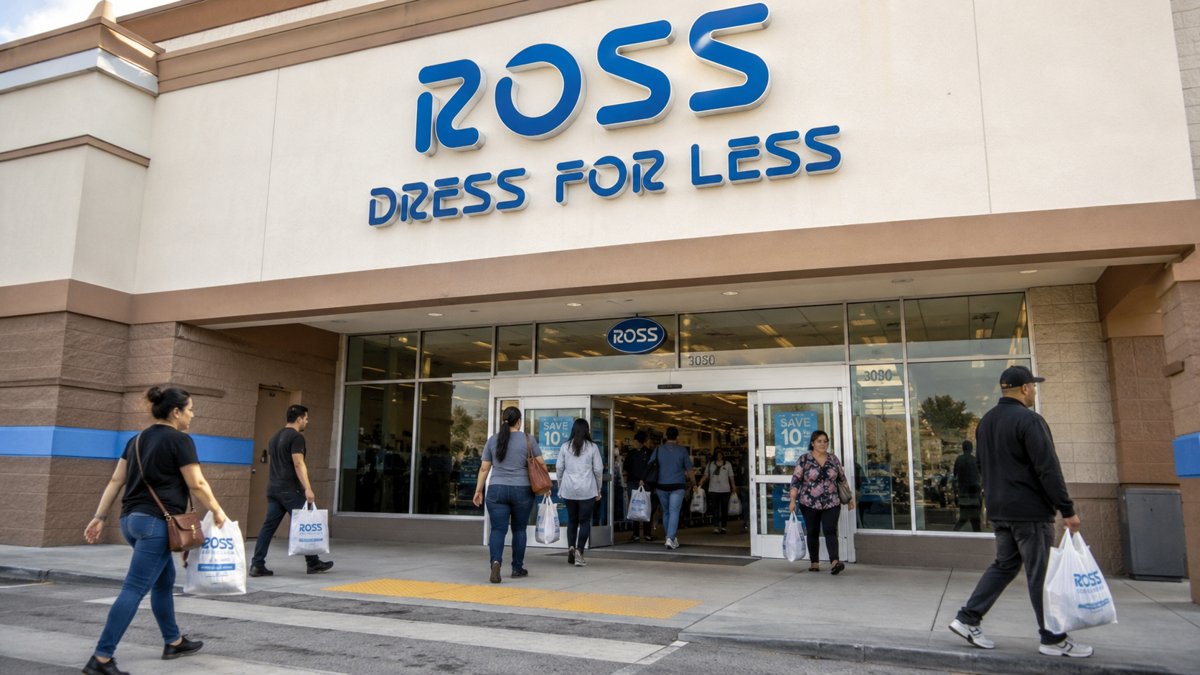
Ross Stores just posted its second straight quarter of double-digit comparable sales growth and raised its full-year profit outlook by more than a dollar a share. Yet the company's own executives refused to raise the long-term sales targets that this kind of growth would normally justify. That gap between what the results say and what management is willing to promise is the real story of the quarter. Investors have to decide whether Ross is entering a new, higher-growth era, or whether a temporary refund and a hot run of market-share gains are flattering a business that still expects to slow back down.
A Guidance Raise Built Partly on a Refund
Ross reported net sales of $6.3 billion for the 13 weeks ended August 1, up 13 percent from a year earlier and roughly 2 percent above the $6.2 billion analysts expected, with comparable store sales up 10 percent. That followed a 13 percent comp gain in the first quarter, marking the first time in years the off-price retailer has strung together two consecutive quarters of double-digit growth. Diluted earnings per share rose to $2.66 from $1.56 a year earlier, beating the roughly $1.95 Wall Street had modeled.
Roughly $0.60 of that per-share result, and $253 million of net income, came from refunds tied to IEEPA tariffs. That one-time benefit drove 405 of the 610 basis points of operating-margin improvement Ross reported for the quarter. Strip it out, and organic operating margin still improved by about 205 basis points, a real gain, but a much less dramatic one than the headline number suggests. The same $0.60 tariff benefit is embedded again in the company's newly raised full-year guidance of $8.61 to $8.77 per share, up from $7.50 to $7.74 just three months ago. Management has not said how much of that increase reflects the non-repeating refund versus genuine acceleration in the business. That is not a small caveat. It is the single biggest open question hanging over the raise.
Traffic Is Growing, but Management Can't Explain Why
Chief Executive Jim Conroy told analysts the growth is unusually broad, saying new customers look similar to existing ones "across every single household income group, every single age group, and every single ethnicity we track." Home and cosmetics led category performance, while apparel grew more slowly than the company average, a step down from the first quarter, when apparel had outpaced it. Geographic strength was broad, with the Midwest performing best.
Bernstein's Aneesha Sherman asked whether the growth reflects share taken directly from Ross's two largest off-price rivals. Conroy said Ross has "mathematically captured more share" than each of its two largest competitors over the past four quarters, but declined to say whose business it came from. Citigroup's Paul Lejuez pushed for hard numbers on new customers and vendor counts; management declined, citing competitive sensitivity. Most notably, UBS analyst Jay Sole asked directly whether marketing or merchandising is driving the traffic gains. Conroy's answer was unusually candid: "We cannot connect that last piece of the arithmetic because we do not have traffic counters." A retailer running double-digit comps cannot currently say what is causing them.
The Algorithm Ross Won't Rewrite
The clearest signal in the entire release came when Chief Operating Officer Michael Hartshorn was asked whether it was time to raise the company's long-standing 3 to 4 percent long-term comp algorithm, given two straight quarters of double-digit growth. His answer: "I think the right time to do that would be further along in some of the initiatives we have in place. So at this point, we would not update the long-term year-over-year algorithm." That is a company posting historically strong growth while declining to say the growth is durable enough to change its own forecasting framework. Read generously, it is prudence from a management team unwilling to overpromise. Read skeptically, it is an internal acknowledgment that the current pace is not fully repeatable.
Other risks received similar hedges. Wells Fargo's Ike Boruchow asked about freight and fuel costs; management confirmed Ross does not hedge fuel and that its guidance could move if fuel prices shift materially in the back half. Inventory, meanwhile, rose 18 percent year over year at quarter-end, with packaway inventory at 36 percent of the total, slightly below last year. Hartshorn said turns and merchandise margin remain healthy, but elevated inventory raises the stakes if demand cools faster than expected.
Weighing the Two Cases
The bull case has real support. Comp growth has now accelerated for two straight quarters, driven mainly by traffic rather than price. Store growth plans were raised to 115 new locations for the year. The balance sheet is strong, with $4.3 billion in cash, and the company bought back $319 million of stock in the quarter alone under a $2.55 billion authorization. Organic operating margin, even after removing the tariff refund, still improved by roughly 205 basis points, evidence the underlying business, not just the refund, is running better than a year ago. Pricing discipline appears intact: management expects only modest, low-single-digit price increases in the back half, suggesting Ross is not relying on price hikes to sustain sales.
The bear case is just as concrete. Nearly a third of the tariff refund's dollar value flowed straight to net income, and that benefit will not recur next year, meaning the EPS base investors are now valuing may overstate what Ross can actually earn on a sustained basis. Management cannot isolate what is driving the traffic gains it is celebrating. It also will not commit to the growth rate being durable, even as it reports growth well above its own long-term targets. Apparel, historically Ross's core category, decelerated in relative terms this quarter. And unhedged fuel costs remain a genuine swing factor for margins investors have not yet had to price in.
The stock's reaction told a similarly two-sided story. Shares jumped roughly 4 percent immediately after hours, then surged toward 9 percent in premarket trading, before settling to a gain of about 3.7 to 4.0 percent by mid-morning, a fade from the earliest enthusiasm that still left Ross meaningfully ahead of both the S&P 500 and the retail sector at that point. That pattern looks like a market that liked the quarter, then spent the morning working out how much of the beat was real.
What Comes Next
The next two quarters will tell investors whether Ross's growth is a new baseline or a peak. Watch whether comps hold above the 6 to 7 percent range management is now guiding to for the third quarter, well below the 10 percent just posted, itself a signal that management expects deceleration. Watch whether organic margin gains continue once the tariff refund rolls off future comparisons. And watch whether management ever does raise its long-term algorithm; that single decision would be the clearest evidence yet that this growth is durable rather than borrowed from a favorable, temporary refund. Until then, the burden of proof sits with Ross to show that two good quarters were the business changing, not the calendar.