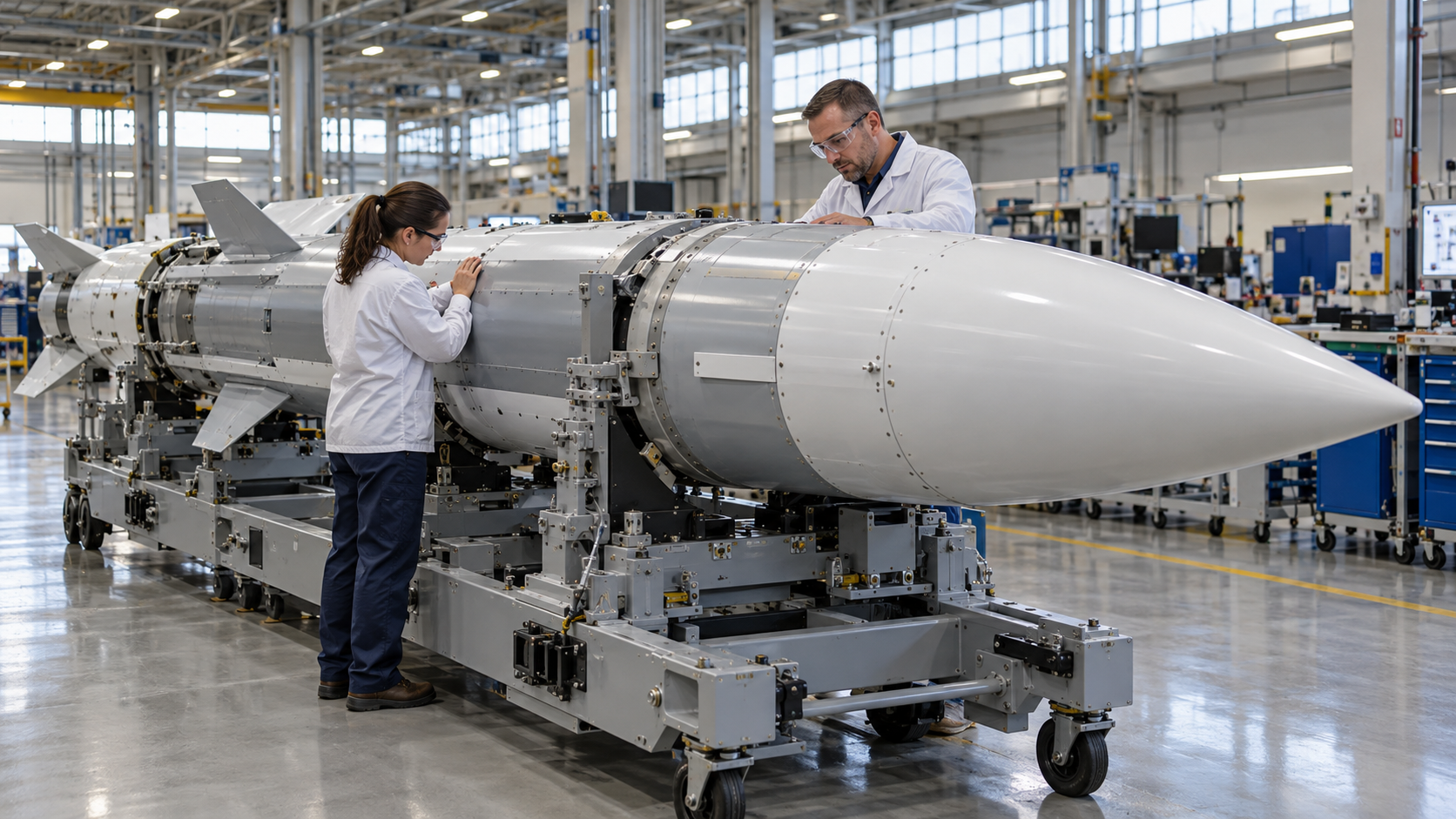
The newest award, for SM-3 Block IB interceptors, is valued at up to $6.3 billion over five years with two option years. RTX shares rose 2.3% on Thursday before it was announced.
The Pentagon's push to restock missile-defense inventories has produced a run of large awards for one company.
Raytheon, part of RTX, said after the close on Thursday that it had won an award worth as much as $6.3 billion to build and support Standard Missile-3 Block IB interceptors over five years, with options covering two more. The Department of War and the Missile Defense Agency described it as a multiyear procurement contract.
It is the third such award in less than two weeks. On Sep 28, 2026, Raytheon announced a contract worth up to $20.7 billion for AMRAAM air-to-air missiles, and on Oct 1, 2026 a contract worth up to $24.4 billion for Standard Missile-6 interceptors. Together the three carry ceilings of $51.4 billion.
What the contract covers
Launched from ships or from land, the SM-3 Block IB is built to hit short- and intermediate-range ballistic missiles in midcourse, and it saw its first combat use in 2024. Raytheon said the contract supports "urgent replenishment of missile defense inventory that has been successfully used in combat." Most of the work will be done at Raytheon plants in Tucson and in Huntsville, Alabama.
"This contract provides production certainty to our defense industrial base, breaks sub-tier manufacturing bottlenecks, and ensures that our fleets and combatant commands have the interceptors required to dominate the battle space," said Michael P. Duffey, under secretary of war for acquisition and sustainment.
Raytheon President Phil Jasper said the award "underscores Raytheon's commitment to increasing production of critical munitions."
The contracts fall under five agreements Raytheon and the Department of War announced in February to expand munitions production.
The scale
RTX had a market value of about $248 billion at Thursday's close. The three awards' combined ceiling equals about a fifth of that. The figures are maximums spread over five to seven years, not guaranteed revenue, and the companies have not disclosed annual delivery volumes or pricing.
RTX shares rose 2.3% to $184.32 during Thursday's regular session, before the SM-3 announcement at 5:14 p.m. Eastern. Early Friday a trade printed at $184.77, little changed. The stock remains well below its 52-week high of $226.88.
Competing views
One reading is that multiyear contracts give RTX unusual visibility. They lock in production for up to seven years, justify the capacity the company has been adding, and arrive as conflict in the Middle East keeps drawing down interceptor stocks.
A second reading is that the headline values overstate what reaches the income statement. Ceilings are rarely fully exercised, the economics of fixed-price multiyear production are not disclosed, and the stock's muted response suggests investors already expected large awards under the February framework.
The figures to watch
RTX's third-quarter results will show how much of these awards enters its funded backlog and what margins it expects on missile production. Any disclosure of delivery rates per year would turn the ceilings into a revenue path.