·
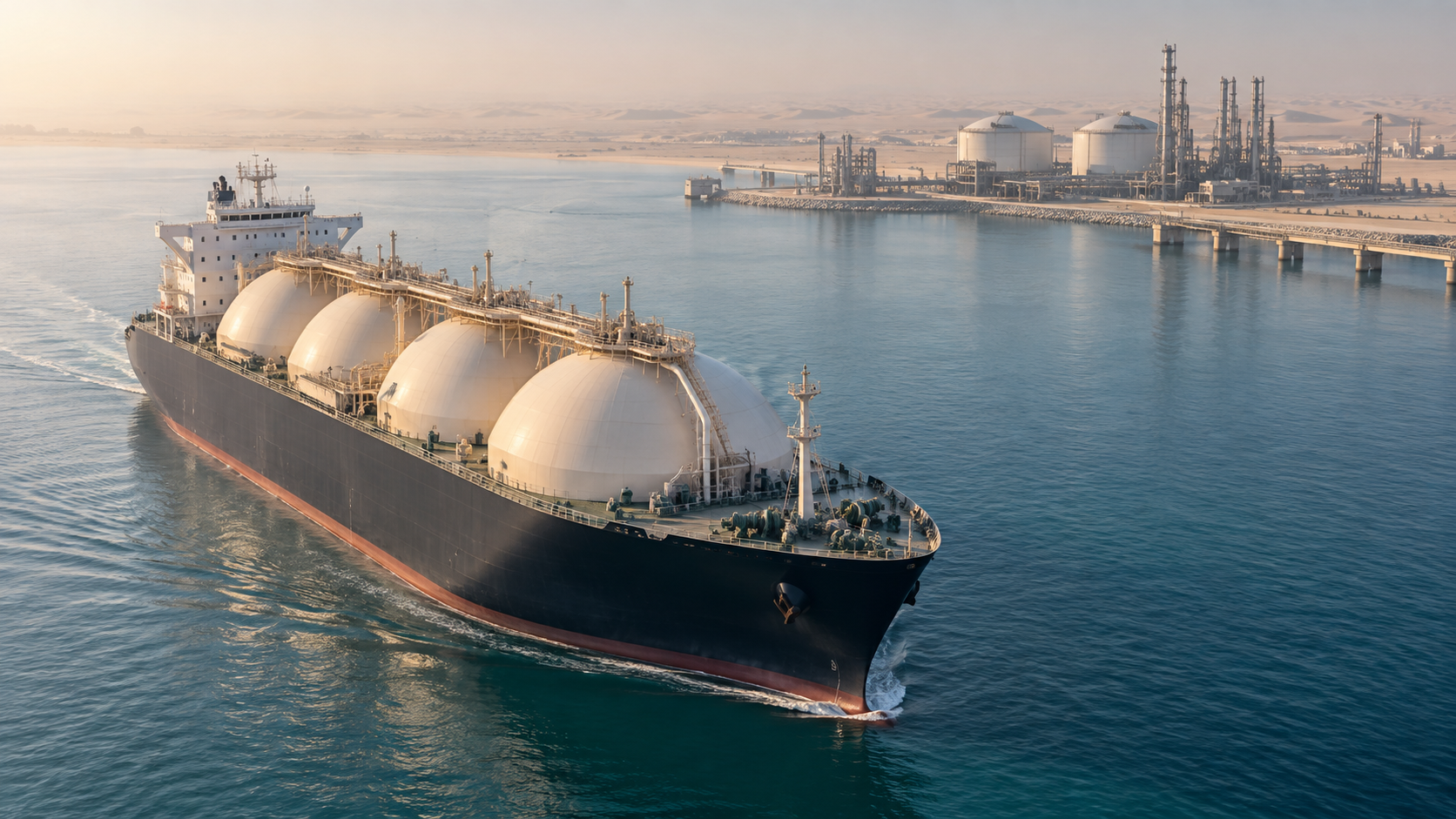
Qatar says it can restart liquefied natural gas operations within weeks of a Strait of Hormuz reopening. Monday's crude decline on diplomatic hopes priced the oil leg of that trade and left the gas leg untouched.
Qatar, one of the world's largest liquefied natural gas exporters before the Iran war, halted production earlier this year after attacks on its export infrastructure and the near-closure of the Strait of Hormuz. Qatari officials said Monday that operations could resume within weeks of the strait reopening. Separately, Qatari Energy Minister Saad al-Kaabi pushed back publicly on the suggestion that the strait has become obsolete as a trade route.
Those two statements sit underneath the same diplomatic track that moved crude 4% lower on Monday. The crude reaction was absorbed within hours. The gas reaction has not happened at all.
Why the asymmetry matters
Crude is the deepest and most liquid commodity market in the world, and a change in the probability of further supply loss gets priced into it almost instantly. Liquefied natural gas is a physical contract market with long-dated offtake, fixed liquefaction capacity and shipping constraints. Price discovery is slower, and a restart of a top-tier exporter is a larger absolute supply swing for European gas than a marginal barrel is for crude.
If the diplomatic track that repriced oil Monday is real, the second-order consequence is a large and relatively fast return of gas supply into a market that has spent the year absorbing its absence. The direct exposures run through European gas benchmarks, European industrial energy costs, the inflation path across the euro area, and the economics of United States liquefaction developers who have spent the year selling into a market short of Qatari volume.
The data point that does not fit
Cheniere Energy rose roughly 3.2% on Monday, on a day the S&P 500 energy sector fell 2.35%. A credible Qatari restart is a supply headwind for a United States liquefaction developer, not a tailwind. Either the market does not believe the restart is near, or Cheniere rose for reasons unrelated to it, or investors are reading the diplomatic track as reopening transit routes that benefit United States cargoes more than they benefit Qatari competition.
None of those explanations has been established, and the divergence is the single most useful unanswered question in the gas complex right now.
What remains undisclosed
Qatar has not published pre-war or current production volumes in connection with the restart comments, has not defined what "within weeks" means operationally, and has not tied the restart to any specific condition beyond a reopening of the strait. No restart timetable exists that is independent of the diplomatic process.
What to watch
QatarEnergy's own announcements are the first place a concrete restart schedule would appear. European gas benchmark prices are the cleanest read on whether the market is beginning to price the option at all. And any actual United States and Iran contact during United Nations General Assembly week is the trigger that converts the option into a schedule.