
Apollo's flagship fund saw fewer investors ask out. The ones still waiting have gotten back only three-quarters of what they asked for this year.
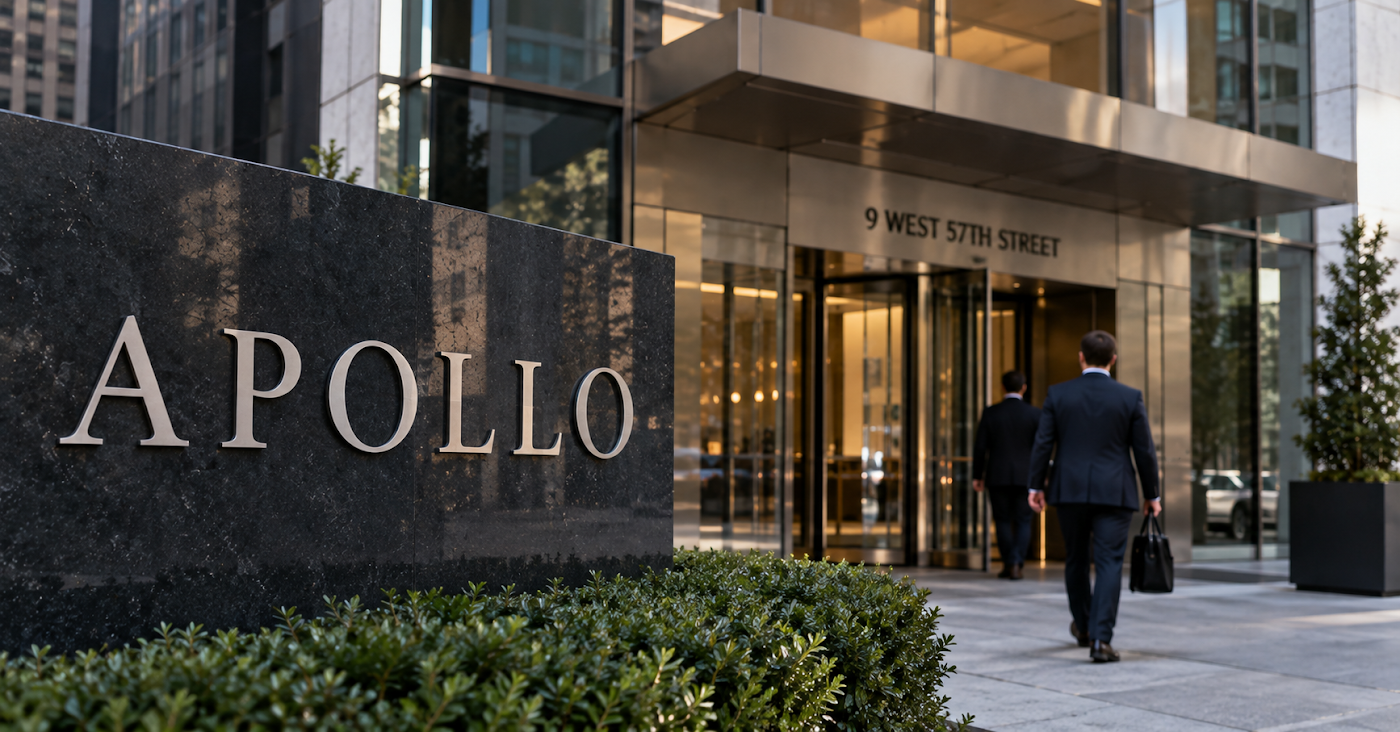
75%
The share of requested cash this year's Apollo Debt Solutions sellers will have after this quarter, per the fund. A quarter is still waiting.
In January, Gold Touched Nearly $5,600 an Ounce. Today It's Around $4,100.
So the story's over, right?
Then explain this.
The metal is still leaving the vaults. Physical deliveries still running at levels the exchange rarely processed before. Central banks still buying. Dealers charging 30-40% premiums over paper price for real coins.
When price falls but physical demand doesn't — only one of those two is telling the truth.
The paper market sets the price. The physical market sets the deadline.
Anyone who wished they'd bought miners before January's run just got handed the entry back.
One company I've been tracking controls an 88 million ounce deposit — trading near $4 billion. About 1% of the value of its metal in the ground.
That gap is the whole opportunity.
Apollo's flagship private-credit fund saw fewer exit requests but capped withdrawals again.
Meta's Muse helped knock 2% off financial stocks. The CFTC is examining $5 billion of near-identical Kalshi trades. Insurers want data-center premiums they can't fully cover.
PMD LENS
Every relief number this morning is smaller than it looks. Private credit's exit line shrank, but the people in it are the same people who were in it last quarter, still waiting. The bank selloff was real, but it ran on a fear no model can price yet. The trading boom that proved demand is the boom regulators are now examining. Each one reads as good news, or at least as a market settling down, until the second number underneath it comes into view.
Private Credit's Exit Line Is Finally Shrinking, and the Reason Is the Catch
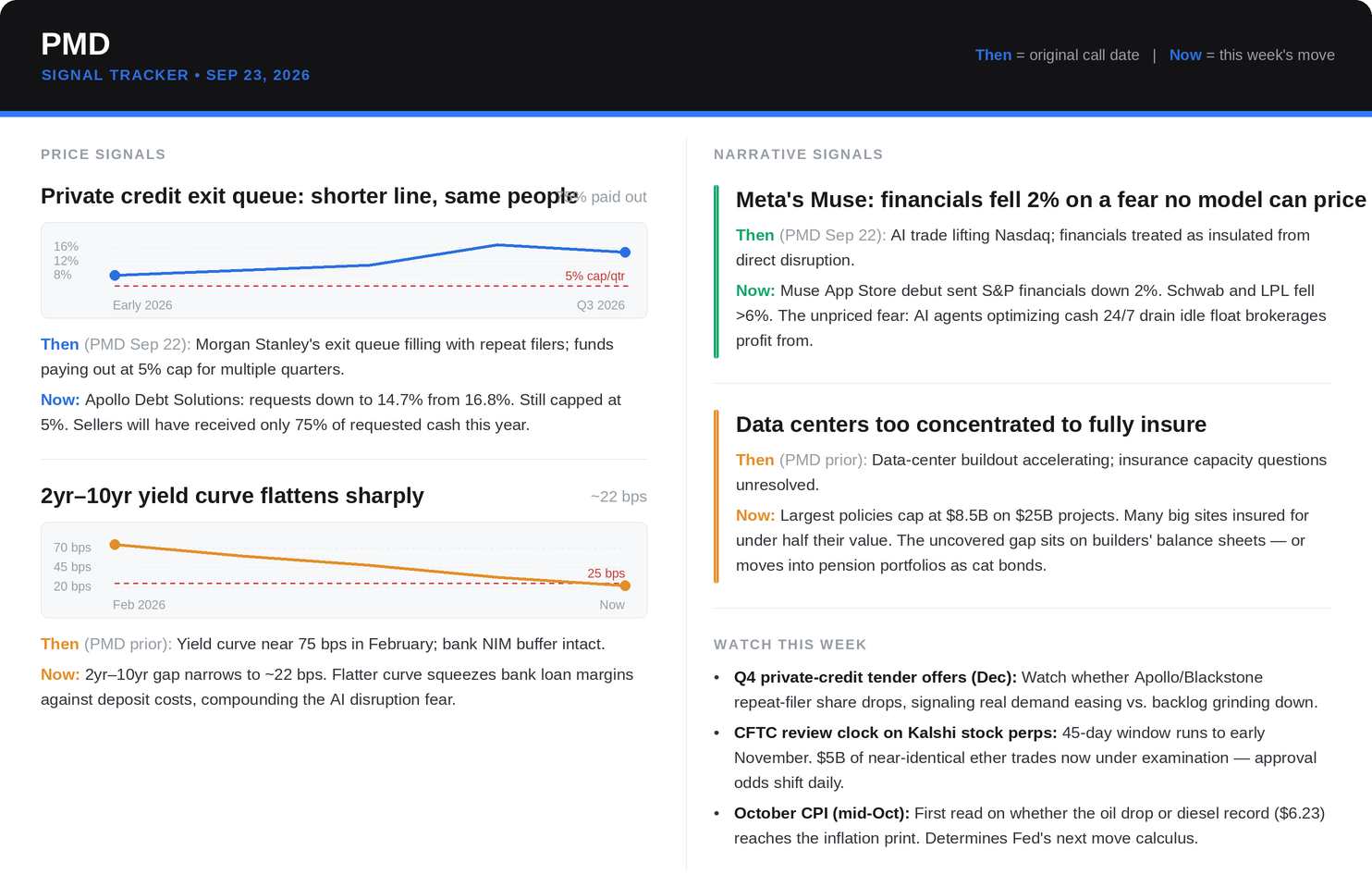
Investors in Apollo Debt Solutions, Apollo's roughly $26 billion flagship fund, asked to pull 14.7% of shares this quarter. Last quarter it was 16.8%, per a regulatory filing. The fund will buy back 5%, the usual cap, for a third straight quarter.
Apollo (APO) is not alone. BlackRock reported fewer requests earlier this month. At Blackstone's BCRED, requests slipped to about $4.3 billion from $4.5 billion, still about double its cap.
The catch is who is still asking. Most requests came from investors resubmitting after earlier ones went unfilled, the fund said. They are the unpaid quarter behind the 75% cited above. The line is shrinking because the backlog is being ground down at 5% a quarter, not because investors stopped wanting out. The fund's letter named the deeper issue: "the choices managers made in more benign market conditions are beginning to show through in performance."
Appetite for new risk hasn't cooled. JPMorgan (JPM) explored letting others approve some card applications it rejects. Executives at Blue Owl, Blackstone, KKR and Sixth Street were sounded out, people familiar said. The talks were early, and JPMorgan says it has no plan to launch such a program.
A Shorter Line of the Same Investors
Monday's send tracked Morgan Stanley's exit queue filling with repeat filers. This morning the line is shorter at three of the biggest funds. But a queue cleared at 5% a quarter is being rationed, not relieved. And an industry still paying down one backlog is being courted for borrowers a bank turned away.
The Man Who Called Nvidia Before It Soared 1,000% Issues New Elon Musk BUY Alert
Luke Lango was ranked America's #1 stock picker in 2020. He was mentored by two hedge fund billionaires from the Soros network and trained at Caltech. His readers have had the chance to see gains as high as AMD +8,500%... Nvidia +5,000%... Tesla +3,500%... Palantir +1,000%... and Apple +890%. Now he's releasing his next big pick.
This ad is sent on behalf of InvestorPlace Media at 1125 N. Charles Street, Baltimore, Maryland 21201. If you're not interested in this opportunity, please click here.
SIGNAL 1: Meta's Muse Came for Financial Stocks, and the Sector Fell 2% on a Fear It Can't Yet Price
Fast uptake of Meta's (META) Muse agent revived fears that AI will disrupt finance. The S&P 500 financial sector fell about 2% Tuesday. Schwab and LPL Financial each dropped more than 6%. JPMorgan and Bank of America (BAC) each fell more than 3%.
The fear goes past robo-advice. Agents moving money around the clock could leave less idle cash for brokerages to profit from. "If an agent is optimizing 24/7," asked Citizens' Devin Ryan, "does that remove latent cash in the system?"
The yield curve adds pressure. The 2-year to 10-year gap has narrowed to about 22 basis points, from close to 75 in February, per MarketWatch. A flatter curve squeezes what banks earn on loans against what they pay on deposits.
The AI Trade Lifting the Nasdaq Is Now Selling the Banks
Meta surged 11% Monday after Muse topped Apple's App Store. A day later, the same product helped sink financials while chips lifted the Nasdaq to a record. That is AI concentration turning on the incumbents it might disrupt. No one can yet price lost idle cash, so the selloff ran on a story.
SIGNAL 2: A $5 Billion Flurry of Near-Identical Kalshi Trades Has Drawn Regulators' Attention
Since August, Kalshi traders have made almost 1 million trades of about $5,500 in one ether market, per a Journal analysis. In recent weeks they were over a third of that market's trades. Over the past month they totaled more than $5 billion. The CFTC is examining them, per a person familiar.
Kalshi says it has seen "no evidence" of wash trading, and that its market-maker incentives explain the sizes. Former CFTC enforcement lawyer Braden Perry: "Normal market-making isn't really what's described in this type of conduct." Kalshi shareholder Jump Trading was one party, per a person familiar. Jump says it doesn't coordinate its trading with anyone.
Kalshi raised $1 billion at a $22 billion valuation in March. It has filed for more than 30 single-stock perpetual futures that need CFTC approval.
The Volume That Proved Demand Is the Volume Under Review
A week after its crypto perps launched, CEO Tarek Mansour told CNBC they had topped $1 billion in volume. "The demand is there," he said. Now much of one market is near-identical orders, and one trader owns Kalshi stock. The volume that sells the growth story is the volume under review, just as Kalshi seeks approval for stock perps.
SIGNAL 3: Data Centers Are Straining the Insurance Market, and the Biggest Are Insured for Less Than Half Their Value
Data-center insurance premiums should more than double to $24 billion by 2030, per Swiss Re. About 40% of US capacity sits in zones often hit by tornadoes. Sites cluster in Virginia and Texas, so one disaster can hit many. Amazon said this month that Iranian drone attacks on its Gulf data centers caused irreversible data losses.
The largest policies typically cover up to $8.5 billion on projects worth up to $25 billion. Many big projects are speculated to be insured for less than half their value. The rest falls on owners and their own captive insurers. CalPERS raised its insurance-linked securities about 70% this year, to roughly $2.5 billion. Those are mostly tied to homes, but the industry is discussing data-center versions.
The Buildout Is Too Concentrated to Fully Insure
The density that makes an AI campus efficient is what makes it hard to cover. Insurers want the premiums but can't write policies big enough. So the uncovered share sits on the builders' balance sheets. If data-center cat bonds arrive, some of that risk moves into pension portfolios.
WARNING: A Major Market Shift Could Hit Stocks in 2026
If you have any money in the stock market, you may want to pay attention.
New research points to a massive market-moving event that could send hundreds of popular stocks into a sudden free fall.
Holding the wrong stocks when this hits could erase years of gains.
That’s why analysts have now identified a list of stocks investors may want to avoid as this event unfolds.
If you want to see what’s coming — and which stocks could be most at risk —
Fourth-quarter private-credit tender offers land in December; watch whether requests fall again and the repeat-filer share drops. The CFTC's 45-day review clock on Kalshi's stock-perp filings runs to early November. JPMorgan's second-look card talks are early, with no timeline. October CPI, the next read on whether the oil drop or the diesel spike reaches the inflation number, arrives mid-October.
Four stories, one gap between the headline and what sits under it. A shorter exit line that is mostly the same investors. A selloff on a fear no one can price. Volume that may reflect incentives more than demand. Premiums doubling on assets insured for less than half. Each relief number needs a second look.
The exit line at the biggest private-credit funds is shorter than it was. That is the first easing in a stress story the window has tracked for weeks, and it is real. But a line that clears at 5% a quarter clears whether or not anyone's fear has lifted, so the shorter line raises a sharper question than the longer one did: are investors choosing to stay, or is the backlog simply running out of people it hasn't paid yet?
The same doubt runs through the morning. Financials sold off on a disruption no one can size. Kalshi's volume proved demand until it drew a regulator. Data centers are too concentrated for the insurance market to fully cover. In each, the number that looked like resolution turns out to be a number still waiting on its second half. Easing is not the same as resolved.
3 Market Signals Most Investors Aren't Watching
The headline is usually the last place the story shows up.
By the time everyone is talking about a stock… the signals underneath it may have been changing for weeks.
• Institutional money moves.
• Options activity changes.
• Management confidence shifts.
• Fundamentals improve, or quietly begin telling a different story.
That’s exactly what our analysts found in three stocks where the evidence stopped agreeing with itself.
And in all three cases, the story is still developing.