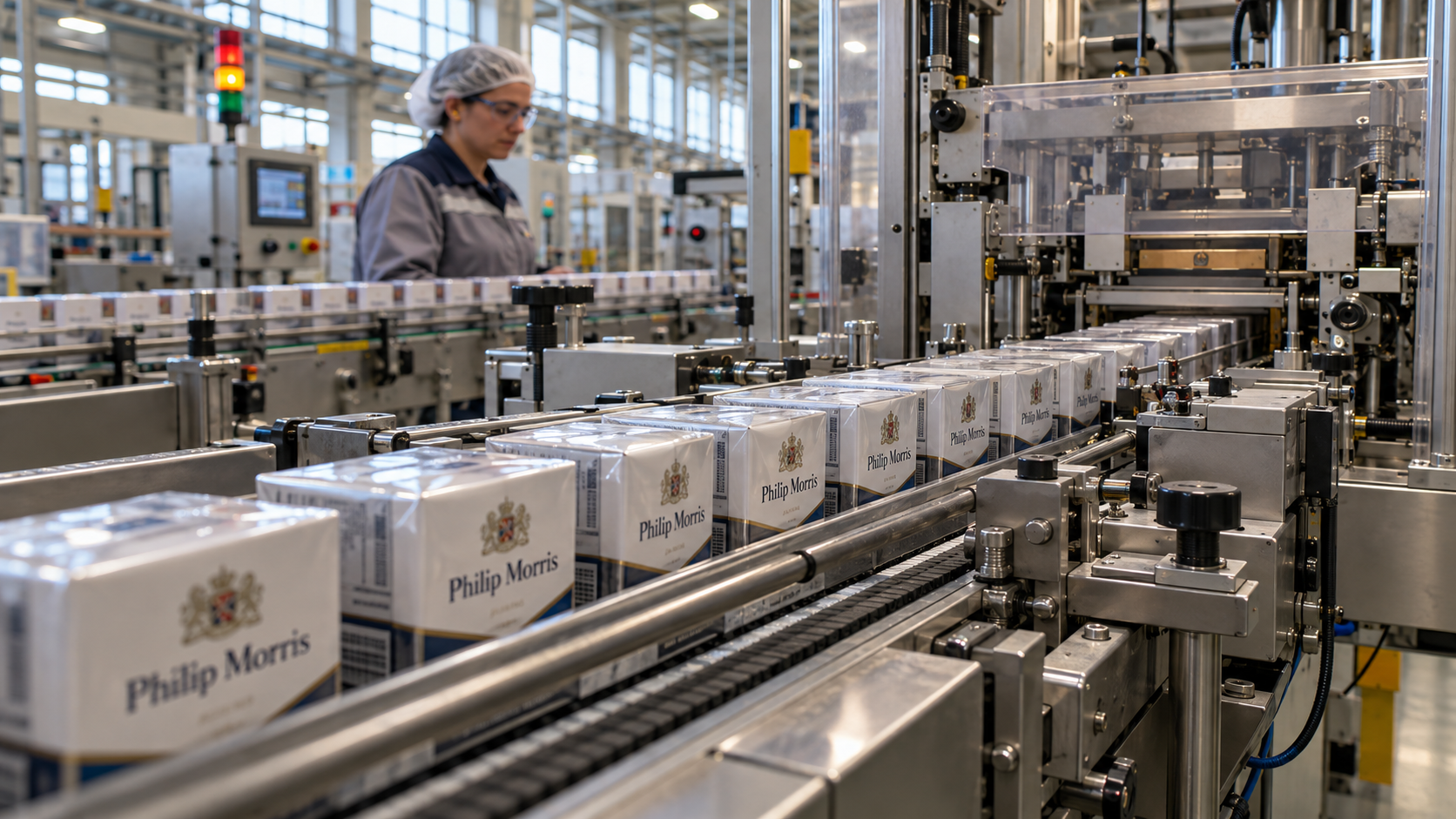
The tobacco company beat third-quarter estimates and topped the high end of its own earnings guidance, but warned that conflict-related energy costs and supply disruptions are building. Shares fell as much as 8% from Tuesday's close and were down 1.55% by 1:46 p.m.
Philip Morris International sold barely more product last quarter and reported much more revenue. The shares were more concerned with the cost side.
Net revenues were $11.438 billion, up 5.5% as reported and 7.1% on an organic basis. Total shipments were 206.2 billion units, up 0.6%. Adjusted earnings were $2.36 a share, up 5.4%, against a $2.29 consensus compiled by LSEG and a company guide of $2.29 to $2.34. Revenue beat the roughly $11.28 billion LSEG forecast. Reported earnings of $2.12 a share fell 4.9%, mainly because of a non-cash fair-value adjustment on equity investments.
Price and mix, not volume
The difference between 7.1% organic revenue growth and 0.6% shipment growth is about 6.5 percentage points. Unit volume cannot account for that, which suggests that pricing and product mix did most of the work.
The split between categories adds a twist. Smoke-free products grew net revenue 4.1% as reported and 6.3% on an organic basis, and shipments of 48.2 billion units rose 2.7%. They made up more than 40% of net revenues. Combustible products grew faster: net revenue rose 6.4% and 7.7% organically.
The warning
The company warned of cost pressure from conflict-related energy prices and supply-chain strikes in Ukraine, and said organic operating income growth is more likely to land in the middle or lower half of its range.
The stock opened at $187.14, fell to $184.00, down 8.0% from Tuesday's close of $199.90, and recovered to $196.81, down 1.55%, at about 1:46 p.m. Eastern. That recovery of about 6.5 percentage points came within about 25 minutes of the open and is large, and nothing in the company's materials establishes what drove it.
Two readings
One reading is that the quarter was strong and the early selloff was a mistake. The company beat, exceeded its own guidance, and smoke-free products stayed above 40% of revenue. A recovery from the low suggests buyers agreed.
The other reading is that the warning is the point. Revenue growth built on price does not continue indefinitely against rising costs, and a statement that operating income will land in the middle or lower half of its range invites a lower price.
What to watch
The company's full-year forecast table, which is where the effect of currency and costs will be visible; shipments of its smoke-free products; the pace of price increases; and energy costs as the conflict continues. Another quarter of near-flat volume would show how far pricing can carry the results.