Procter and Gamble closed fiscal 2026 with organic sales up 1%. All of it came from pricing. Volume and mix were unchanged for the year.
Reported growth looked better at 3%, but two of those points came from currency. The fourth quarter was flatter still, with organic sales, volume, pricing and mix all unchanged.
Management's case is that the underlying business is turning. Consumption is running ahead of shipments, global share has stabilized, and category-level interventions are working. The market's response was that none of that is visible yet in the consolidated numbers.
What the growth was made of
Core EPS of $1.43 beat the $1.41 consensus compiled by Zacks. Revenue of $21.2 billion missed by about 0.7%.
The beat carried little information. Core EPS still fell 3%, and 5% on a currency-neutral basis. Reported diluted EPS fell 15% to $1.26.
Two items explain why the beat should not be read as operating progress. The quarter absorbed about $0.06 of higher energy, transportation and material costs, and those costs were mostly offset by tariff refund receipts. Reported sales growth of 2% came entirely from currency and rounding.
Margins moved the wrong way despite strong cost work. Core operating margin fell 130 basis points even after 460 basis points of gross productivity savings. Those savings went into commodity absorption, product improvement and brand spending rather than into the margin line.
Market context matters for reading the reaction. P&G entered the print up 3.9% for the year against an 8.5% gain for the S&P 500, with earnings estimate revisions already trending down. Shares fell more than 3% pre-market. The broad market was also weak that morning, with the Dow down 1.6%, so the move was not purely company-specific.
The shipment gap keeps recurring
North America is where the disconnect is clearest. Consumption ran at plus 2% while shipments ran at minus 1%, a three-point gap. Organic sales in the region fell 1%.
Management attributed the gap to the Amazon Prime Day shift into late June, which pulled merchandising spending into the quarter, plus retailer inventory reductions and a pull-forward into the prior quarter. Europe showed a similar pattern, driven by retailer negotiation windows.
Robert Ottenstein of Evercore ISI asked whether something about P&G makes this recurring rather than incidental. Chief Financial Officer Andre Schulten answered directly. P&G has the biggest brands and the highest shelf velocity, so it is the easiest inventory for a retailer to cut and the easiest to rebuild. His conclusion was that the volatility does not disappear through better forecasting. It disappears through faster growth.
That framing is honest, and it also sets a bar. Schulten said the company needs to return to three percent growth or better for the swings to stop mattering. Guidance for the coming year does not reach that level.
The share data show the same pattern of progress without confirmation. Global aggregate share was flat for the quarter and the year. But 23 of the top 50 category-country combinations held or grew share in the quarter, against 26 of 50 for the year. Lauren Lieberman of Barclays flagged the step backward. Only five of 10 categories held or grew global share.
Where the interventions are working
The evidence that P&G's playbook functions is specific, and worth separating from the consolidated result.
Greater China grew organic sales 4% in both the quarter and the year, and gained share for the first time in 15 quarters. P&G is now the number one baby care brand in that market. SK-II grew 8% excluding travel retail. The market itself is still shrinking by about 2%.
Latin America grew 6% for the year. Mexico grew high single digits and captured 60% of category growth, roughly twice its fair share, after shifting retailers from tactical planning to longer-term joint business planning.
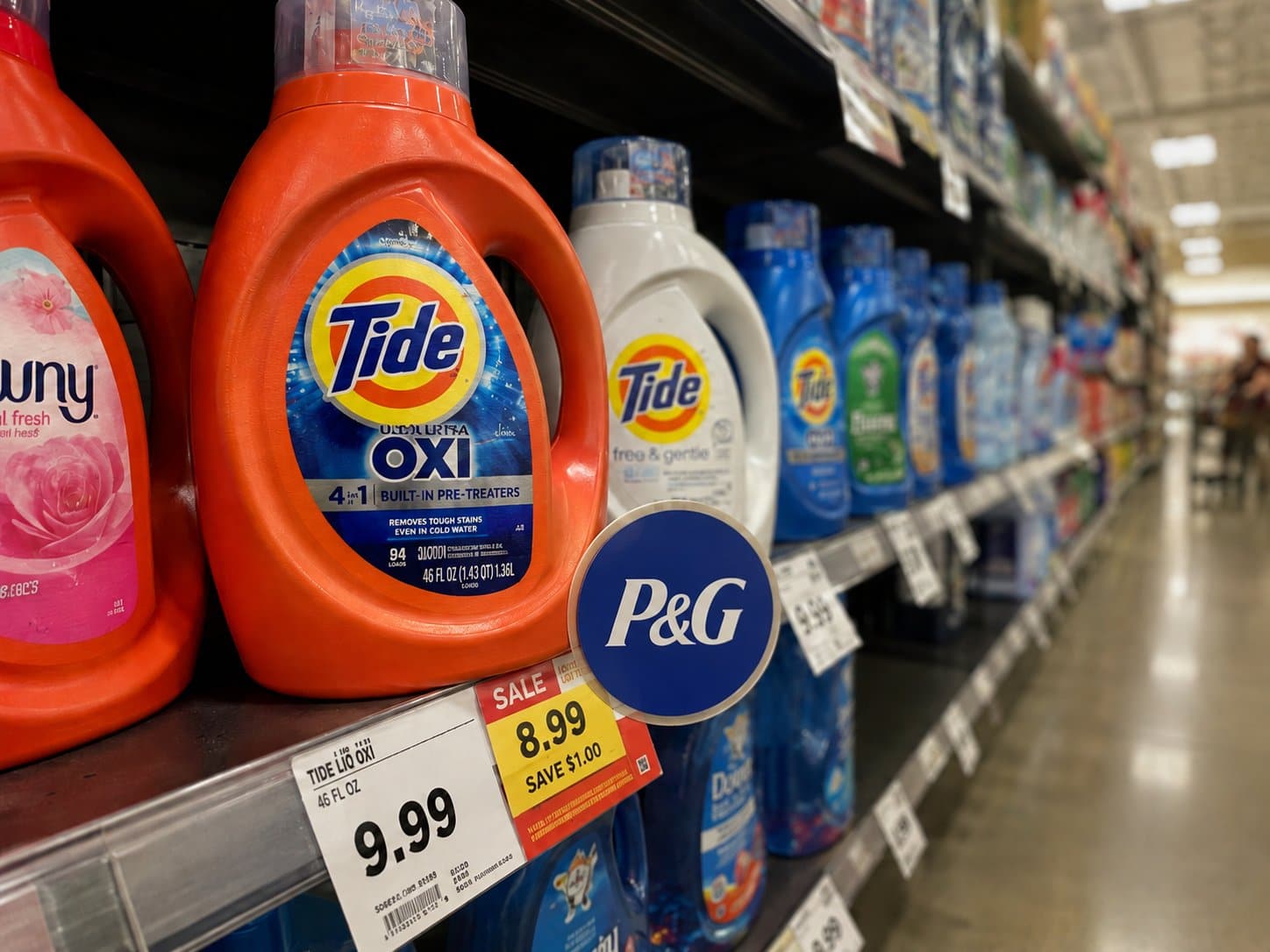
The clearest proof point is domestic. Tide upgraded its original liquid detergent, which covers more than a quarter of Tide users, and held the price. The product moved from declining to high single-digit growth. Chief Executive Shailesh Jejurikar said the result exceeded internal expectations.
Two smaller signals point the same way. Family care grew users for the first time in the most recent period, before its planned interventions launched. And in the United States, the share of top customer and brand combinations holding or growing share rose from under 10% in the first half to roughly 50% in the second.
None of that reached the company total. Focus markets fell 1%. Home care, feminine care, family care and oral care all declined in the quarter.
What the guidance assumes
Fiscal 2027 guidance calls for 1% to 3% organic sales growth and core EPS of $6.89 to $7.11, a midpoint of $7.00. Consensus sits near $7.03 on about 2.8% sales growth, so both midpoints land slightly light.
Peter Grom of UBS drew out what the range embeds. Category growth is assumed at about 2%. Restructuring of brands, product forms and go-to-market arrangements costs 40 to 50 basis points. Reaching 2% organic growth therefore requires about 2.5 points of underlying growth, which requires share gains rather than share stability. The midpoint is not a status-quo outcome.
The cost side is heavier than the headline suggests. External headwinds total about $1.4 billion after tax, or $0.56 per share and 8% of fiscal 2026 core EPS. That breaks into roughly $1 billion of input costs, $150 million of higher net interest, $150 million of lower non-operating income and $50 million of currency.
The composition of the input cost pressure has shifted. The $1 billion estimate is unchanged from last quarter even though the assumed oil price is lower, now $90 Brent. The difference sits in ocean freight, trucking surcharges, supplier inflation and force majeure premiums. The pressure is broadening beyond crude.
Timing concentrates the pain early. Management expects first-quarter EPS down 5% or more, because much of the affected material was produced when oil traded above $100.
One guidance line deserves more attention than it received. Adjusted free cash flow productivity was 133% in the quarter and 100% for the year. Fiscal 2027 is guided to 85% to 90%.
Schulten was explicit about where the uncertainty sits. In his framing it rests entirely on Middle East oil and underlying consumer strength. Execution he treats as controllable.
The reframed burden of proof
The consumer picture is specific rather than uniform. Higher-income households continue buying larger pack sizes. More pressured households buy smaller packs and respond to promotions. Jejurikar described P&G's user base as skewed toward households above $100,000 in income, and characterized the behavior as discernment rather than inability to buy.
That environment is workable. It is not an explanation for a pricing-only growth year.
Four things now have to convert. Consumption has to show up as shipments, which management concedes happens only at three percent growth or better. Share stabilization has to become share gains, since the guidance midpoint already requires them. Productivity has to reach the margin line rather than being fully absorbed. And volume has to contribute to organic growth, which it did not do at all last year.
Accountability is also changing hands. Jon Moeller is retiring after 38 years, and the results of the restructuring will belong to Jejurikar. The November 19 Investor Day is the next scheduled test of whether the interventions have moved from examples to arithmetic.
The turnaround case is coherent, and better supported at the brand level than a flat quarter suggests. What it lacks is conversion. Until pricing stops being the only source of growth, P&G is defending its earnings rather than compounding them.