If the KFC account were simply moving profit from one soda company to the other, the gain should show up in Coca-Cola's stock. It did not hold, which suggests investors priced the news as a verdict on PepsiCo rather than a transfer of business.
When a big customer changes suppliers, one company's loss is usually the other's gain. Thursday's trading in the two soda giants did not follow that script.
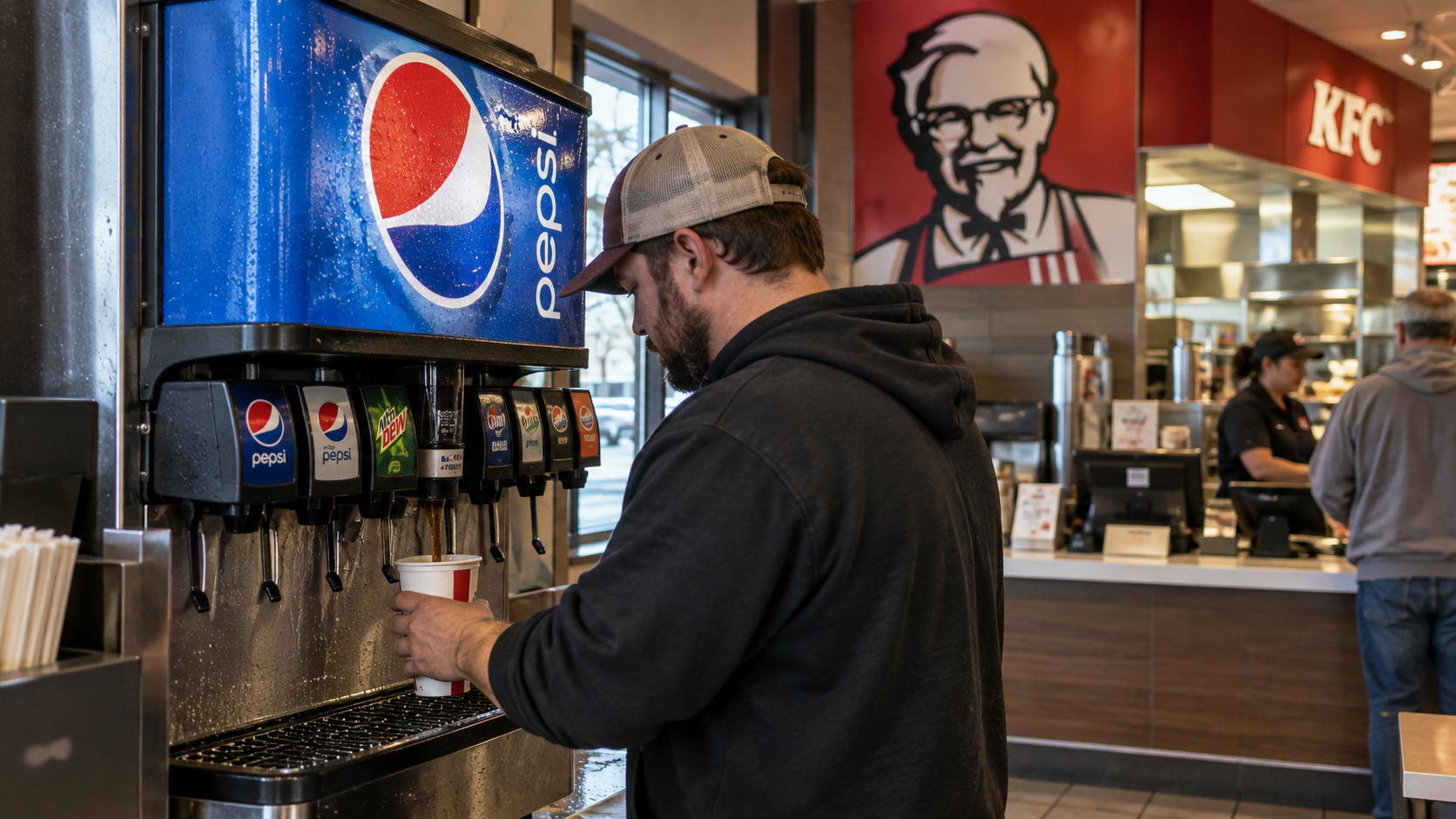
KFC said its U.S. restaurants will start serving Coca-Cola drinks in January 2027, ending a relationship with PepsiCo that dates to PepsiCo's purchase of the chain in 1986. The changeover is expected to reach every U.S. location by spring 2027. None of the three companies involved disclosed what the account is worth.
PepsiCo finished the day down 0.69% at $128.38. Coca-Cola finished up 0.24%. A consumer-staples ETF gained 0.72%, so the company that won the business underperformed its own sector.
The arithmetic of a one-sided reaction
PepsiCo's slide began in the 3:16 p.m. minute, when the first report of the switch appeared, and the low came five minutes later at $127.28. KFC's own announcement followed at 3:33 p.m. Measured from the last quiet minute before the report to the close, PepsiCo shed about $1.6 billion of market value, by this publication's calculation.
Coca-Cola did react, briefly. Its shares rose as much as about 0.5% in the two minutes after the report, on heavy volume, then gave the gain back within minutes and ended the 15-minute period flat. Coca-Cola is worth about 2.26 times as much as PepsiCo, so a $1.6 billion transfer would equal a gain of roughly 0.4%. The stock touched that level and could not hold it.
That asymmetry is the most useful signal in the episode. A reaction that stuck only to the loser points to investors repricing PepsiCo's U.S. beverage business as a whole, not the cash flows of one contract.
Why investors might read it that way
KFC is not just any account. It was a PepsiCo property for about a decade before the restaurant spinoff, and it has poured Pepsi ever since. Losing it lands on top of other questions about the franchise. PepsiCo's chief executive said this month that growth and margin recovery are taking longer than planned.
Why the hit may be smaller than it looks
A PepsiCo spokesperson said the company has just renewed its agreements with KFC's parent, Yum Brands, for Taco Bell, for 10 years, and for KFC's restaurants outside the U.S. The switch has no effect on 2026, since it starts in January. And PepsiCo had already dropped about 2.7% from its morning high before the report appeared, so the full-day loss mixes the KFC news with selling that had no visible cause.
Market implications
One reading is that the market is right to treat this as a symptom. A loss confined to PepsiCo, from a chain with deep historical ties, alongside management's own admission that recovery is taking longer than planned, points to a franchise problem rather than a lost contract.
A second reading is that the reaction overstates the economics. The contract's size is unknown, the rest of the Yum relationship stayed with PepsiCo, nothing changes before January, and part of Thursday's decline predates the news.
What to watch
Whether Coca-Cola sizes the account on its Oct. 27 earnings call, and how PepsiCo trades against staples peers over the next week. If PepsiCo keeps lagging while Coca-Cola stays flat, the market is pricing a franchise question; if PepsiCo recovers, Thursday was a headline trade.