PepsiCo's second-quarter results did not resolve the North America turnaround debate. They sharpened it.
Revenue clearly beat expectations at $24.18 billion, up 6.4%. But EPS was mixed against consensus. Core EPS of $2.20 was a penny below the $2.21 LSEG estimate and a penny above the $2.19 FactSet estimate. CNBC's headline called it a miss. MarketWatch and Barron's called it a beat. That framing divergence tells the story.
Investors looked through the headline number. The concern was that PepsiCo's growth increasingly leans on international strength, FX, acquisitions and below-the-line help, while the core US business remains under pressure from price-sensitive shoppers, weak convenience-store traffic and market-share questions.
The stock fell as much as 4%. That was PepsiCo's biggest single-day drop in 15 months. Shares are now down 4.7% year to date, while Coca-Cola is up 17.7% and the S&P 500 is up 9.7%. Coca-Cola shares also fell 1.4% on the PepsiCo read-across, showing how much this print mattered for the whole category.
The Beat Was Not Really About the US Business
The quality of the beat was mixed.
Reported revenue growth of 6.4% looked much stronger than organic growth of 2.4%. FX and acquisitions did most of the work. Core operating margin contracted 40 basis points. UBS analyst Peter Grom called it a “low quality beat driven primarily by lower interest expense” and said organic sales still fell short of expectations.
Morgan Stanley's Dara Mohsenian added that US topline softness and second-half cost pressures are likely to be offset by international strength and tariff refunds — meaning the earnings story is increasingly held up by things other than domestic operating momentum.
International was the clearest bright spot. International organic revenue rose 7%, with double-digit growth in each region. Global convenient foods volume grew 3% and beverages volume grew 2%. Management called out broad-based share gains and continued strength in developing and emerging markets.
That supports the long-term diversification story. But it also changes the equity debate. Investors are now asking whether international can offset US weakness without PepsiCo becoming a slower-growth, more externally supported staples name.
North America Is the Real Story
Inside North America, the picture was two different problems.
PepsiCo Foods North America, or PFNA, showed signs of stabilization. The segment gained volume share. Household penetration improved. Management said affordability actions helped move US salty snacks back into modest volume growth. That is real progress after several tough quarters.
But PFNA revenue still fell 2%, volume was flat and net pricing was down 2%. Pricing had been down 1% the prior quarter, so the pricing drag is deepening as the company continues its affordability push. Back in February, PepsiCo cut prices on Lay's, Tostitos, Doritos and Cheetos by as much as 15% to try to win shoppers back. Two quarters later, the volume response is still not enough to reverse revenue declines.
That is stabilization, not a clean turnaround.
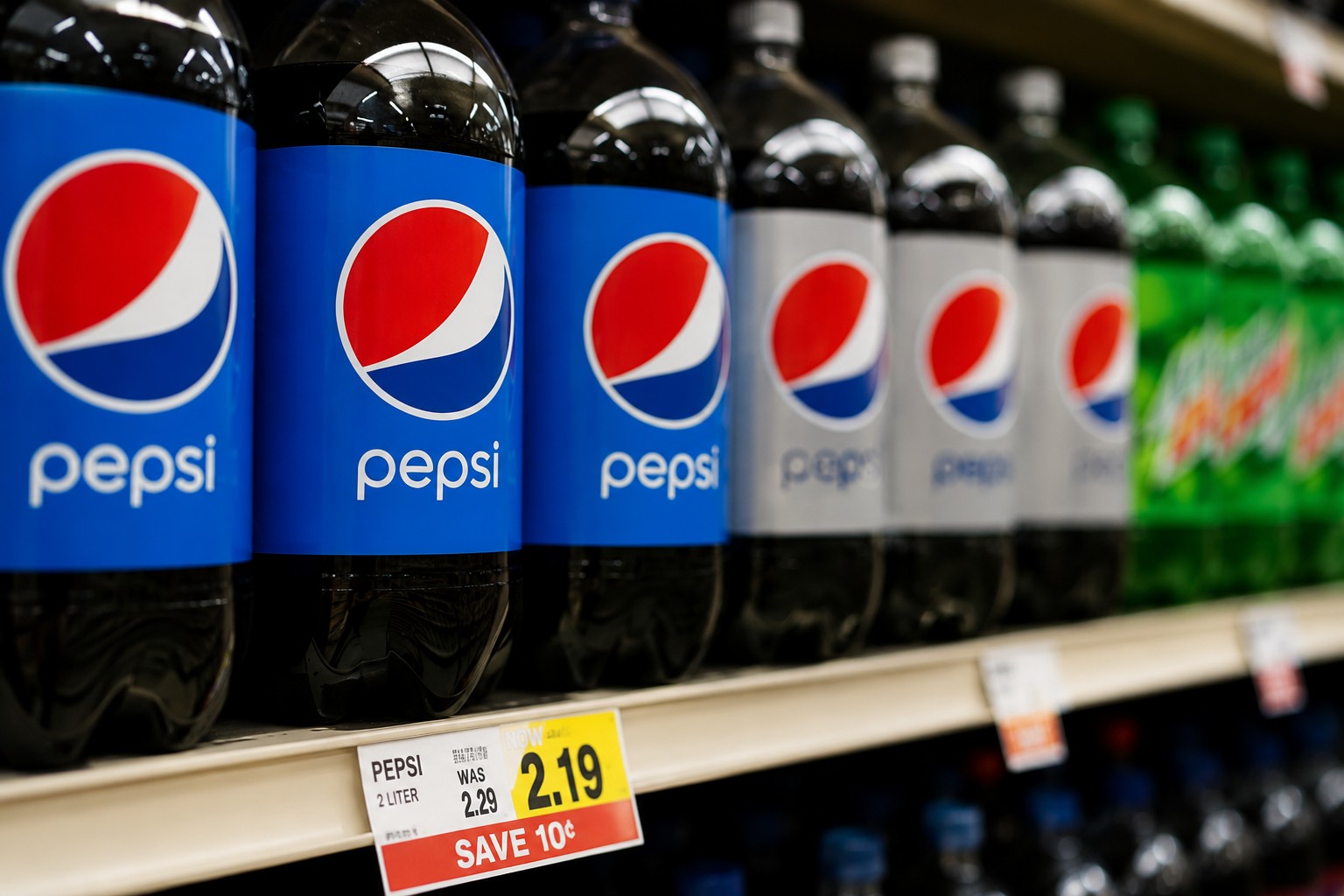
Beverages were worse. PepsiCo Beverages North America, or PBNA, reported net revenue growth of 7%, but that was almost entirely acquisition-driven. Organic revenue rose only 1%. Organic volume fell 4%, extending a streak of quarterly volume declines that goes back to Q3 fiscal 2022.
That is nearly four straight years of negative beverage volume. Pricing also decelerated sharply, dropping from +6% the prior quarter to +3% this quarter.
Management called North America beverages volume “subdued.” The Q&A centered on convenience-store and gas-channel weakness, affordability pressure, and whether the consumer environment or PepsiCo's own execution was the bigger issue.
The Consumer Was Worse Than Expected
Management's explanation leaned cyclical.
During Q2, global oil prices swung dramatically due to the US war with Iran. The US national average gas price hit a four-year high of $4.56 per gallon in late May. That squeezed lower-income households and pulled money away from discretionary snack and beverage purchases, especially at convenience stores and gas stations.
“I think the consumer is worse than what we had anticipated, and it's driven mainly by gas prices,” CEO Ramon Laguarta said on the call.
CFO Steve Schmitt was equally direct. “Our North America business was softer than we anticipated in the second quarter, and we now expect a more gradual improvement in performance trends for the balance of this year,” he said. “We need to see some improvement in the convenience and gas channel, and hopefully we'll get some tailwinds from gas prices to do that.”
That framing puts a lot of weight on gas prices easing in the second half.
The bear case is that this cyclical framing may be masking a structural issue. PBNA has posted volume declines for 15 straight quarters. Snack price cuts have not yet restored full-price demand. Consumers are shifting toward products with less sugar, simpler ingredients and more protein — a category-wide shift that goes beyond gas prices. PFNA's market-share gains are real, but they are coming while total category volume stagnates.
That is why the earnings story looks better than the demand story.
Activist Pressure Has Sharpened the Scrutiny
Elliott Investment Management's activist campaign is now a real part of the debate.
Elliott has been pushing PepsiCo to cut prices on selected products, expand more affordable pack sizes, refresh flagship brands like Lay's and Tostitos, and launch new products such as Doritos Protein. Some of those actions are already in motion. The February price cuts, the ongoing brand restaging efforts on Gatorade and Lay's, and new product work reflect Elliott's playbook.
The company has also been closing plants and eliminating manufacturing lines to offset higher advertising and marketing spending. Q2 operating margin came in at 16.6%, up sharply from 7.9% a year earlier, which reflects both cost actions and lapping charges.
But the activist pressure raises the bar. If demand does not respond to the affordability actions, the case for more aggressive portfolio or capital allocation changes strengthens. PepsiCo now has to prove that its own turnaround plan is working faster than the activist critique can gain traction.
Guidance did not help make that case. PepsiCo reaffirmed full-year organic revenue growth of 2% to 4% and core constant-currency EPS growth of 4% to 6%. But the commentary implied limited visibility rather than upside momentum. North America recovery is now expected to be more gradual. Advertising and marketing spending will rise. Input cost inflation will be higher in the second half. EPS growth is more Q4-weighted.
Reaffirmed guidance without an upside signal, on a mixed EPS print, is not what an already-nervous market was hoping for.
Relief on Margins, Not on Demand
The market fell on a disconnect.
Management still believes the plan is working. The data showed North America demand remains fragile. Snacks are stabilizing but not accelerating. Beverages are still deteriorating. International is strong but is doing more and more of the work.
The quarter modestly strengthened the case that snacks can stabilize through affordability, portion control, permissible products and brand restaging. It weakened the case that the broader North America turnaround is already underway, especially in beverages.
That leaves the investment debate in a different place than it was three months ago.
It is now less about whether PepsiCo can protect margins. It is about whether the company can defend core US franchises without leaning on international growth, below-the-line support and acquisitions to carry the consolidated numbers.
Until PBNA volume declines end and PFNA revenue returns to growth alongside share gains, the market appears willing to give PepsiCo credit for a resilient operating model — but not for a durable US recovery.
The KO comparison captures the setup. Coca-Cola is up nearly 18% this year. PepsiCo is down almost 5%. The market has clearly decided which US beverage story it trusts more. This quarter did not change that.