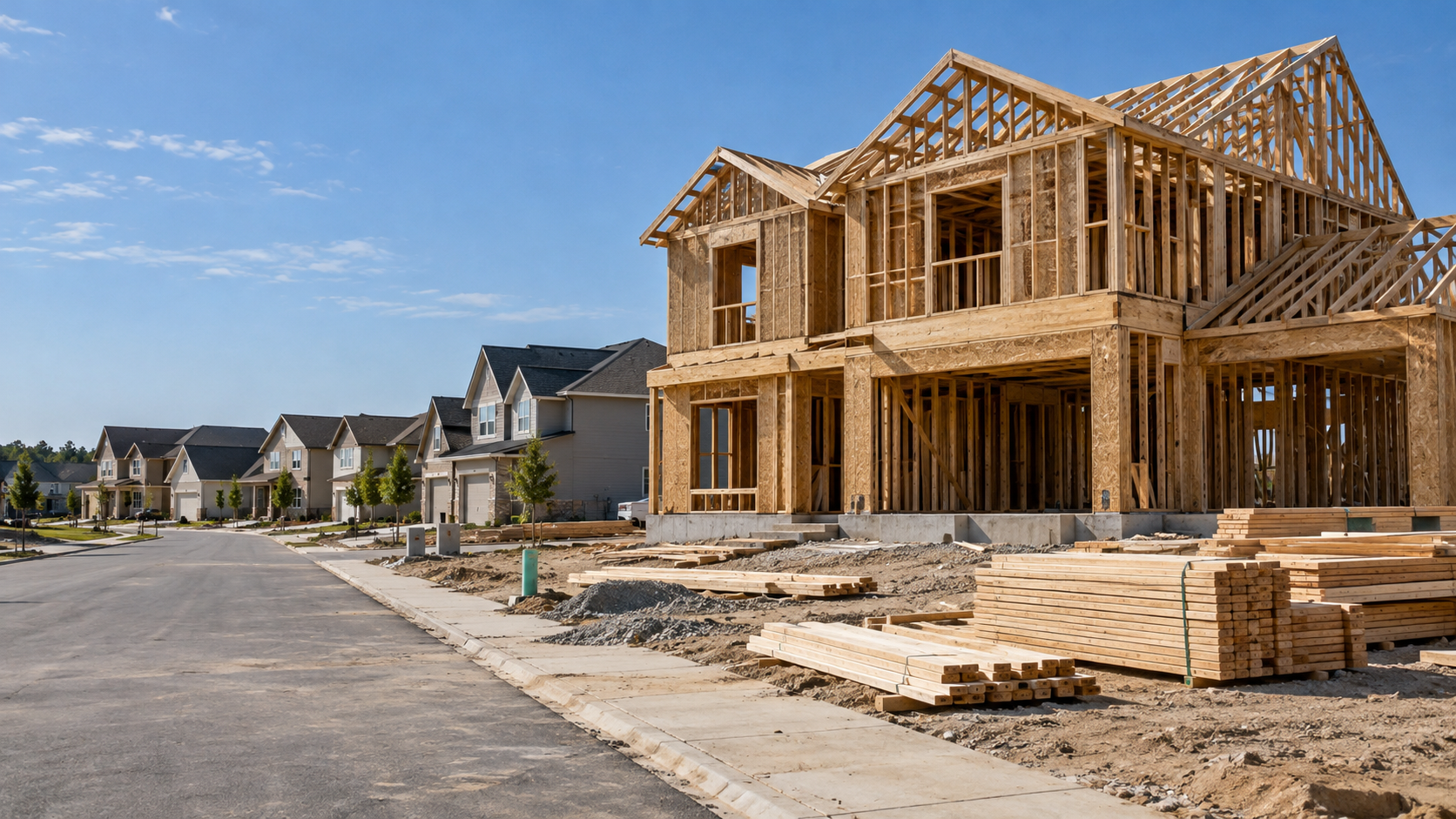
September starts fell to an annual rate of 1.221 million, though the decline sits inside the Census Bureau's own margin of error. Signed contracts on existing homes fell in every region, and builder confidence is at its lowest since 2012. Building permits, the steadier measure, barely moved and came in slightly above forecasts.
Three housing reports in two days told the same story about demand. The stock market drew a different conclusion about the builders.
Privately owned housing starts ran at a seasonally adjusted annual rate of 1.221 million in September, the Census Bureau and the Department of Housing and Urban Development said on Tuesday, 5.2% below August's revised 1.288 million and 7.4% below a year earlier. Forecasters had expected about 1.30 million. Single-family starts fell 4.6% to 859,000.
The National Association of Realtors said pending home sales, which track contracts signed on existing homes, fell 7.3% from August and 11.3% from a year earlier, with declines in all four regions. Forecasts had called for a drop of about 0.5%. "Market conditions weakened in September due to fast-rising mortgage rates," said Lawrence Yun, the group's chief economist.
On Monday, the National Association of Home Builders' confidence index fell three points to 29, its lowest reading since June 2012. Forty-three percent of builders said they cut prices this month, by an average of 6%.
Yet at about 2 p.m. Eastern, the iShares U.S. Home Construction ETF was up 2.4% and the SPDR S&P Homebuilders ETF 1.8%.
Reading the numbers carefully
The starts figure is the headline, and it is also the least reliable of the three. The Census Bureau's 90% confidence interval for the monthly change is plus or minus 11.8 percentage points, so a 5.2% decline cannot be distinguished from no change at all on the agency's own terms. Starts are volatile month to month and are frequently revised.
Permits are steadier, and they tell a calmer story. Building permits ran at 1.400 million, down just 0.2% from August and 3.0% from a year earlier, and slightly above the 1.39 million forecasters expected. Single-family permits did weaken, falling 4.0% to 845,000, and completions were 1.192 million.
The contract data carry the clearest signal. Pending sales lead closed sales by a month or two, and a 7.3% drop in a single month, spread across every region, is far larger than forecasters expected. Taken together with the builder survey, the picture is of buyers stepping back and builders paying to keep them, through price cuts, rather than a collapse in construction.
The rate channel
The Realtors' chief economist tied September's decline to mortgage rates, and the backdrop fits his account. The 10-year Treasury yield closed Monday at 5.15%, and 30-year mortgage rates have been running above 7%; Freddie Mac's weekly survey put the average at 7.40% last week. Higher rates shrink the pool of buyers who can afford a home at a given price, and builder price cuts are one way to keep them.
Builder shares rose as long yields fell. The 10-year yield was trading near 5.12% at about 2 p.m., having touched 5.075% earlier, and the 30-year yield was down nearly 4 basis points. Oil also fell sharply during the session and small-cap stocks rallied broadly, so the builder move cannot be tied to the housing data, or to any single driver. Homebuilders tend to trade on the direction of rates as well as on the current pace of sales, which may explain why a weak data day and a strong stock day coincided.
Market implications
One reading is that housing is now doing the Federal Reserve's work. Contracts, builder sentiment and single-family permits are all weakening under 7% mortgage rates, which is the kind of evidence that policy is already restrictive. On that view, investors buying builders are betting that the rate peak is close.
A second reading is that housing is a casualty of inflation, not a cure for it. The Fed is responding to energy-driven price pressure, economists widely expect a rate increase in December, and one weak sector is unlikely to change that path. On that view, Tuesday's builder rally is a bounce on lower yields that will not survive the next rise in rates.
The permits number is the hinge. As long as permits hold near 1.4 million, builders are still planning to build, and the weakness is in demand at current prices rather than in the industry's pipeline.
What to watch
Mortgage applications and the Mortgage Bankers Association's 30-year contract rate on Wednesday morning; Freddie Mac's weekly rate survey on Thursday; homebuilder earnings commentary on incentives and price cuts; the Fed's decision on Oct. 28; and the October starts and pending-sales reports on Nov. 18. A drop in permits below 1.35 million would show the weakness reaching builders' plans.