

PayPal Holdings had a suitor. It had a price. It had a board that thought both were beneath it. On Friday, all three of those things stopped being true at the same time, and the stock fell 12.71% to close below the number that had just been rejected as inadequate. There is a specific kind of pain that comes from saying no to an offer and then watching the market tell you the offer was probably right. Yahoo felt it in 2008. Is PayPal about to feel it now?
3 Movers in 3 Minutes
- Gap +13%. The Gap Inc. (GAP) had one of the strangest good days in retail this year. Q2 sales came in down 2% year over year and the CEO Richard Dickson himself called the top line "modestly below expectations." What lifted the stock was a $417 million tariff-recovery windfall, a bumped FY26 adjusted EPS range of $2.35 to $2.45, and the naming of ex-Target executive Michael Francis as Old Navy's incoming CEO.
- Domino's +5%. Domino's Pizza (DPZ) snapped back after weeks of drift, with Oppenheimer reaffirming a $415 price target on the same day Baird cut its rating to Neutral. The underlying story hasn't changed: U.S. same-store sales grew just 0.1% in Q2, versus 3.4% a year earlier, and CEO Russell Weiner is still citing consumer-demand pressure across the whole QSR industry. Friday's rally was dip-buyers, not new believers. The name has rewarded that trade twice in 2026 already.
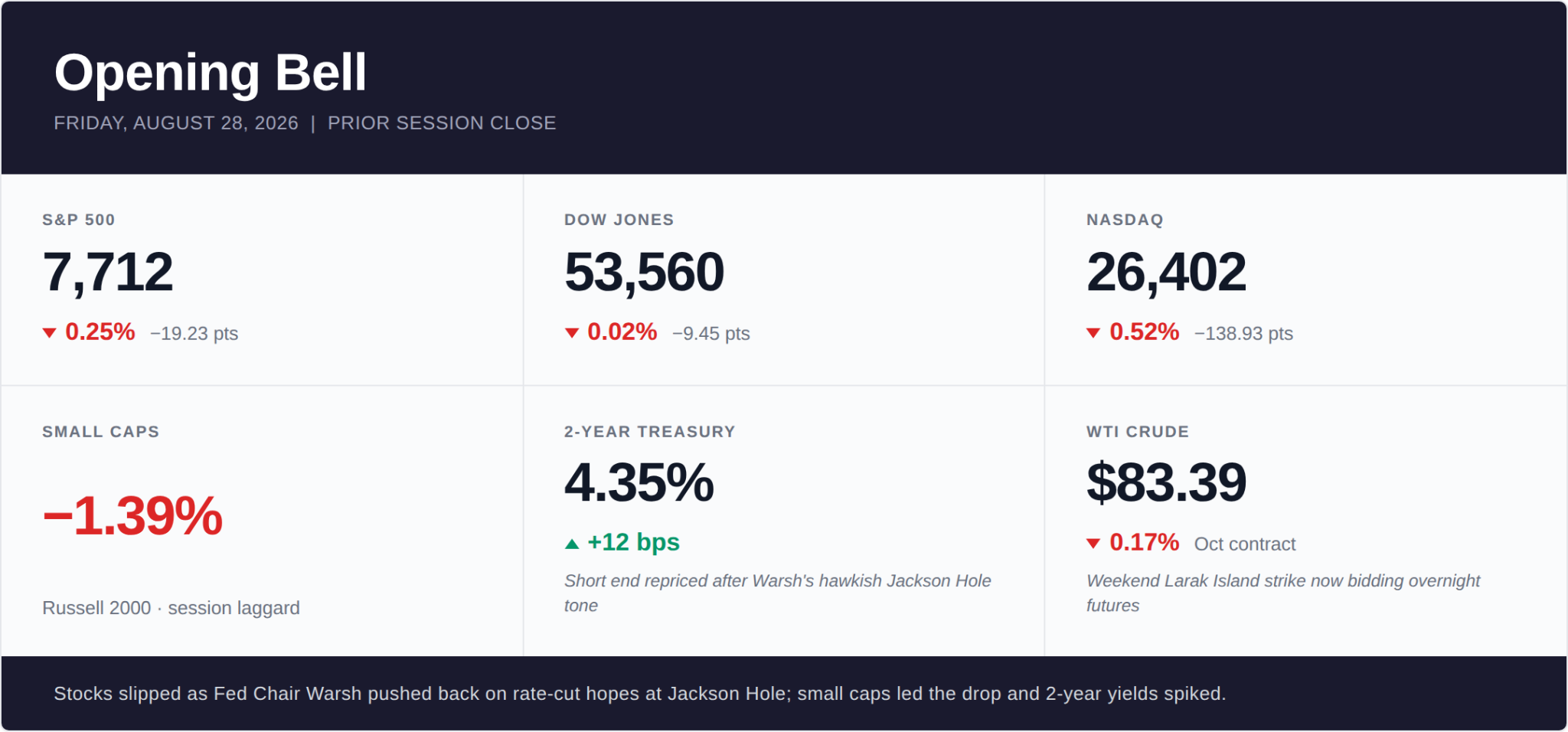
- Amazon +4%. Amazon.com (AMZN) extended Thursday's tech rally into a second session, closing at $266.43 on nearly 48 million shares, roughly $12.8 billion of turnover in one name. AWS pricing commentary and the AI-infrastructure narrative are doing the work. Worth noting: this happened on a red day for the broader tape, with the S&P 500 down 0.25% and the Russell 2000 off 1.39% after Fed Chair Warsh's Jackson Hole remarks pushed the 2-year Treasury yield up 12 basis points.
3 Signals for Today and This Week
Oil open. US forces struck two Iranian rocket launchers on Larak Island in the Strait of Hormuz on Sunday, the first military action in a month. Brent futures jumped 2% in early Asia trade before easing. Iran's IRGC has vowed retaliation. WTI opens the week with an actual bid on it for the first time in weeks.
August jobs report, Friday. The single most important print of the week. Consensus is still forming, but the read that matters is whether Warsh's hawkish Jackson Hole tone gets ratified by another firm labor number or undercut by a soft one. Kalshi now shows 48% odds of a September Fed hike, up from single digits last month. JOLTS Tuesday and ADP Wednesday set the tone.
Palo Alto Networks earnings, Tuesday after the close. Palo Alto Networks (PANW) reports into a cybersecurity tape that just watched CrowdStrike (CRWD) and Fortinet (FTNT) get sold on decent-but-not-spectacular prints. The question isn't whether platform consolidation is happening. It's whether anyone still wants to pay for it at 60 times forward earnings.
For 15 Consecutive Months, Physical Silver Has Been Leaving COMEX Warehouses at Volumes the Exchange Has Never Processed.
December alone: 65 million ounces. A single-month record.
All of 2025: 474 million ounces delivered — against 203 million the year before.
Silver has traded in backwardation. Buyers paying MORE for metal today than for a promise of metal next month.
Backwardation is the fire alarm of commodity markets. It only rings when people stop trusting the promise.
Silver's supply has run a deficit five years straight. The government stockpile that used to backstop it is gone.
The gold story gets the headlines. The silver story might be more violent — because the market is a fraction of the size and the exit door is smaller.
One junior miner is sitting on one of the highest-grade silver veins discovered in the last decade.
And with that out of the way, here's the story worth sitting with today: what actually happens when the only bidder puts down its cards and walks out of the room.
The Sip
Every company has a moment when someone knocks and offers to buy the whole thing. Most of the time, the knock goes unanswered. Sometimes the company opens up and sells. And every so often, the company listens to the number and says no thank you.
Then it spends the next decade trying to remember why.
That's roughly where PayPal Holdings (PYPL) is standing this morning.
The offer that just wasn't enough
On Thursday night, it was reported that Stripe and the private-equity firm Advent International had walked away. The two had been chasing PayPal since April, originally alongside Block (XYZ). Block quietly stepped out. Stripe and Advent stayed in, and in July they put a firm number on the table: $60.50 a share. Roughly $53 billion. Which would have made it one of the largest leveraged buyouts ever attempted.
PayPal's board looked at the offer and decided the number substantially undervalued the company.
On Friday, PayPal's stock closed at $53.6, down 12.71%. Volume ran to 35.9 million shares, roughly 124% above average. The market's verdict took a few hours to arrive. It was not subtle.
The auction of one
Here's the thing nobody puts in the M&A brochures.
Most companies don't get auctioned. They get approached. One buyer. One number. One conversation. If you say no, the second bidder doesn't magically appear from the wings. What appears is your stock price the morning after the news breaks.
Yahoo learned this in February 2008. Microsoft (MSFT) knocked with $44.6 billion, or $31 a share, a 62% premium. Jerry Yang's board decided the offer substantially undervalued the company. Microsoft raised the number briefly, then walked. Yahoo's stock fell to below $12.
Eight years later, Verizon acquired Yahoo's core internet business for $4.48 billion. Roughly a tenth of what Steve Ballmer had put on the table.
There was never a second Microsoft. There is rarely a second anything.
The auction of one is only an auction while the buyer is still in the room.
The rails and the wallet
To see why PayPal's board arrived at "not enough," remember what PayPal used to be.
At the pandemic peak in 2021, PayPal was worth roughly $360 billion. It was the default checkout button of the internet. It owned Venmo, which was quietly doing to peer-to-peer transfers what email had done to letters.
Then two things happened. Pandemic online commerce cooled. And Apple (AAPL) and Alphabet (GOOGL) put payments inside the phone. Once the wallet lives inside the device you already carry, nobody needs a separate wallet.
That's the pattern. In every technology category, the companies that own the rails eventually get squeezed by the companies that own the user. PayPal built the rails. Then the iPhone became the rails. Stripe, invisible on the merchant side, became the plumbing everyone else builds on top of.
PayPal wasn't losing customers. It was losing gravity.
FREE Gold Ticker to Buy ASAP: (NYSE:___)
Jim Rickards – the world’s #1 gold expert – has just revealed one of his favorite gold plays… 100% FREE
As Jim sees it, we’re witnessing the biggest gold boom of the last 100 years – and those who keep their money on the sidelines are missing their chance at a fortune thanks to gold’s epic run.
But smart investors who get in now, could make 10X their money in the coming months.
The turnaround premise
The board's case for saying no rests on a real thesis. Enrique Lores took over in February after Alex Chriss was pushed out for missing plan. Lores has cut costs, raised the 2026 profit outlook, applied to form PayPal Bank, and put weight behind branded checkout upgrades and Venmo monetization.
None of that is fake. Q2 was better than feared.
But there is a gap between "we can run this business better" and "we are worth 40% more than the bid." The board seems to have assumed the public market would show up to close that gap if Stripe and Advent didn't. On Friday, the public market showed up with a bill instead. Mizuho cut its target to $51 from $60. Loop Capital cut too. The house money was suddenly gone.
What Wall Street just repriced
The Friday selloff isn't only about a walked deal. It's the market saying, out loud: without the takeout premium, this business is worth about $46 billion, not $53 billion, and probably not much more than that.
The math isn't complicated. If the most-motivated bidder in the world priced you at $60.50 and then walked, the ceiling of what public shareholders will pay is somewhere below that. Certainly not above it. Not unless the fundamentals bend up quickly and visibly.
Which is the same problem Yahoo had. The turnaround had to be legible in the numbers before the market would re-rate the stock. Marissa Mayer bought Tumblr. Bought a lot of things. Revenue never bent. By the time Verizon came around, there was nobody left to argue with.
The Long Angle
Every board that rejects a bid does the same internal math. They line up the offer against their own DCF, their own view of strategic option value, and they almost always come out ahead. That is the point of being a board. You are supposed to believe in the business more than the market does.
But the walk-away is a data point too. The bidders had the same books, the same models, the same access to Lores. They looked at Venmo, at branded checkout, at PayPal Bank, at four quarters of guidance. And they arrived at $60.50 as the price at which the deal stopped being interesting.
When a private-equity firm and the world's most valuable payments-infrastructure company independently land on "no higher," the public market tends to agree eventually.
PayPal now has to prove the turnaround the old-fashioned way. Quarter by quarter. Without a bid holding the stock up.
The Yahoo comparison isn't exact. PayPal is not sliding into irrelevance the way Yahoo was in 2008. It has a genuine brand, genuine cash flow, and in Venmo an asset that still matters to the generation now aging into higher earning years.
But the shape of the moment rhymes. A management team convinced the company is worth more than any buyer will pay. A market that stayed patient right up until the bid disappeared. And a question in the mirror the board would rather not answer:
If nobody wanted to pay $53 billion... who is going to?
On September 8th, a powerful new law signed by President Trump
will trigger a radical shift in America’s money system...
When a small group of private companies — not the Fed — will perform a major mint of a new kind of money.
And those who act before this new system fully kicks in could see gains as high as 40X by 2032.
But those who fail to prepare will be blindsided by this sea change to the U.S. dollar.
Go here now for the details — before the September 8th mint hits the market.
The MarketSipsTakeaway
Rejected bids are the most expensive lessons in corporate finance because they only teach you anything years later. What Friday showed is that PayPal's next act is now entirely on management: Lores has to convert cost discipline, PayPal Bank, and Venmo monetization into visible revenue growth without the pillow of a takeout premium under the stock. Watch three things in the next two quarters: branded checkout volume acceleration, Venmo's transaction take rate, and any hint about strategic partnerships that reprice the story. If those numbers move, the stock will find its own bid. If they don't, the ghost of Yahoo will get louder.
Until then, sip slowly!
The Market Sip Desk
Reply prompt:Was PayPal's board right to walk away from $60.50, or is this a Yahoo-in-2008 moment?
Tickers: UI MS GAP EPS DPZ QSR AMZN AWS IRGC WTI JOLTS ADP PANW CRWD FTNT COMEX PYPL XYZ MSFT AAPL GOOGL ASAP DCF