

America produces more oil than any country on Earth. And yet, a narrow waterway 7,000 miles from Washington is now the single biggest factor in whether the Fed raises interest rates on September 16. Oil above $90 does not just raise gas prices. It rewrites the inflation math that the Fed uses to make its next move. Somewhere between a Saudi supertanker and a rate-hike probability, there is a story about the limits of independence.
But before we get to that, let's take a quick look at the markets and what matters today...
[Opening Bell widget image]
3 Movers in 3 Minutes
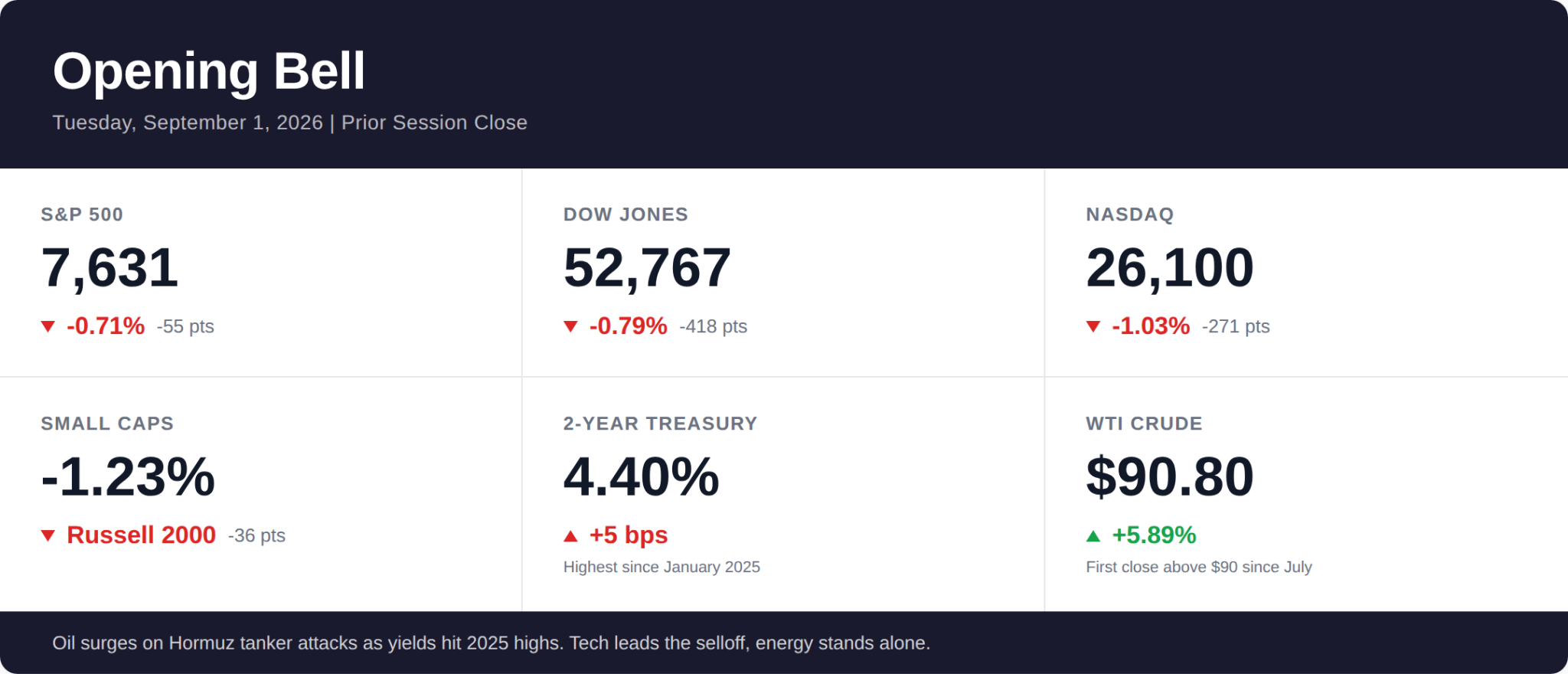
- Oil surges past $90 as tankers take fire. Two supertankers carrying Saudi crude were struck by unidentified projectiles in the Strait of Hormuz late Monday, each loaded with roughly 2 million barrels from Saudi Aramco's Juaymah terminal. WTI crude jumped above $90 for the first time since late July, and Brent rose past $94. The U.S. responded with fresh strikes on IRGC targets inside Iran. Energy stocks rallied broadly, with Chevron (CVX) and EOG Resources (EOG) both climbing on the session while the rest of the market bled.
- Dell crushes Q2, up 9% after hours. Dell Technologies (DELL) reported record revenue of $47 billion, up 58% year over year, and adjusted earnings of $7.04 per share against a consensus of $4.92. AI-related orders hit a record $60.9 billion in the quarter alone, with a backlog topping $95 billion. Dell guided Q3 revenue to $49 billion, implying 81% growth and well above the $41.4 billion Wall Street had penciled in.
- Chip stocks lead the session's losses. The VanEck Semiconductor ETF (SMH) fell more than 2% as rising Treasury yields pressured growth names across the board. Advanced Micro Devices (AMD) dropped 3% and Micron Technology (MU) lost about 2%, with the 10-year yield touching 4.78%, its highest since January 2025.
3 Signals for Today
ADP Employment Report lands this morning with consensus at 48K new private-sector jobs, a reading that will shape expectations ahead of Friday's nonfarm payrolls.
Dell Technologies pre-market trading will test whether the market rewards a 43% earnings beat or flinches at $435-level valuations in a rising-yield environment.
Friday's August nonfarm payrolls report looms as the single most consequential data point before the September 16 FOMC meeting, where rate-hike odds now sit above 65%.
The Market Is Already Looking Beyond the Mag 7
The Magnificent Seven reshaped the market, but leadership rarely stays concentrated forever.
As these giants mature, history shows leadership rotates toward companies with growing cash flows and scalable business models.
Our analysts believe that shift is already underway.
That’s why they created These 7 Stocks Will Be Magnificent in the second half of 2026, a FREE report highlighting the next group positioned to step into market leadership.
And with that out of the way, let's get to today's big story: how $90 oil is rewriting the Fed's September playbook.
The Sip
Twenty-One Miles
There is a waterway between Oman and Iran that is roughly 21 miles wide at its narrowest point. It contains two navigable shipping lanes, each about 2 miles across, separated by a 2-mile buffer zone. On a normal day, about 20 million barrels of oil pass through it. That is one-fifth of everything the world consumes.
The Strait of Hormuz is the most important chokepoint in global energy. And as of Monday night, two supertankers carrying Saudi crude were hit by projectiles while transiting outbound through it. Each vessel was loaded with roughly 2 million barrels from Saudi Aramco's Juaymah terminal, a facility that had only resumed loadings in mid-August after months of conflict-related shutdowns. The U.S. responded with strikes on Iranian Revolutionary Guard Corps positions. Iran then threatened retaliation against American bases and interests across the region.
Oil surged. WTI crude crossed $90 a barrel for the first time since late July. Brent pushed past $94.
And then something more important happened.
The Transmission Mechanism
The Federal Reserve does not set oil prices. But oil prices set the conditions under which the Fed must act. And that is the part most people miss.
When crude rises, it feeds into transportation, food prices, manufacturing inputs, and shipping rates. Those increases show up in the Consumer Price Index within weeks. The July CPI reading came in at 3.4% year over year. Core PCE sat at 3.3%. Both remain well above the 2% target that Fed Chair Kevin Warsh has spent his first 100 days pledging to defend.
"We have work to do," Warsh said at Jackson Hole on August 28, in what markets interpreted as a direct signal that a September rate hike is on the table.
Before that speech, the probability of a 25-basis-point hike at the September 16 meeting was roughly 35%. By Monday evening, CME FedWatch had it at above 60%. After Tuesday's oil spike and the corresponding bond selloff, prediction markets pushed it past 65%.
The 10-year Treasury yield climbed to 4.78%, its highest since January 2025. The 2-year yield touched 4.40%. These are not abstract bond market numbers. They are the prices at which corporations borrow, mortgages are priced, and growth stocks are valued. And they are moving because of a waterway in the Persian Gulf.
Landmark Executive Order 14241 Unleashes
TRUMP’S NEW DOLLAR
Republican or Democrat – whether you support or oppose Trump’s New Dollar – every American could soon be forced to use it

Discover three critical moves to help you prepare, before it’s too late
Independence Is Not Insulation
Here is the part that most readers will find counterintuitive. The United States is the world's largest oil producer. It imports only about 0.5 million barrels per day from the Gulf through Hormuz, a fraction of what it did a decade ago. The shale revolution was supposed to insulate America from exactly this kind of shock.
But oil is priced globally. When 20 million barrels per day face disruption, every barrel on Earth gets repriced, including the ones pumped in Texas and North Dakota. Energy independence means producing enough crude. It does not mean price independence.
Before the 2026 Iran war began in February, oil flows through Hormuz were running at their normal 20 million barrels per day. By March, flows had collapsed to roughly 2.7 million barrels per day, a 90% drop. Prices spiked above $100 per barrel. A U.S.-led naval convoy system and partial reopenings eventually brought flows back to around 6 million barrels per day by August, well below pre-war levels but enough to stop the bleeding.
Then the tanker attacks happened. And the progress unraveled.
The Fed's Dilemma
The labour market is strong. July's unemployment rate sat at 4.1%. The ISM Manufacturing PMI, released Tuesday, showed the eighth consecutive month of expansion at 54.6. Low unemployment and persistent inflation above target is a textbook case for raising rates. Warsh essentially said as much at Jackson Hole. Inflation has been above 2% for 65 consecutive months. At some point, patience stops being a strategy and starts being a concession.
But oil-driven inflation creates a specific kind of trap. Raising rates does not fix supply disruptions in the Persian Gulf. Higher borrowing costs do not reopen shipping lanes. What they do is slow demand across the economy, hitting consumers and businesses already absorbing higher energy costs. The risk is that the Fed tightens into a supply shock, creating the recession it was trying to prevent.
The playbook is familiar. The 1973 embargo produced a decade of stagflation. Iraq's 1990 invasion of Kuwait helped end a presidency. Russia's 2022 invasion of Ukraine forced the fastest hiking cycle in forty years. Every time, the Fed was forced to choose between tolerating inflation and risking a downturn. The Strait of Hormuz is now presenting the same choice.
What $90 Oil Actually Prices
There is a number underneath the number. When traders push WTI past $90, they are not just pricing barrels lost in the Strait. They are pricing the uncertainty about how many more might be lost tomorrow. Insurance premiums for Gulf tankers have risen sharply. Some vessels are switching off transponders to avoid detection. Others are rerouting entirely, adding days to voyage times.
The market is also pricing the absence of a diplomatic off-ramp. A U.S. official told Axios the latest strikes "bought at least a month" of reduced threat. A month is not a resolution. It is a ceasefire measured in ammunition cycles.
And so $90 oil is not just a price. It is a forecast that inflation will remain sticky and that the Fed will have no easy path forward on September 16.
Could the AI Boom End Like the Dot-Com Bubble?
But one market statistic — praised by Warren Buffett as the best measure of valuations — is now flashing a historic warning.
It’s currently higher than it was at the peak of the Dot-Com Bubble.
If the signal proves accurate, the coming AI unwind could shake the entire market.
See the alarming stat — and what investors should do before the next crash unfolds.
The MarketSipsTakeaway
Watch Friday's payrolls number carefully. If August jobs come in strong, Warsh will have every justification to hike. If they come in soft, the decision becomes agonizing: tighten into a slowing economy with oil-driven inflation, or hold and risk letting price expectations become entrenched. Either way, the most consequential variable is not in the BLS data. It is floating through a 21-mile strait that most Americans could not find on a map.
Until then, sip slowly!
The Market Sip Desk
Reply prompt:What is the single biggest risk to markets right now: oil, rates, or something else entirely? Hit reply and tell us.
Tickers: UI MS WTI IRGC CVX EOG DELL SMH AMD MU ADP FOMC CPI PCE CME TRUMP ISM PMI BLS