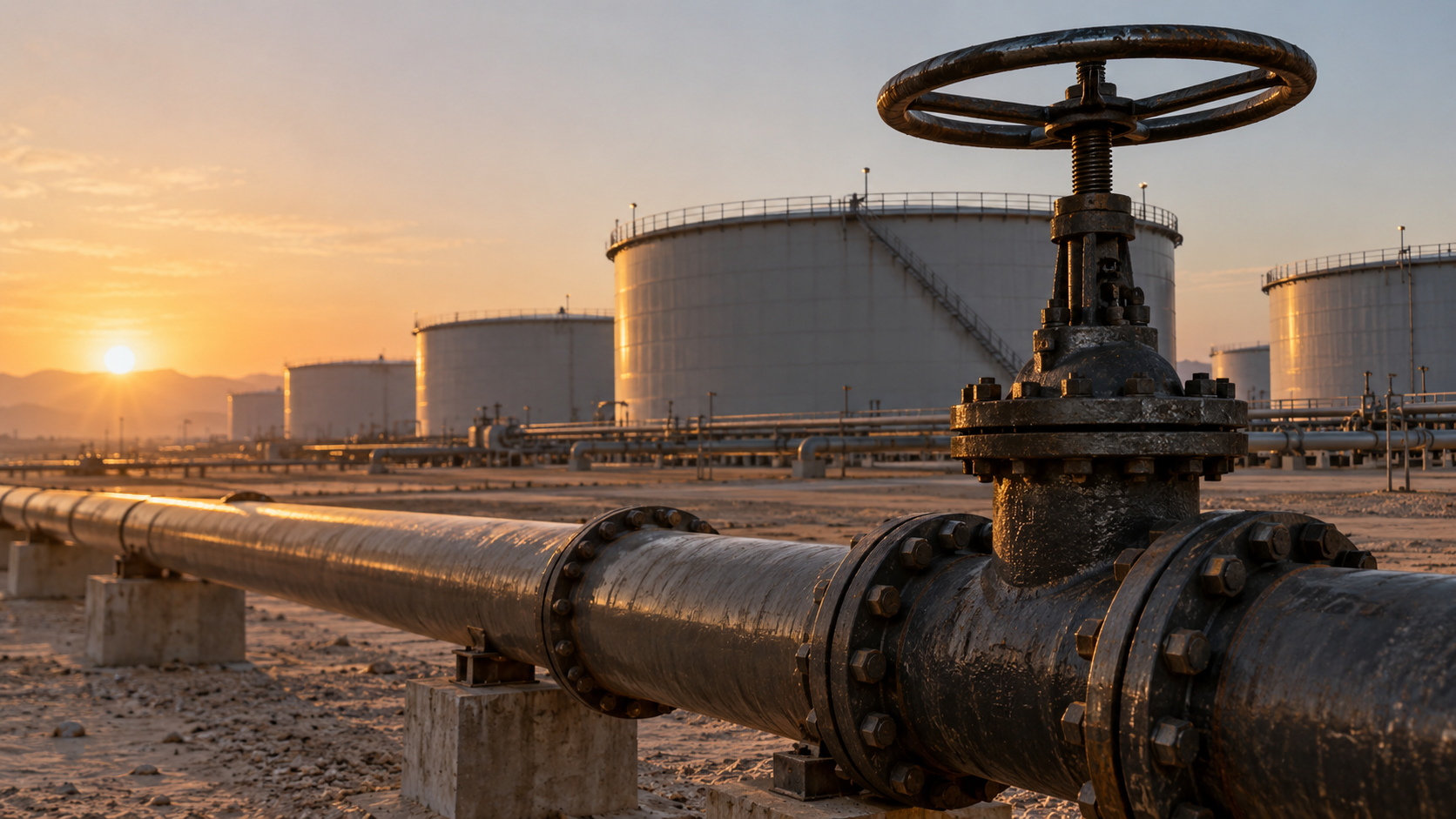
A reported 7.1 million barrel U.S. crude build contradicts the supply-disruption narrative that has driven crude since September 10, and the government's own weekly data lands this morning to settle it.
Crude traded lower in Wednesday's premarket session, with WTI near $104.07 a barrel, down roughly 1.7% from Tuesday's settlement of $105.83, and Brent near $107.78, down about 0.9% from a Tuesday settlement of $108.75. The proximate cause was an industry-survey estimate showing U.S. crude inventories built by 7.1 million barrels in the week ended September 11, against expectations for a draw of roughly 1.6 million barrels.
Tuesday's settlement at $105.83 marked the high of the move that began with the September 10 attack. The overnight decline is the first session in which the supply story has failed to carry the price.
That is a direct contradiction of the story crude has been trading on for six days. Saudi Arabia's East-West pipeline, which moves crude from the kingdom's eastern oil fields to the Red Sea port of Yanbu, remains shut following attacks on the morning of September 10.
What the Saudi statement actually says
The Saudi Press Agency's own account states the pipeline "was subjected to multiple attacks" and "was shut down as a precautionary measure," that the attacks "resulted in a number of injuries" with medical care provided, and that "any further developments will be announced in due course." No attacker has been named and no group has claimed responsibility.
The geography is worth stating precisely because it has been widely blurred. The drones that struck the pumping stations are reported to have originated in Iraq's Maysan province. That is a separate matter from the Houthi advance toward the Bab el-Mandeb strait in Yemen, which involves a different actor operating roughly a thousand miles away. Neither Saudi Arabia nor Iraq has publicly identified suspects, and treating the two threats as one event overstates what is actually established.
Days or months
The reopening timeline is genuinely in dispute, on the record, between named officials. U.S. Energy Secretary Chris Wright has described the outage as "a brief interruption that will last days." Andy Lipow of Lipow Oil Associates has estimated that repairs "could take months." Other accounts have put the outage at five to six weeks. The pipeline normally carries an estimated 2.6 million to 4 million barrels a day.
That range is not a rounding difference. It is the difference between a headline and a structural supply problem, and no party has produced evidence that resolves it.
The resolving data arrives this morning
The Energy Information Administration publishes its own Weekly Petroleum Status Report at roughly 10:30 a.m. Eastern, with full tables after 1:00 p.m. The industry-survey build is a private estimate; the EIA print is the government series that the market treats as authoritative.
If it confirms a build of that magnitude, the argument that crude is pricing a physical shortage weakens considerably and the past week's rally starts to look like a risk premium in search of a shortage. If it contradicts the estimate, the pipeline outage reasserts itself as the dominant driver. Oil volatility, at 61.73 and still rising, suggests the options market is not treating the question as settled.