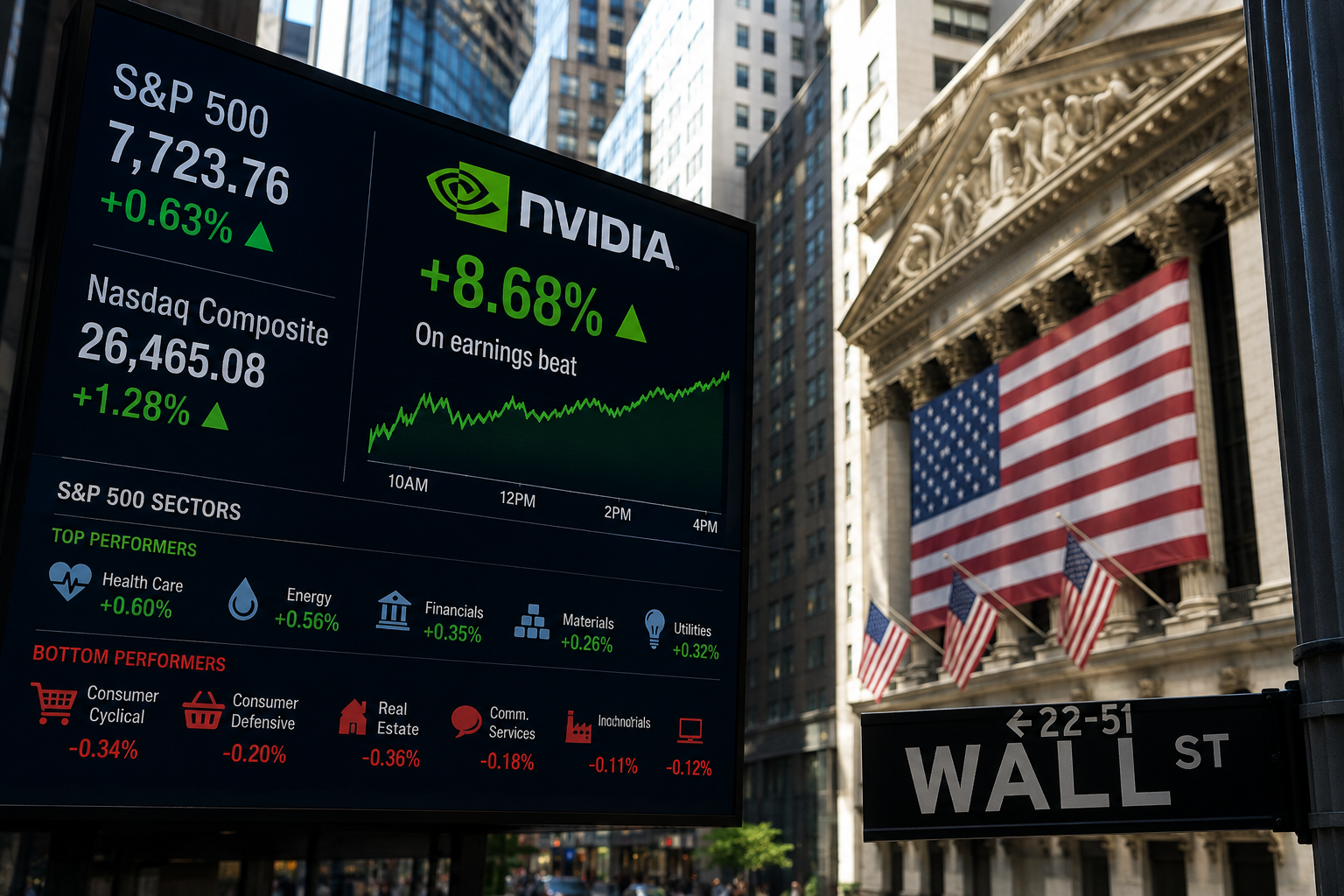
The S&P 500 and Nasdaq closed higher on Nvidia's earnings beat, but the average technology stock finished the day lower, and six of eleven sectors closed in the red.
The S&P 500 closed up 0.63% to 7,723.76 today, and the Nasdaq Composite rose 1.28% to 26,465.08, both lifted by Nvidia's earnings beat. Nvidia itself gained 8.68% intraday. Taiwan Semiconductor rose 2.32% and Broadcom rose 3.32%, both moving with Nvidia's result. AMD fell 1.88%, Micron fell 2.64%, Arm slipped 0.04%, and Marvell slipped 0.18%, all in the same session, all in the same sector, all moving the opposite direction.
The gap shows up clearly in the sector data. The average technology-sector stock was actually down 0.12% on the day, even as the two indexes most associated with tech, the S&P and the Nasdaq, both posted solid gains. Only five of eleven sectors finished positive: healthcare rose 0.60%, energy 0.56%, financials 0.35%, basic materials 0.26%, and utilities 0.32%. Consumer cyclical, consumer defensive, real estate, and communication services all finished negative.
The index gains were heavily concentrated in Nvidia and a small group of beneficiaries, while the average technology stock finished lower. Most investor capital sits in cap-weighted funds, so a genuine, single-name-driven earnings beat producing a genuine index gain is not necessarily a distortion; it is how cap weighting works. It is also a concentration signal: the market's advance rested on a narrowing base of stocks rather than a broadening one.
The VIX closed at 14.64, down 3.75% on the day and near its 2026 lows. Options traders, at least, are not treating the narrow breadth as a fragility signal today.
The numbers are what they are: a 0.63% S&P gain and a 1.28% Nasdaq gain, both built overwhelmingly on the session's best-performing stock, alongside four negative sectors and a technology sector that, on average, lost ground the same day its most prominent constituent rallied nearly nine percent.