

Somewhere in Pike County, Ohio, on a patch of federal land once used to enrich uranium for Cold War warheads, a building is being drawn up to house the largest single artificial intelligence campus on Earth. It will run on Nvidia chips. It will be leased by OpenAI. It will be built by SoftBank. And if OpenAI can't pay the rent, Nvidia has quietly agreed to write a check for up to $105 billion. When the chipmaker underwrites its own customer's landlord, you're either watching the birth of new infrastructure or the top of a market. Which is it?
But before we get to that, let's take a quick look on the markets and what matters today…
3 Movers in 3 Minutes
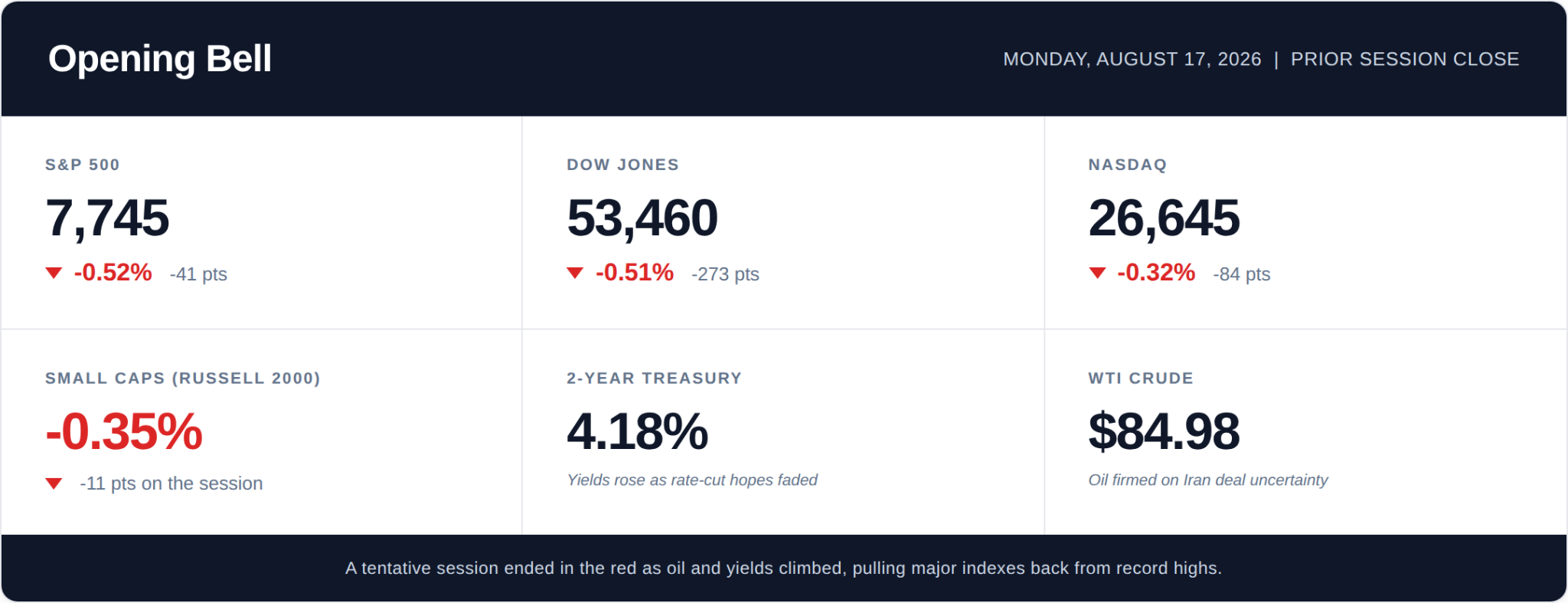
1. Meta braces for Big Tobacco moment. Meta Platforms (META) dropped 3.5% on Monday as investors priced in the trial that begins today in California, brought by 29 state attorneys general who accuse the company of designing Facebook and Instagram to addict minors. Meta itself has conceded potential damages could reach $1.4 trillion. The states' own estimate is closer to $200 billion. Either number would be the largest platform liability ever tested in a US court.
2. SanDisk gets its "AI infrastructure" re-rating. SanDisk Corporation (SNDK) jumped 9.2% Monday after JPMorgan (JPM) restarted coverage with an Overweight rating and a $2,250 price target, closing a five-day rally of roughly 35%. The Street is quietly reframing a historically cyclical NAND maker as a durable AI storage supplier, and pricing it accordingly.
3. Oil keeps rising, and rate-cut hopes keep dying. West Texas Intermediate closed near $85 after President Trump ruled out extending the expiring US-Iran interim agreement and fresh fighting broke out in Lebanon. Brent crossed $90. The 30-year Treasury yield hit its highest level since 2007.
3 Signals for Today
1. Home Depot (HD) reports before the open. The Street expects $4.71 EPS on $47 billion in revenue, but the tell will be pro-contractor demand versus DIY, and whether the interim leadership team can reaffirm full-year guidance after CEO Ted Decker's sudden medical leave last week.
2. July Housing Starts and Building Permits at 8:30 AM ET. Consensus looks for a modest pullback from June's surprisingly hot 1.43 million annualized starts. With the 30-year mortgage rate tracking the 30-year Treasury back toward multi-decade highs, this is the first read on whether the summer building bounce was real or a rate-window mirage.
3. Palo Alto Networks (PANW) reports after the close. The pure-play cybersecurity bellwether kicks off a mini earnings cluster (Analog Devices, Baidu, Estée Lauder later this week) that will test whether enterprise IT budgets are still expanding or beginning to feel the crowding-out effect from AI capex.
The 7 Stocks Built to Outlast the Market
Some stocks are built for a quarter… others for a lifetime.
Our 7 Stocks to Buy and Hold Forever report reveals companies with the strength to deliver year after year - through recessions, rate hikes, and even the next crash.
One is a tech leader with a 15% payout ratio - leaving decades of room for dividend growth.
Another is a utility that’s paid every quarter for 96 years straight.
And that’s not all - we’ve included 5 more companies that treat payouts as high priority.
These are the stocks that anchor portfolios and keep paying.
This is your chance to see all 7 names and tickers - from a consumer staples powerhouse with 20 years of outperformance to a healthcare leader with 61 years of payout hikes.
The report is free for a limited time - go here to get it now.
And with that out of the way, let's get to today's big story: the deal that quietly turned Nvidia into a bank.
The Sip
An unusual guarantee
On Monday, buried in an SEC 8-K filing, Nvidia disclosed that it had agreed to guarantee up to $105 billion in lease and power payments for OpenAI's newest data center. The site sits in Pike County, Ohio, on federal land that was once part of the Portsmouth Gaseous Diffusion Plant, where uranium was enriched for American nuclear weapons.
The building will be owned by SB Energy, a SoftBank subsidiary. OpenAI will pay the rent under a 20-year lease. And Nvidia, the chip supplier, will act as the financial backstop if OpenAI ever falls short.
If you had to design a diagram that captures how deeply the AI economy has folded in on itself, this would be it. The chipmaker guarantees the customer's rent, so the customer can lease the building, so the building can house the chips, so the chipmaker can book the sale.
The number that isn't what it looks like
$105 billion is a headline that does a lot of work. It sounds like Nvidia has written a check. It hasn't. The figure is a conditional ceiling on the first 4.25 gigawatts of compute at the site, and only comes due if OpenAI defaults on rent or power obligations.
But the number matters even when the money doesn't move. Because the guarantee is what makes the project financeable. SB Energy needs debt to build. Debt needs someone with a balance sheet to back the future cash flows. OpenAI is still a private company burning tens of billions a year on model training. Its credit rating is, being generous, aspirational. Someone had to make the paper investable.
That someone is Nvidia. The number was originally reported as high as $250 billion, then cut to below $120 billion, before landing at Monday's $105 billion. That range tells you how much Nvidia is willing to sign for, and how carefully the risk is being partitioned by the lawyers.
Where you've seen this before
This is not the first time a supplier has financed the buyer of its own product. It's a well-worn pattern, and the reruns don't always end well.
In the late 1990s, Cisco Systems, Lucent, and Nortel extended vendor financing to telecom customers so they could buy the switches and routers to build out the internet. But when the dot-com bubble burst, those receivables went bad in cascades. Nortel eventually collapsed. Lucent nearly did.
Every time this pattern shows up, the argument for it is identical: demand is real, customers are constrained only by financing, and the supplier has a unique window into the buyer's credit. Every time, that argument turns out to be partially true and partially the kind of story you tell yourself when the growth is too good to walk away from.
Nvidia's balance sheet is genuinely different. It generates more free cash flow in a single quarter than most of its historical peers made in a decade. It can absorb this. And whether it should is a separate question.
The circular economy of AI
Here's what makes this specific deal unusual, and worth reading carefully.
Nvidia is not just guaranteeing OpenAI's rent. It is also investing $1.5 billion in SB Energy, the landlord. OpenAI's Sam Altman was an early personal investor in SB Energy. SoftBank owns SB Energy and is also a major OpenAI backer through its Vision Fund. Nvidia has a stake in OpenAI. OpenAI is Nvidia's largest customer.
Which means, on the Ohio site alone, Nvidia is effectively:
- selling chips to OpenAI (revenue),
- owning a slice of OpenAI (equity upside),
- owning a slice of the landlord (equity upside),
- guaranteeing the rent OpenAI pays to that landlord (contingent liability),
- and locking in exclusive supply to the site for multiple chip generations.
Each relationship is legitimate. Together, they form a loop where the same dollar can be counted as demand, investment, revenue, and collateral, depending on which slide of which pitch deck you're looking at.
Last week, Nvidia partnered with BlackRock and five other institutions to launch platforms targeting more than $500 billion in third-party AI infrastructure funding. Monday's deal is not an outlier. It's a template.
15X Bigger Than SpaceX: Elon's New Launch

While the rest of the market goes crazy for "the mother of all IPOs", a new Elon Musk innovation is quietly being rolled out nationwide. It's been 27 years in the making, and it could have a radical impact on how millions of people manage their money… and even collect Social Security. Here's everything you need to know.
This ad is sent on behalf of InvestorPlace Media at 1125 N. Charles Street, Baltimore, Maryland 21201. If you're not interested in this opportunity, pleaseclick here.
What Nvidia actually bought
Strip away the loop and one thing becomes very clear about what Nvidia is doing. It is not just selling chips anymore. It is quietly buying the physical real estate of the AI age.
Jensen Huang described the Ohio structure on X as a "land, power and shell" deal. Translation: Nvidia gets to lock up prime sites where its chips can run for multiple generations. The site will pull 10 gigawatts of new power generation, funded in part by Japan under a 2025 trade deal. That is enough electricity to run more than seven million American homes.
Sites like these are not fungible. There are only so many places in the country where you can co-locate 10 gigawatts of power, cooling water, fiber, land, permitting, and political goodwill. Nvidia has decided that owning first-refusal rights to those sites is worth $105 billion in contingent risk. In a world where compute is the new oil, this is the equivalent of leasing every good drilling patch in the Permian Basin.
The chip company is behaving like an infrastructure sovereign.
The signal for the rest of the market
The reason this deal matters to the average investor isn't the number. It's the message.
Nvidia is telling the market that AI demand is now so central to its future that it will backstop its own customer's balance sheet to keep the flywheel turning. That is either extraordinary conviction or extraordinary exposure. Probably both.
For everyone else, the read is simpler. When suppliers start guaranteeing customers, one of two things is happening: you are at the beginning of an infrastructure era so obviously durable that supplier financing is a rounding error, or you are watching the last mile of a boom, where the only way to keep the numbers growing is to lend the growth into existence.
The honest answer is that we won't know for years. But the pattern is old enough that it should be watched, not ignored.
Louis: The "Strawberry Problem" Is Stalling the AI Revolution
Billion-dollar tech investor Louis Navellier calls it "AI's darkest secret." Until AI models solve the "Strawberry Problem," they'll never create new breakthroughs in medicine, energy, or quantum computing. The good news? One company is about to solve the crisis… unleashing a new $100 trillion opportunity.
This ad is sent on behalf of InvestorPlace Media at 1125 N. Charles Street, Baltimore, Maryland 21201. If you're not interested in this opportunity, pleaseclick here.
The MarketSipsTakeaway
Watch the shape of AI deals, not the size. When money starts moving in circles, from supplier to customer to landlord and back, reported demand and actual demand begin to diverge.
The single most useful metric for the next twelve months will not be Nvidia's revenue. It will be the credit quality of its customers.
Today's reply prompt: When a supplier guarantees its customer's rent, what does that tell you about the customer?