

Everyone will lead with the beat. The guide. The 2 million GPU AWS deal. Fine. But somewhere on page four of Nvidia's script, its CFO said something that reprices half the S&P 500 if it turns out to be true. The market barely noticed. We think that's the whole story.
But before we get to that, let's take a quick look at the markets and what matters…
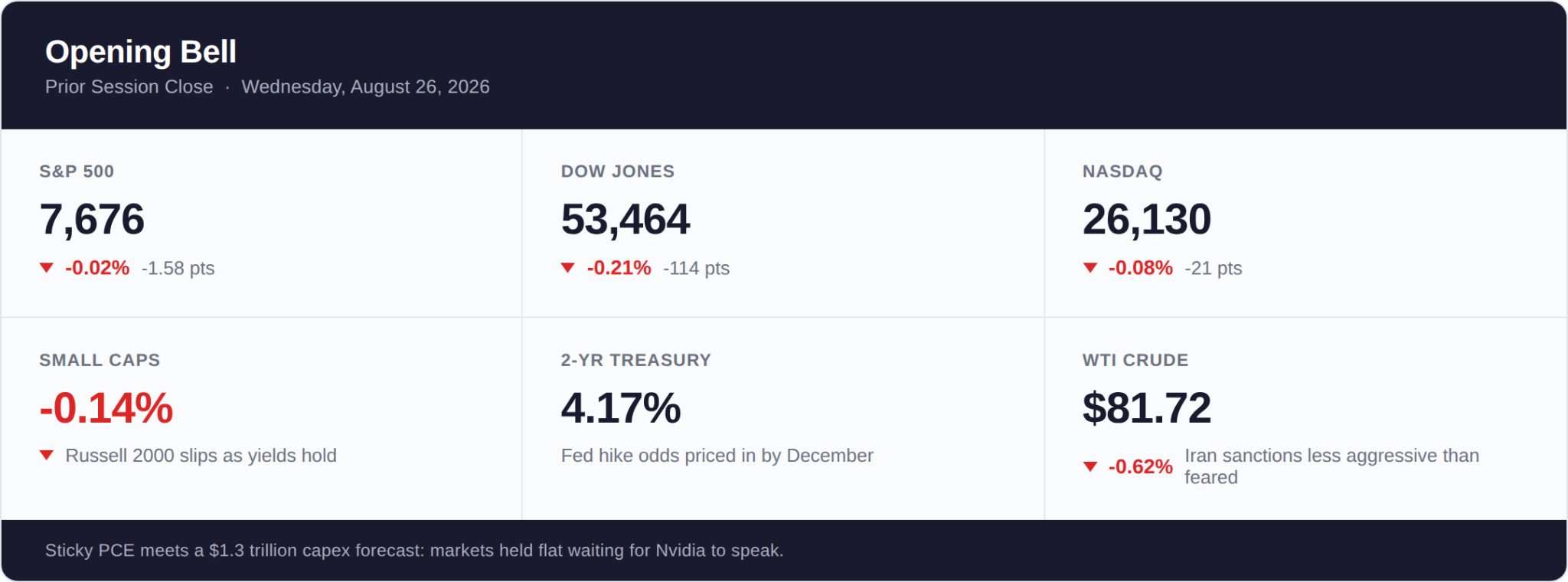
3 Movers in 3 Minutes
1. Nvidia beats. NVIDIA Corporation (NVDA) reported Q2 revenue of $96.2 billion, up 106% year over year, with adjusted EPS of $2.22 against a $2.10 consensus, and guided Q3 to $108 billion versus the $104.2 billion the Street penciled in. Shares climbed roughly 5% in after-hours trading after CFO Colette Kress said fiscal 2028 revenue growth would come in around 70% and, almost as an aside, pegged 2027 hyperscaler capex at $1.3 trillion, up from $800 billion this year. More on that below.
2. Meta writes a check to make the trial go away. Meta Platforms (META) settled a landmark trial brought by 29 states for up to $16.68 billion over allegations that Facebook and Instagram were engineered to hook teenagers. The company also agreed to daily use limits and nighttime blocks for teen accounts, along with a decade of independent auditing. Meta said it will accrue a $10 billion legal expense in Q3. California AG Rob Bonta had warned the courtroom risk topped $1 trillion. Shares finished up 1% on the day.
3. PCE reprices the whole rate trade. July core personal consumption expenditures rose 0.2% month over month and 3.3% year over year, matching consensus, while headline PCE hit 3.7% annualized against a 3.6% forecast. That may sound benign. It isn't. Fed funds futures now fully price in a quarter-point hike by December and give better than 60% odds to a second hike by mid-2027, with total US public debt now above $40 trillion for the first time. The 2-year Treasury closed near 4.17%. The rate trade is being rebuilt in real time.
3 Signals for Today
Weekly initial jobless claims. With a Fed hike now the base case, any softening on the labor side becomes a Warsh-defining data point 24 hours before his Jackson Hole keynote.
Jackson Hole kicks off (August 27 to 29). Fed Chair Kevin Warsh delivers his first keynote as chair Friday morning, and the theme this year is "Financial Stability." That is not an accident. Everyone in Kansas City will be reading the same two-year yield we are.
Marvell Technology (MRVL) reports after the close. Alongside Ulta Beauty (ULTA), Autodesk (ADSK), Workday (WDAY), Best Buy (BBY), Dollar General (DG), and Dollar Tree (DLTR). Marvell is the tell: it sells the custom silicon that hyperscalers are increasingly using to reduce their dependence on Nvidia. If its guidance moves in the same direction as Nvidia's, the capex story is real. If it diverges, that's the first crack.

The $16 Trillion Rare Earth Discovery
The Guardian calls it "the beginning of the biggest gold rush in history"... and one stock under $5 owns exclusive rights to harvest these rare earths.
Elon Musk and his companies need these minerals before a January 1 Pentagon deadline.
And with that out of the way, here's the number worth remembering.
The Sip
The line that mattered
Nvidia's earnings were fine. That's the boring truth. Revenue of $96.2 billion, up 106% year over year. Q3 guidance of $108 billion. A gross margin of 75%. A $26 billion return of capital in a single quarter. Every headline you'll read this morning is some version of the same story: the AI trade is still working, Jensen delivered, buy the dip.
But that isn't what actually moved the stock in after-hours.
About fifteen minutes into her prepared remarks, Colette Kress said this: "With cloud industry backlog now greater than $2 trillion, CapEx by the top 5 hyperscalers is expected to reach nearly $800 billion in 2026 and $1.3 trillion in 2027."
Read that sentence again slowly. The five largest cloud companies on Earth are collectively projected to spend $1.3 trillion on infrastructure in a single calendar year. That is 62% higher than the number they're already spending, which is itself the largest capex cycle any five companies in history have ever coordinated on.
For context: $1.3 trillion is roughly the GDP of Mexico. It is more than global oil and gas exploration capex at the 2014 peak. It is close to one-third of all US business fixed investment. Five companies. One year.
The parallel nobody wants to draw
Between 2011 and 2014, US oil and gas companies committed roughly $200 billion a year in upstream capex, betting that shale economics and $90-plus crude would justify the debt they were taking on. The math was beautiful right up until the moment it wasn't. When oil broke in late 2014, roughly 200-plus North American E&P and oilfield-services companies filed bankruptcy over the following six years. The rigs didn't disappear. The wells didn't disappear. Only the equity did.
The AI capex cycle rhymes structurally but on a scale several multiples larger. And the assets being purchased, unlike wells, depreciate on a three-to-four year cycle into a market where Chinese labs are commoditizing the underlying models every few months.
The question is not whether $1.3 trillion gets spent. It probably does. The question is who's still standing at the other end.
What Nvidia's own numbers hinted at
Look inside Nvidia's release and the tension is already there. Days sales outstanding stretched to 60 days. Kress attributed this to "extended payment terms for large purchases by certain investment-grade customers to be shipped over multiple quarters." Translation: even the hyperscalers, sitting on cash mountains, are asking Nvidia to finance them.
Meanwhile, Nvidia's own supply commitments more than doubled from $119 billion last quarter to $279 billion this one, primarily to lock in memory before the AI capex frenzy exhausts supply. Gross margins are guiding down from 75% toward 71 to 72% by the fourth quarter. The story of AI infrastructure is getting more expensive to build, not less.
The circular financing is already visible in the deals announced this year. Nvidia takes an equity stake in OpenAI. Oracle finances customers that turn around and buy Oracle capacity. Meta co-invests in neoclouds. Amazon commits to buying 2 million more GPUs while Nvidia commits to buying AWS services. Money is doing loops the way it did in the late 1990s, when Cisco Systems (CSCO) and Lucent Technologies vendor-financed the carriers that bought their switches. By early 2001, Cisco was carrying more than $2.5 billion in customer receivables it would never collect. Lucent booked $7 billion in vendor-financed sales that turned into a $16 billion writedown. The equipment worked. The customers didn't.
None of this means Nvidia is Lucent. Nvidia's margins, market share, and technological moat are all in a different universe. But the mechanical setup, where the seller finances the buyer's ability to pay in a market growing faster than either can sustain, is a pattern the market has seen before and struggled to price accurately in real time.
Watch for the first blink
Here's what history teaches. Every capex supercycle from telecom to shale to solar has an inflection point that arrives before the demand assumption breaks publicly. Someone always blinks first. In shale it was Chesapeake trimming its 2015 capex in October 2014. In telecom it was WorldCom.
For AI, the equivalent will be the first hyperscaler that guides capex down. Not flat. Down. Amazon, Microsoft, Alphabet, Meta, Oracle. Any one of them signaling "moderating investment cadence" on a Thursday earnings call would end this trade before the sell-side has finished its Q3 previews.
For now, none of them is close. Amazon just committed to another 2 million GPUs. Microsoft, Alphabet, and Meta are all guiding capex meaningfully higher into 2027. Kress said the demand outlook is supply-constrained. Nvidia's backlog just crossed $2 trillion.
But this is exactly the setup where turning points get made. Everyone is committed. Everyone believes the demand curve holds. Everyone is racing to lock in supply. The trade works right up until it doesn't, and by the time it stops working, most of the capex is already ordered.
The Nvidia print wasn't the story. The $1.3 trillion aside was.
Why are companies flying spy planes over Elon's closely-guarded AI lab?
Elon did the seemingly impossible – far faster than anyone expected...
And it's sent the tech industry into PANIC MODE.
ChatGPT, Claude, Google Gemini, and DeepSeek could soon become obsolete.
And three little-known firms could soar 10X or higher as a result.
The MarketSipsTakeaway
Watch the hyperscalers, not Nvidia. The next Nvidia earnings print will move the tape for a day. The first hyperscaler capex revision will move it for a year. Amazon reports Q3 in late October. Microsoft, Alphabet, and Meta follow within a week. If any one of them takes 2027 capex guidance down, or even holds it flat when the Street expects a raise, that is the signal. Everything else is noise dressed up as news.
Middle East Conflict Lights Fuse on US Debt Bomb
America was already drowning in $38 trillion of debt, but the recent conflict in the Middle East just accelerated the timeline.
As oil spikes, a 100-year-old stock market signal that accurately predicted the 2008 and 2020 crashes is flashing a massive "Sell" on dozens of popular U.S. equities.
If you hold the wrong stocks when this debt crisis hits, it could wipe out years of gains.
Click here to see the 10 popular stocks to dump immediately
11780 US Highway 1, Palm Beach Gardens, FL 33408-3080 Would you like to edit your e-mail notification preferences or unsubscribe from our mailing list? Copyright © 2026 Weiss Ratings. All rights reserved.
Until then, sip slowly!
The Market Sip Desk
Reply prompt: Which hyperscaler do you think blinks first on 2027 AI capex, and what's the tell you're watching for?
Tickers: UI MS GPU AWS NVDA EPS META AG PCE MRVL ULTA ADSK WDAY BBY DG DLTR CSCO PANIC MODE FL