

Between November 2021 and today, Nike has lost over $200 billion in market capitalisation. Not because the shoes got worse. Not because a recession hit. Because the company looked at every retail shelf in the world carrying its products and decided it no longer needed them. It was the most expensive distribution experiment in consumer history. And it is still not over.
But before we get to that, let's take a quick look at the markets and what matters...
3 Movers in 3 Minutes
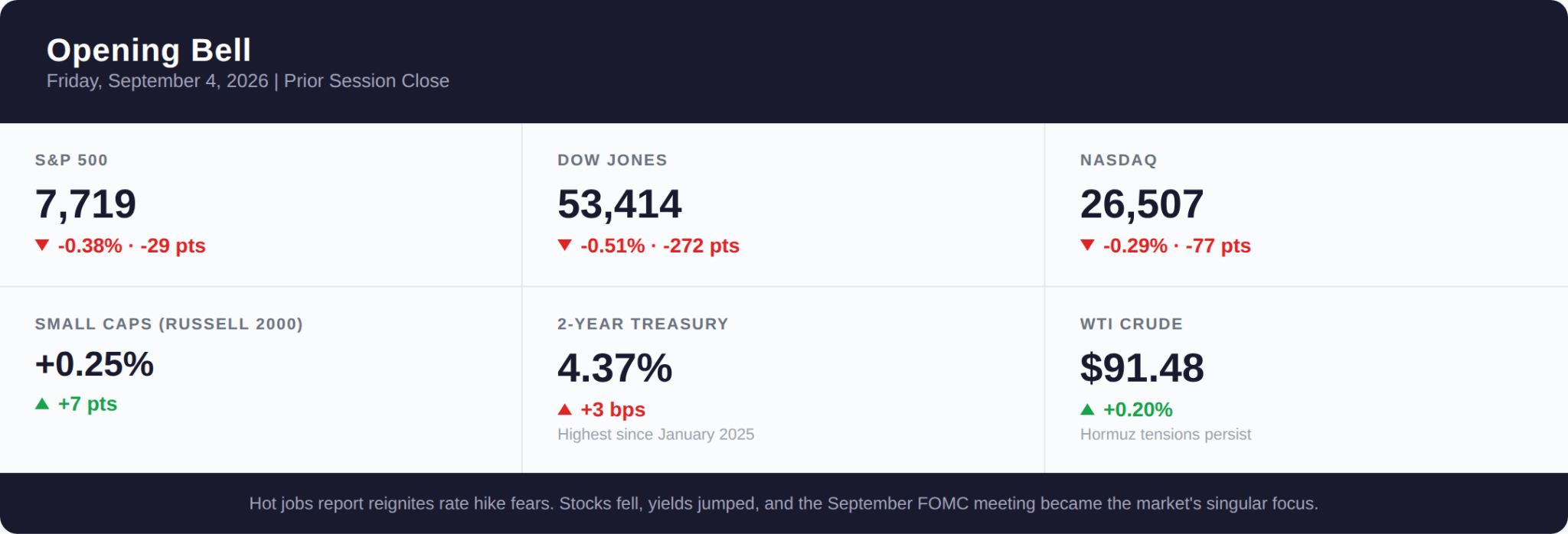
1. The jobs number that flipped the script. The U.S. economy added 162,000 nonfarm payrolls in August, nearly triple the 53,000 Wall Street expected. Unemployment held at 4.1%. Treasury yields jumped on the print, with the 2-year hitting its highest since January 2025, and fed funds futures now price a roughly 60-65% chance of a September rate hike. Good news is bad news again.
2. Cybercab hangover hits Tesla. Tesla (TSLA) dropped more than 6% on Friday, erasing all of Thursday's Cybercab launch gains. Analysts left the Austin event with more questions than answers on regulatory timelines, pricing, and production scalability. The stock ended the week roughly flat despite the launch spectacle.
3. Chipmakers staged a rally inside the selloff. While the broader market sold off on rate fears, semiconductor stocks moved sharply higher. Micron Technology (MU) rose 6.1%, Marvell Technology (MRVL) gained 7%, SanDisk (SNDK) soared 11.9%, and AMD (AMD) added 4.7%. Optimism around OpenAI's new GPT model and broader AI infrastructure demand gave the group a tailwind even as yields repriced higher.
3 Signals for Today
August CPI (Friday, September 11 at 8:30 AM ET) is the single most consequential data point before the September 15-16 FOMC meeting. July headline CPI sat at 3.4% year-over-year, and any surprise higher would all but lock in a rate hike.
August PPI (Thursday, September 10) hits before CPI and will set the tone for producer-side inflation expectations heading into Friday's consumer print.
Apple's iPhone event (Wednesday, September 9) will be the first major product launch under CEO John Ternus, who took over from Tim Cook on September 1. Markets will watch closely for signals on pricing power and AI integration.
Wall Street Owns 88% — Yet Most Investors Don’t Know the Name

Institutions already control 88% of this little-known company.
BlackRock owns roughly 32 million shares. Vanguard owns about 48 million.
And management authorized a 40-million-share buyback.
One man believes Wall Street may see something Main Street has missed.
And with that out of the way, let's get to today's big story: what actually happened to Nike.
The Sip
The Shelf You Give Up
In November 2021, Nike (NKE) was worth roughly $280 billion. The stock traded near $180 a share. It was the undisputed king of global sportswear. Every retail wall in every sporting goods store in every country had the Swoosh front and centre.
Today, Nike trades near $38. It has lost approximately 78% of its value from that peak and roughly $200 billion in market capitalisation. The stock sits at a 12-year low. Not because of a recession. Not because people stopped wearing sneakers. Because Nike systematically dismantled the one thing that made it nearly impossible to beat.
Its distribution.
The Spreadsheet Said Cut the Middleman
Starting around 2017, Nike began pulling products from its wholesale partners. The pitch was simple: go direct to the consumer. Own the customer relationship. Capture the data. Keep the margin. It sounded brilliant, and for a while, it was. Nike Direct revenue hit $18.7 billion by fiscal 2022, growing 14% on a reported basis.
But behind the growth numbers, something else was happening. Nike slashed its retail partner list, dropping accounts like Big 5 Sporting Goods, Dunham's Sports, Urban Outfitters, Dillard's, and Zappos. It exited Amazon entirely in 2019. Wholesale allocations to partners like Dick's Sporting Goods (DKS) and Foot Locker (FL) were cut by an average of 18% between 2020 and 2023.
Former CEO John Donahoe, who led the acceleration, later acknowledged that the brand's aggressive shift away from wholesale failed to sustain momentum. The digital channel became overly promotional, discounting product to move volume and eroding the premium perception Nike had spent decades building. Meanwhile, the product pipeline stalled. Innovation took a back seat to data analytics. Nike leaned on classic silhouettes like the Air Force 1 and Dunk until consumers grew tired of them.
The logic was clean on a spreadsheet. In reality, Nike had just vacated the most valuable real estate in retail: the shelf.
Shelf Space Abhors a Vacuum
When Nike walked out of those stores, the shelf space did not sit empty. Hoka, owned by Deckers Outdoor (DECK), was already gaining momentum in performance running. On Holding (ONON) had a technology story and a Roger Federer co-sign. New Balance was making its streetwear pivot. Brooks was quietly eating up the serious running market.
The timing could not have been worse. Nike pulled back from wholesale right as the post-pandemic running boom exploded. Consumers who might have grabbed a pair of Pegasus on impulse at Dick's were instead discovering Hoka Cliftons and On Cloudmonsters. Those brands did not just sit on the shelf. They built relationships with store staff, invested in local run club partnerships, and offered the kind of retail attention Nike had stopped providing.
"Nike's wholesale exodus created an unprecedented opportunity for hungry competitors. They didn't simply occupy Nike's abandoned shelf space. They revolutionised the relationships Nike had neglected."
Nike's global sports footwear market share fell to 22.9% in 2025, the third straight year of decline. Adidas climbed back to 12%. And the competitors who replaced Nike on those shelves had no intention of giving the space back.
They recommended Amazon, Microsoft, Nvidia, Palantir, and more…
Now, two financial legends have joined forces to show Americans how to protect and grow their wealth…
Because as they reveal, Artificial Intelligence is about to change everything during America’s New 1776 Moment.

The China Problem Made It Worse
While the DTC experiment was fraying in the West, Nike's most important international growth market was collapsing. Greater China revenue is down roughly 30% from its 2021 peak. In fiscal 2026 alone, the region fell 11% year-over-year to $5.9 billion, with eight consecutive quarters of sales declines.
The issue is structural. Chinese consumers have been trading toward domestic brands, and Nike's pricing (Air Force 1s north of $115, Jordan retros at $230) increasingly clashed with a consumer base tightening spending. Digital sales in Greater China dropped 29%.
So Nike was losing distribution in the West and losing consumers in the East. At the same time.
The Swoosh Lifer Returns
In October 2024, Nike brought back Elliott Hill. He had spent 32 years at the company before retiring in 2020, right before the DTC strategy accelerated. He was the definition of a Swoosh lifer, and the board bet that the institutional memory of how Nike actually worked would matter more than a fresh outside perspective.
Hill has been explicit about the fix: rebuild wholesale, reorganise around sports rather than consumer segments, put innovation back at the centre. In April, he bought $2 million worth of Nike shares at the stock's lowest point since 2014.
The early numbers show the diagnosis was right. North America wholesale grew 11% in recent quarters. Running has grown more than 20% for three consecutive quarters. Those are precisely the areas the DTC strategy damaged most.
But turnarounds cost money before they make money. In Q3 of fiscal 2026, revenue was roughly flat at $11.3 billion, and net income fell 35%. Nike Direct declined 4%. Greater China fell 7%.
Hill himself described the company as being in "cleanup mode". Analysts expect fiscal 2027 to be the earliest the turnaround shows up in headline numbers.
The Bigger Lesson on That Shelf
For the past decade, every consumer brand has been told the same thing: own the customer, cut out the middleman, go direct. Casper, Warby Parker, Peloton, and a hundred DTC startups built entire businesses on that premise. Nike, the largest sportswear company on the planet, tried it at scale. And what it proved is that distribution is not a cost centre to be optimised. It is a moat.
The shelf at Foot Locker, the rack at Dick's, the display at your local running store: those were not intermediaries eating Nike's margin. They were outposts of brand presence, discovery, and habit. When Nike abandoned them, it did not just lose revenue. It lost the ambient awareness that made "Just Do It" mean something in the first place.
Whether Hill can rebuild that presence before the stock slides further is the open question. But the $200 billion lesson is already clear. Sometimes the moat around a business is not a patent, a network effect, or a switching cost. Sometimes it is just being on the shelf when someone walks in looking for a pair of shoes.
Buffett, Gates and Bezos Quietly Dumping Stocks—Here's Why
The world's wealthiest individuals are making huge moves with their money.
Warren Buffett just liquidated billions of shares. Bill Gates sold 500,000 shares of Microsoft. Jeff Bezos filed to sell Amazon shares worth $4.8 billion.
What is going on? One multi-millionaire believes they are preparing for a catastrophic event. But not a crash, bank run, or recession. It’s something we haven’t seen in America for more than a century.
The MarketSipsTakeaway
Nike's collapse is the most expensive proof that distribution is strategy, not a logistics line item. Elliott Hill's turnaround is showing up in the categories that matter most, but the stock is priced for the pain of the rebuild, not the payoff. What to watch: fiscal Q1 2027 earnings in late September, which will be the first real test of whether wholesale partners are giving Nike back the shelf space it walked away from. If that number moves, the narrative shifts from "value trap" to "turnaround."
Until then, sip slowly!
The Market Sip Desk
Reply prompt: Would you buy Nike stock at a 12-year low, or is the Swoosh a brand that has permanently lost its edge?
THE MARKET WON’T WAIT FOR YOUR INBOX
Get the Alerts That Could Move Your Money
Breaking market news, actionable trade ideas, analyst signals, and major catalysts—sent straight to your phone when they matter.
Join FinancialMarkets.com FREE market alert list today.
SEND ME THE NEXT ALERT →(free)
Tickers: UI MS TSLA MU MRVL SNDK AMD GPT CPI ET FOMC PPI NKE DKS FL DECK ONON DTC WAIT YOUR INBOX SEND ALERT POLL