

For two decades, Netflix's entire identity was one word: unbundling. It ripped the channel package apart and sold you exactly what you wanted, when you wanted it. This week, it was reported Netflix is in talks to bring Peacock and Fox One inside its app. That is not a partnership. That is a bundle. The revolutionary just applied for a cable license.
3 Movers in 3 Minutes
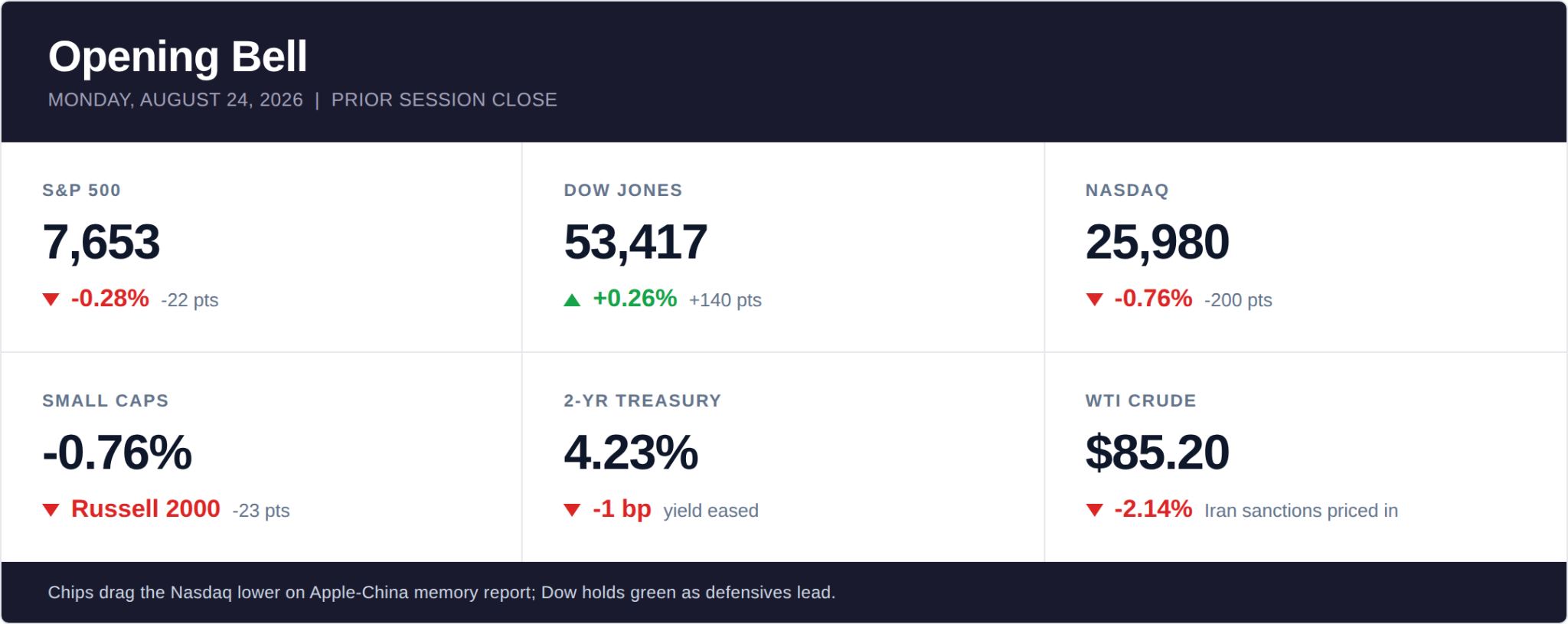
1. Alibaba raises $10.2B, but only from non-Americans. Alibaba Group Holding (BABA) priced a HK$80 billion share placement of 710 million new shares at HK$112 apiece, structured under Regulation S so U.S. persons cannot buy in. Every dollar of the roughly $10.2 billion raise goes to full-stack AI infrastructure. The framing matters: the world's third-largest AI capex program is now being funded entirely by capital pools American investors are legally excluded from touching.
2. Chip stocks got policy-shocked. SanDisk Corp (SNDK) fell 6.45% and Micron Technology (MU) dropped roughly 6% after reports surfaced that the Trump administration may permit Apple (AAPL) to source NAND from China's YMTC and DRAM from CXMT ahead of President Xi's expected September visit. SanDisk was still up 542% year-to-date at Monday's close. When a stock like that gives back seven percent in a session, it is not a fundamentals story. It is a positioning story.
3. Oil fell because sanctions arrived. WTI crude settled around $85.20, down 2.14%, even as Treasury Secretary Scott Bessent unveiled "Operation Economic Outcast," a sweeping set of new Iran sanctions targeting entities and individuals doing business with Tehran. The counterintuitive move tells you something: the market had already priced Iran out of global supply. Bessent's announcement was not new pressure. It was confirmation.
3 Signals for Today
CB Consumer Confidence, August. Last month's print came in at 90.8, missing consensus and continuing the downward trend. A second consecutive soft reading would sharpen the debate about consumer resilience heading into holiday season.
New Home Sales, July. Housing has been telegraphing weakness through builder sentiment for three months. A miss versus consensus reinforces the case that rate-sensitive corners of the economy are already in recession, even as headline GDP holds up.
Nvidia Q2 FY27 earnings, Wednesday AMC. Consensus is around $92 billion in revenue and $2.08 EPS for Nvidia Corp (NVDA). This is the single most important earnings release of the quarter for a market pushing on record highs.
Markets Don't Reprice When a Mine Pours Its First Gold. They Reprice the Day Uncertainty Dies.
On May 21, 2026, a federal bank voted unanimously to lend nearly $3 billion to build a gold mine on American soil.
Congress got 25 days notice. Nobody objected.
Final papers expected before year's end. The day that ink dries, three things happen at once:
- Funding risk goes to zero
- The U.S. government becomes financially fused to the project
- Wall Street re-rates the stock from speculative developer to federally backed strategic asset
One more detail. This company's filings carry a phrase I've never seen on a gold project: substantial support and partnership from the Department of War.
Why? The deposit carries a second metal alongside its gold — one China formally banned from export to the United States. The only domestic reserve of it in the country.
Gold for the dollar war. The banned metal for the shooting war. Both from the same pit.
The company is about one fiftieth the size of Newmont.
The Sip
The bundle Netflix killed
In 2007, cable was a bloated $80 monthly ransom for 200 channels you did not watch. Netflix's whole pitch was that you could pay $8 and watch what you wanted. That was the wedge. Then came a decade of the streaming wars, where every studio built its own walled garden and every household ended up subscribing to five services just to keep up with prestige TV. The bundle was dead. Long live the app.
Except somewhere between 2022 and now, the content spend went vertical. Subscriber growth flatlined. Password sharing crackdowns bought Netflix one good year. And the average household is once again paying north of $80 a month for television, only now the money is scattered across a dozen billing pages.
Which brings us to Monday, when it was reported that Netflix (NFLX) executives have been in early talks to bring Peacock and Fox One inside the Netflix app. Not a bundle deal. Not a co-marketing arrangement. Actual integration. It was later confirmed it was unclear whether Netflix would resell subscriptions the way Amazon does, or fold the content into its own library the way YouTube is doing with Peacock. Either way, the direction of travel is unmistakable.
Netflix, the company whose founding myth is bundle-slaying, is quietly building a bundle.
Why Netflix stopped believing its own story
Two years ago, in a shareholder letter, Netflix wrote that it was already the go-to destination for entertainment and did not need to partner with anyone. Co-CEO Greg Peters said it out loud in earnings calls. The line was the whole strategic identity.
Then came France. In June, Netflix quietly went live with TF1, the country's largest broadcaster, integrating five live channels and TF1+'s entire on-demand library directly into the Netflix interface. The results were, in industry terms, ridiculous. TF1+ hit 44 million monthly streamers in June and blew past its 18-month audience targets in three weeks.
The economics behind the pivot are worse than most people realize. Netflix's own content spend is punishing. Growth in domestic subscribers has been essentially zero for three years. Live sports rights, the one category with genuine engagement leverage, are being auctioned at eye-watering multiples. And a data point from research firm Antenna cuts to the heart of it: roughly one-third of new streaming subscriptions in the U.S. now come through third-party platforms rather than directly from the service itself, up 60% in three years. Amazon Prime, YouTube, Roku, and increasingly the phone OS itself are becoming the front door to television. And if you are not the front door, you are the tenant.
Netflix looked at that trend line and did the math. Being the front door pays better than being a channel.
The industry is quietly rebuilding what it broke
Look at the field right now. Amazon has sold rival subscriptions inside Prime Video for years. YouTube just announced Peacock will come inside the YouTube Premium tier. Comcast, of all companies, is selling a StreamSaver bundle of Peacock, Netflix, and Apple TV+ for $15 a month. Every incumbent is racing to become the one app the household opens first, because whoever wins that fight collects the discovery rent on everything else.
This is aggregation. It has a name. Cable used to do this.
Cable's actual innovation was never the wire. It was the aggregation and packaging: pay one bill, get a curated hierarchy, let a discovery engine (the on-screen guide) surface what you might want. Streaming shattered that model and spent a decade rediscovering, painfully, why it existed. Consumers do not actually want a hundred apps. They want a couch and a remote and something good on. The service that owns the interface owns the customer. And Netflix, with 300 million global members and the industry's best recommendation algorithm, is the natural successor to the cable operator, without the coaxial.
If this plays out, Peacock's future looks less like HBO circa 2020 and more like TNT circa 2005. A channel inside somebody else's package. Still profitable, still valuable, but no longer a destination in itself. Fox One, launched barely a year ago with sports and news, becomes carriage rather than a company. The middle tier of streaming, the services that never quite got to scale, become distribution problems, not content problems.
Free Stock Pick: The Company First in Line
for America’s New Super Fuel
The U.S. Army and Department of Energy are about to flip the switch on a revolutionary new fuel — and one obscure defense contractor has a five-year head start on every competitor.
This joint, high-priority initiative — ordered by President Trump — is called Project Janus.
And the first powerplant to run this new fuel is expected to go live beforeDecember 18, 2026…
When it does, this company’s name will be everywhere.
Full details — including the name and ticker symbol — are being revealed for free.

Click HERE to get the stock name, ticker, and the full Project Janus story for free.
The Long Angle
Every industry that experiences a great unbundling eventually gets rebundled. Music went from CDs to iTunes singles to Spotify's all-you-can-eat catalog. News went from newspapers to individual blogs to Substack aggregators. Television is now on the same arc. The interface changed. The delivery mechanism changed. But the underlying economic truth, that discovery and packaging are worth more than content itself, never changed.
Netflix's original insurgent value proposition was that you should not have to pay for channels you did not want. Its emerging one is that you should not have to remember which app you subscribed to. Both are compelling. Both are, at their core, about reducing the cognitive tax of watching television. And it turns out that reducing that tax is a much better business than producing the shows themselves.
The last decade of media disruption did not end with cable's death. It ended with cable's reincarnation, in a nicer sweater.
Trump Just Executed a Bloodless Coup.
Nobody Noticed.
For the first time ever, a sitting U.S. President has effectively seized control of the world's most powerful financial institution.
Trump didn't just stack the Fed board.
He's about to weaponize it.
And when it starts on September 16…
A handful of little-known stocks could deliver 1,000%+ gains in 12-24 months.
Discover details on 3 stocks that could explode imminently — and get one FREE ticker symbol today.
The MarketSipsTakeaway
Watch how much of your streaming budget flows through Netflix by 2028. If Peacock and Fox One end up inside the Netflix app, the next domino is smaller services accepting the same terms. That reshapes the equity story for every media company that is not one of the three or four winning gateways: Netflix, Amazon Prime, YouTube, and maybe Disney. For public-market investors, the tell will be gross margin trajectory. Aggregators earn distribution fees at software margins. Producers earn content margins. Guess which one Wall Street pays a higher multiple for.
Until then, sip slowly!
The Market Sip Desk
Reply prompt:In five years, will you open one app for television, or ten?
Tickers: UI MS BABA HK SNDK MU AAPL NAND YMTC DRAM CXMT WTI CB AMC EPS NVDA TV NFLX OS HBO TNT