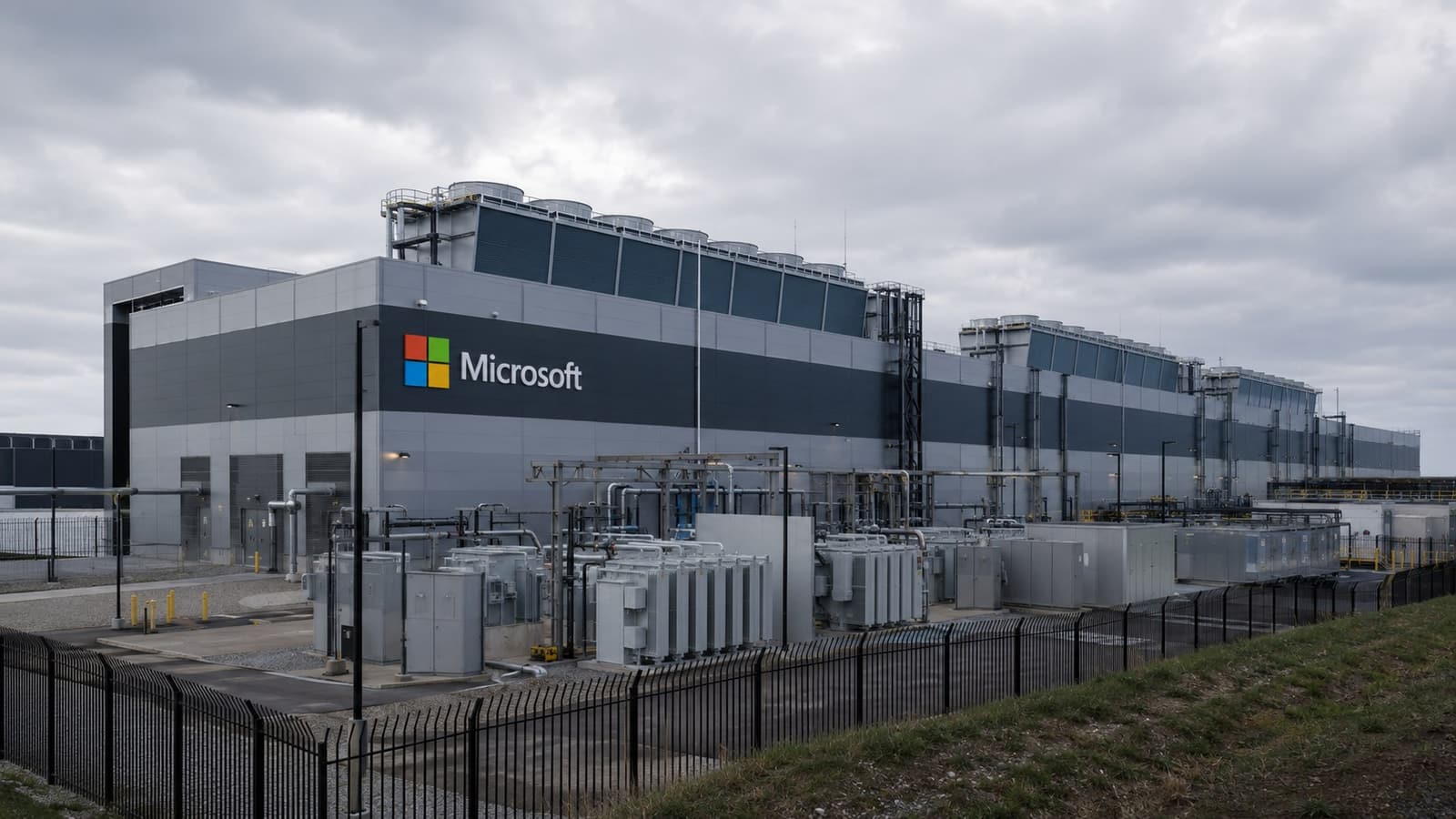
Microsoft delivered the Azure figure the market had been waiting for. Growth reached 43% in the June quarter, roughly three points above the company's own April guidance, and first-quarter guidance points to 45%. Shares rose about 3% after hours, against a stock down roughly 18% so far this year. The muted reaction points to a market weighing the cash cost of serving that demand.
The makeup of the beat
FactSet consensus called for $4.24 in earnings per share. Microsoft reported $4.74 on an adjusted basis, an apparent beat of nearly 12%.
The makeup of that figure matters. Microsoft disclosed that one-off items added $0.27 against its April guidance. The largest was a $3.2 billion gain on the company's investment in Anthropic. Lower-than-expected costs from a voluntary retirement program helped further, offset in part by severance and an impairment charge in Xbox. Adjusting for those items leaves a clean beat of roughly $0.23.
The adjusted figure needs a closer look as well. Microsoft's non-GAAP measure excludes only the impact of its OpenAI investment. The Anthropic gain stays inside the $4.74, and it is worth about $0.34 per share after tax. That gain is an unrealized mark on a private holding and carries no operating content. Amy Hood guided first-quarter other income and expense to about negative $100 million, which removes any expectation of a repeat.
Revenue followed a similar pattern. The $90.0 billion result cleared the top of Microsoft's April guidance by $2.2 billion. Hood named five sources for the upside. Two were operating in nature: efficiency gains across the Azure fleet that monetized within the quarter, and stronger GitHub Copilot consumption after the June shift to usage-based pricing. Three came from timing. Microsoft 365 commercial products grew 19% on in-period revenue recognition from long-duration contracts. On-premises server revenue held flat on renewal timing. Windows OEM beat expectations as channel partners built inventory ahead of rising component prices.
All three timing items are guided lower. Commercial products and server products decline in the mid single digits across fiscal 2027. Windows OEM and devices decline in the high teens.
Azure carried the quarter
Azure gives the strongest evidence in the release. The 43% result cleared the 39% to 40% constant-currency range Microsoft guided in April, and the 45% first-quarter guide implies further acceleration.
Hood tied the outperformance to fleet efficiency and faster deployment of new capacity. With demand still running ahead of supply, capacity that came online converted to revenue inside the quarter. That mechanism carries more signal than a single large contract.
Commercial bookings grew 18% excluding OpenAI, against 7% in the March quarter. Including OpenAI commitments, bookings grew 10%.
The backlog needs a closer read. Commercial remaining performance obligations reached $678 billion, up 84%. Excluding OpenAI, growth was 25%. The comparable figures a quarter earlier were 99% and 26%. The headline rate slowed while the underlying enterprise rate held flat. Microsoft did report that the entire sequential increase came from customers outside the frontier model companies, which improves the mix without lifting the growth rate of the core book.
Microsoft 365 Copilot passed 30 million paid seats, up from 20 million in March and 15 million in December. Seat economics remain less visible. Paid Microsoft 365 commercial seats grew only 6%, and Hood noted that additions skewed toward small business and frontline worker SKUs at lower average revenue per user. Premium bundle upgrades are doing more of the work than seat expansion.
Cash flow absorbed the cost
Operating cash flow rose 30% to $55.4 billion. Free cash flow fell 23% to $19.6 billion. Across the full fiscal year, net income rose 31% while free cash flow declined roughly 6% to $67 billion.
Capital expenditures reached $41 billion in the quarter, more than 70% above the prior year. Guidance calls for over $50 billion in the September quarter. Microsoft gave no full-year dollar figure, indicating only that spending will grow.
Two accounting changes shape the reported picture. The company cut its stated calendar 2026 capital expenditure figure from $190 billion to $175 billion, while Hood confirmed that underlying investment plans were unchanged. The reduction reflects a shift of certain data center leases from finance to operating treatment, which moves them off the capex line. Microsoft also extended the estimated useful life of data centers and office buildings from 15 years to 25 years, with what Hood called a minimal benefit to fiscal 2027 operating income. Neither change extends the working life of the GPUs and CPUs inside those buildings.
The lease commitment carries more weight. Microsoft has signed $329.1 billion of data center leases that have not yet started, against $196.6 billion three months earlier. Terms run as long as 20 years. Owned infrastructure can be deferred, repurposed or sold. Signed leases carry obligations even if model efficiency improves or pricing falls.
One line in the outlook stands out for what it withholds. Hood said Microsoft expects to remain free cash flow positive in fiscal 2027. For a company that generated $67 billion in fiscal 2026, the threshold is low, and it was the only cash flow guidance offered.
Component prices reach the PC business
The component inflation driving Microsoft's capital budget is also lifting PC prices. Windows OEM and devices revenue is guided down in the low 20s for the September quarter and the high teens for the fiscal year. More Personal Computing revenue already fell 4%.
Management calls the pressure a market cycle. The driver looks more lasting. Memory and accelerator demand from AI infrastructure buildouts is structural, and part of that cost now lands on Microsoft's own device customers.
Nadella addressed the cycle risk directly. Responding to a question from Bernstein's Mark Moerdler on oversupply and component pricing, he referenced 1873, the year a railroad construction boom collapsed, and added that the task is to “run an efficient railroad.” Three of the six analyst questions on the call concerned cost, pricing or return on capital.
The burden of proof
The quarter settled the demand question. Capacity converts to revenue quickly, commitments are broadening beyond the frontier labs, and Copilot adoption is scaling across large enterprises.
What stays open sits below operating income. Microsoft has to show that roughly $175 billion of annual investment, alongside $329 billion in leases already signed, produces free cash flow that expands rather than contracts. Fiscal 2027 guidance leaves that unanswered: operating margins decline by less than a point, capital expenditures rise again, and free cash flow is committed only to staying positive.
A stock down 18% year to date and a 3% move on a quarter of this quality point the same way. The market has accepted the demand case. The return on capital behind it remains the open position.