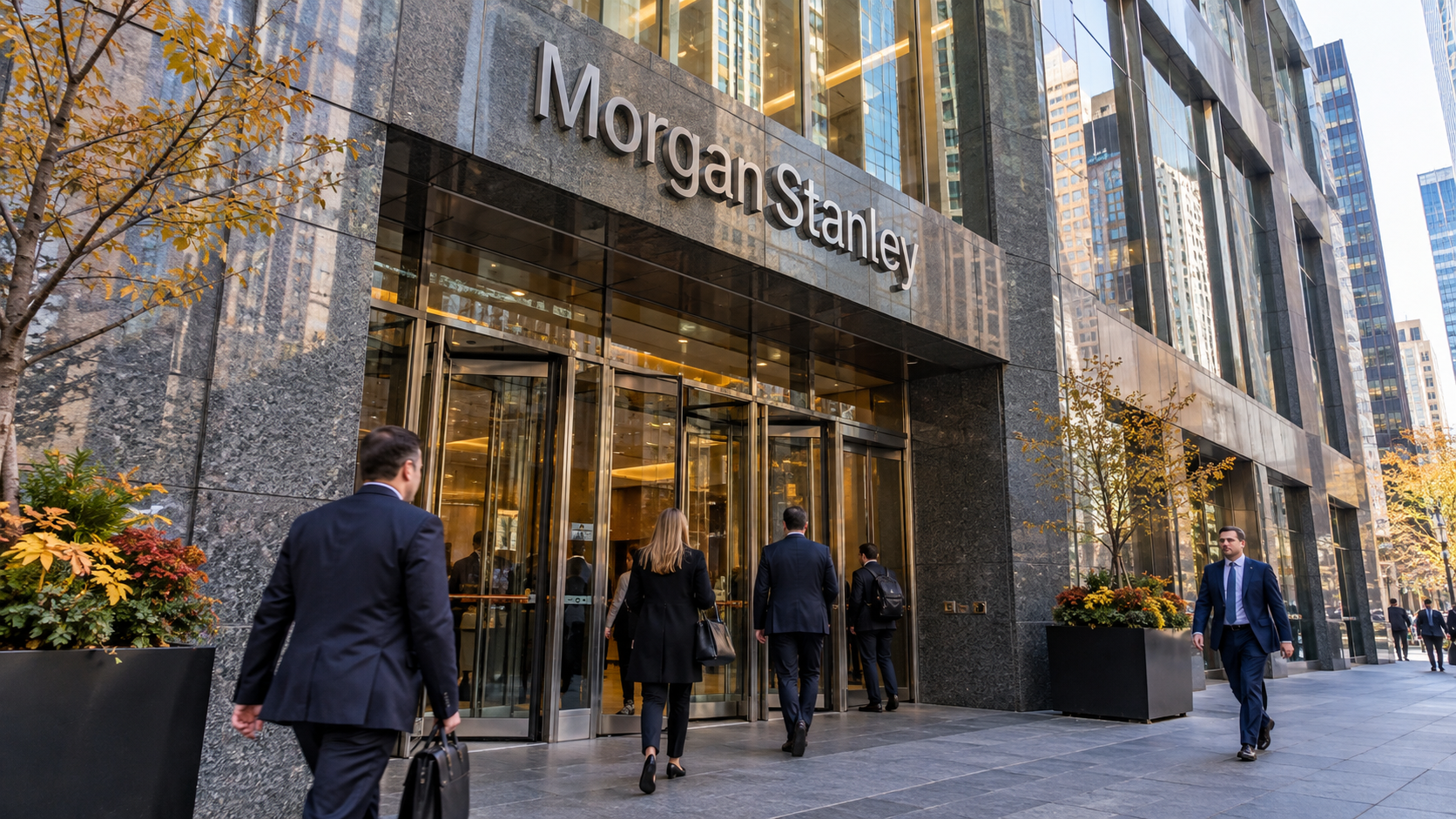
Earnings of $3.03 a share topped the $2.91 LSEG consensus, equities trading revenue beat by more than $900 million and wealth management posted record revenue. The stock fell at the open and was down nearly 4% by early afternoon.
Morgan Stanley delivered the kind of quarter that usually lifts a stock. Its shares went the other way, and the composition of the quarter offers one possible reason.
The bank earned $4.91 billion in the third quarter, up 6% from a year earlier, or $3.03 a share, up 8% and above the $2.91 analysts expected, according to LSEG. Revenue rose 12% to $20.34 billion, against forecasts of $19.95 billion.
The shares opened 2.8% lower at $181.34. By about 1:45 p.m. Eastern they were down about 3.9% at $179.39.
Trading did the heavy lifting
Equities trading generated $5.8 billion in revenue, more than $900 million above the StreetAccount estimate. The institutional securities division, which houses trading and investment banking, brought in $10.03 billion.
Wealth management posted record revenue of $9.07 billion. Net new assets reached $232 billion, and fee-based flows were $80 billion. Total client assets across wealth and investment management rose to $10.5 trillion. The bank's common equity tier 1 ratio stood at 14.9%.
The composition question
The bank said just over half of the $232 billion in net new assets was associated with IPO-related flows. That is a sign of a strong franchise, since founders and employees who gain liquidity in a listing can bring those assets to the bank that advised on it. It is also a sign that a large share of the quarter's asset growth depends on the pace of new listings, which can slow sharply when markets turn.
The $80 billion of fee-based flows, which generate recurring advisory fees, is the steadier part of the picture. The bank said those flows reflected strength in its adviser-led channel and included a new corporate retirement mandate.
A tough tape for banks
The stock did not trade in isolation. Bank of America fell about 6% after missing estimates and absorbing a $1.2 billion regulatory charge, and an index of large bank stocks sank to a four-month low during the session. A hotter inflation report pushed up expectations for Fed rate increases, and the broader market was down more than 1% by early afternoon. Citigroup fell 5.6% on Tuesday after its own results.
The sector backdrop is one possible explanation for the decline: investors may be setting a higher bar for financial stocks this earnings season. It does not explain all of it. Morgan Stanley's roughly 3.9% drop was well beyond the Financial Select Sector SPDR's decline of about 1.1% at the same time, which leaves room for the reading that investors discounted the quality of the quarter's strongest lines.
Market implications
The bullish reading is that Morgan Stanley is gaining share in both trading and wealth at the same time, with a capital ratio that leaves room for buybacks. The cautious reading is that the quarter's two standout lines, equities trading and IPO-linked asset gathering, are among the most market-dependent businesses a bank runs, and both could weaken if the selloff continues.
What to watch
Net new asset figures in the fourth quarter, which will show how much of the inflow pace survives without the IPO calendar, and how equity trading volumes hold up through the rest of October.