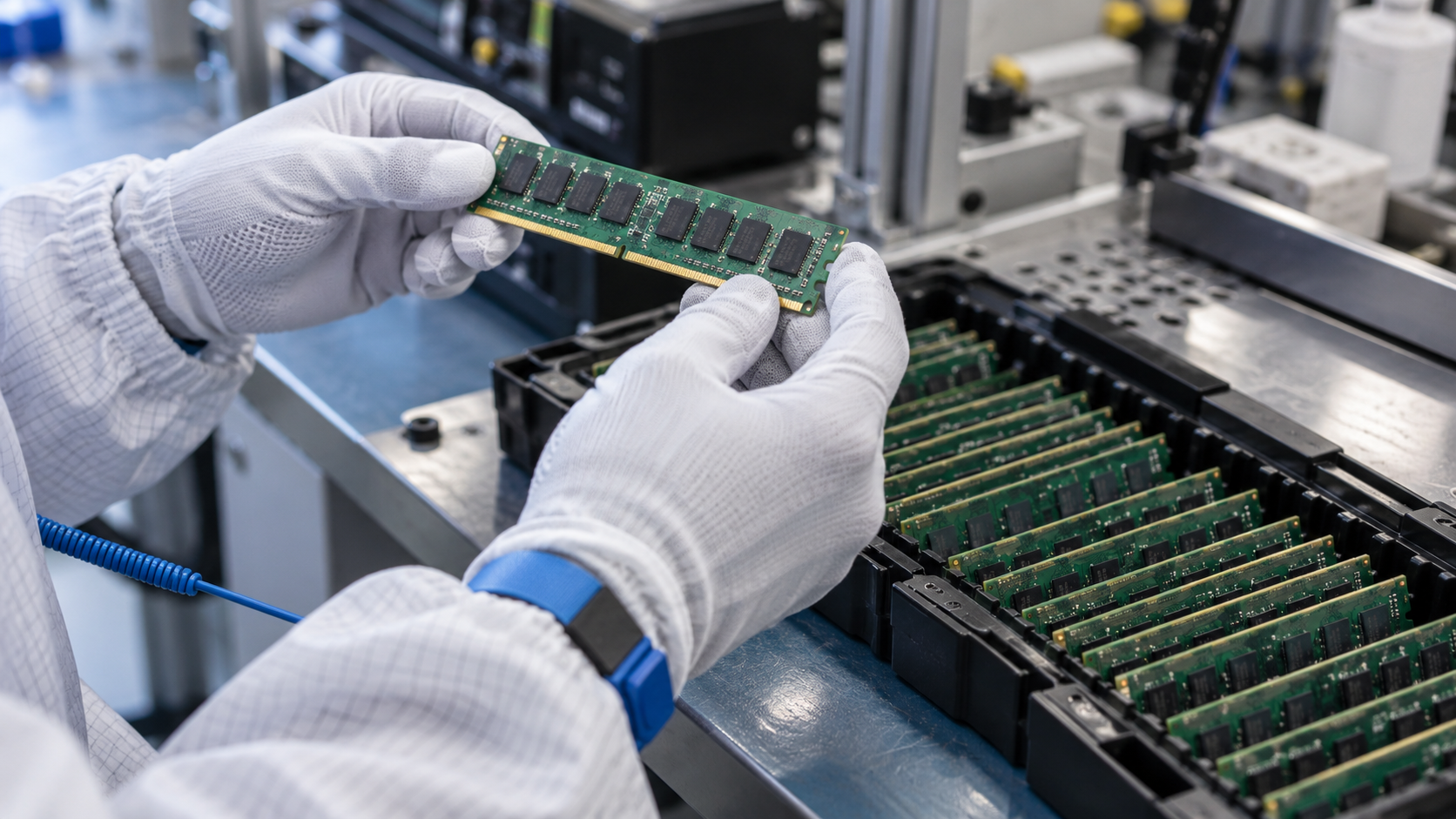
Micron is down about 9% in two sessions, and Western Digital, Seagate and SanDisk also slid. Nvidia, AMD and Broadcom edged higher. Elon Musk said China can out-scale rivals in most products but that advanced memory "will be harder to solve."
The selloff in chip stocks reached its second U.S. session on Tuesday with a narrower target. Memory makers fell hard. The chip designers at the center of AI spending did not.
Micron Technology was down 5.35% at $936.10 at about 1:45 p.m. Eastern, after losing 3.88% on Monday. That puts the two-day decline at about 9%. SanDisk fell about 2.8%, and Western Digital and Seagate also fell. SK Hynix's Nasdaq-listed ADRs fell about 4%.
Nvidia rose 0.34%, AMD 0.45% and Broadcom 0.40%. Taiwan Semiconductor Manufacturing's U.S. shares slipped 0.32%.
The iShares Semiconductor ETF fell about 1.1%, on track for a sixth straight decline, its longest losing streak since May 2025.
What started it
The selling began Monday after ChangXin Memory Technologies, China's largest maker of DRAM chips, described progress on a denser memory design and said it plans to release a new product by year-end. It spread to Seoul overnight, where the Kospi fell 5.5%.
Elon Musk weighed in on X on Monday afternoon, before Micron's 3.9% decline was complete. Replying to an analyst who had questioned whether a design announcement means much before mass production, he said China tends to out-produce the rest of the world combined once it has mastered a product. The exceptions he named were the newest memory formats, including high-bandwidth memory and chips stacked on top of processors, which he said "will be harder to solve." After the close, Micron slipped another 1.4%.
The size of the challenger
By TrendForce's count, CXMT took in 9.5% of worldwide DRAM revenue in the April-to-June quarter, against 7.6% three months earlier. Samsung Electronics led with 39.4%, ahead of SK Hynix at 24.9% and Micron at 23.3%.
That is a challenger with less than a tenth of the market, but one that gained nearly 2 points in the second quarter alone. The three incumbents together hold nearly 88%.
Positioning
The selling fell on one of the market's most popular trades. Nearly half of the investors in Bank of America's monthly fund-manager poll, 45%, picked owning global chipmakers as the market's most crowded position. The runner-up drew 27%.
The broader index barely noticed. Broad indexes barely registered the chip losses, with gains in Apple and Meta keeping the S&P 500 within about a tenth of a percent of Monday's close.
Market implications
One reading is that CXMT changes the long-term price of memory. A Chinese supplier gaining share in DRAM threatens the pricing that has fueled record margins at Micron, SK Hynix and Samsung, and the most crowded trade in the market has the most room to unwind.
A second reading is that the threat is being priced ahead of evidence. CXMT has announced a design, not volume production, and Mr. Musk's own caveat points to high-bandwidth memory, the product most tied to AI servers, as the hardest to copy.
What to watch
ASML reports Wednesday and TSMC on Thursday, the next reads on chip demand. Any pricing data for DRAM contracts in the fourth quarter will show whether the competitive threat is reaching customers' invoices.