

Oil rose 3% overnight and Treasuries rallied anyway. The bond market is telling you which risk it fears more.
The AI trade added to the unease. Lam grew 54% and fell. IBM raised its cash outlook, then turned lower. Nasdaq 100 futures were down about 1.6% after 7 a.m.
Meta's quarter was strong. Its filing matters more: a new stock Meta can sell to raise capital, with no vote attached.
But before we get to that, let's take a quick look at the markets and the three moves that set up the day.
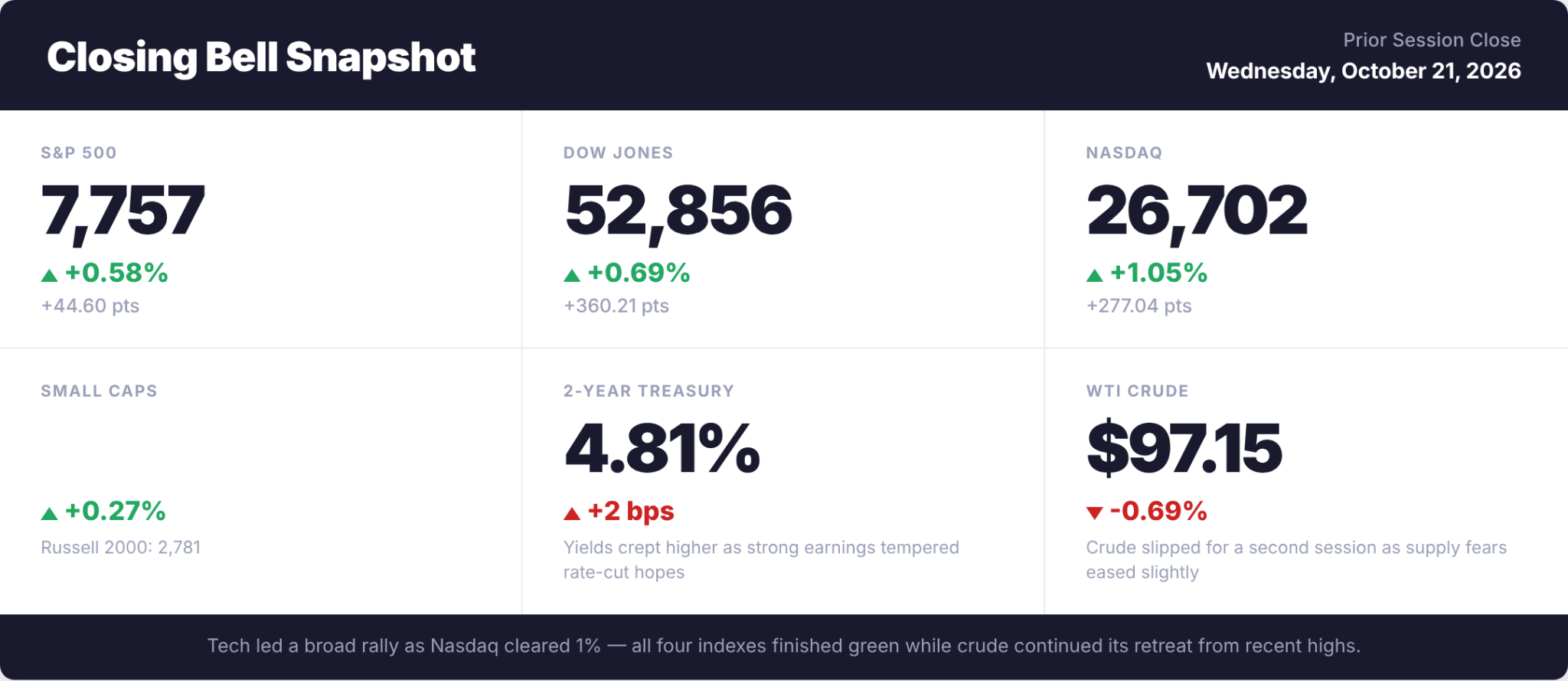
3 MOVERS IN 3 MINUTES
1. Oil rose 3%. Treasuries rallied anyway. Brent traded near $112 after a drone aimed at Saudi Aramco's Shaybah field was intercepted and falling debris killed two people. Washington ordered non-emergency U.S. staff out of Saudi Arabia. The Saudi Energy Ministry said operations were unaffected. The 10-year yield fell to near 5.09%, about 4 basis points below Wednesday's close, and gold slipped 1.1%.
In this war, oil spikes have usually lifted yields. This time bond buyers appeared to fear the hit to growth more than the hit to inflation.
2. Lam grew 54% and fell. IBM's CEO named the worry. Lam Research (LRCX) posted record revenue of $8.22 billion and guided December to $8.60 billion, plus or minus $400 million. The low end sits below the quarter it just reported. Shares were indicated down about 8%.
IBM (IBM) beat, raised its cash flow outlook and rose as much as 7% after hours. On the call, CEO Arvind Krishna said larger enterprises are "getting worried" some AI spending lacks a real return, calling that a tailwind for IBM. The stock later turned lower, indicated down about 5%.
The question is moving from AI spending to AI returns.
3. EQT signed for Qiagen. Most of the premium was already priced. An EQT-led group agreed to buy Qiagen (QGEN) for €46.50 a share in cash, about €10.8 billion including debt, with both boards recommending it. The price is 40.3% above the undisturbed July 8 close, but Frankfurt shares had closed at €42.80 Wednesday, so roughly 72% of that premium was priced before signing. The acceptance floor is a simple majority. Thermo Fisher's 2020 offer needed two-thirds and drew about 47%. New York shares sit about 3.5% below the offer at current exchange rates, a thin spread for a deal closing in mid-2027.
3 SIGNALS FOR TODAY
1. The bond market votes twice. Jobless claims land at 8:30 a.m., and the Treasury sells 5-year inflation-protected notes at 1 p.m. Soft demand for inflation protection would back the read that oil is now a growth threat. Strong demand would say pass-through fears are back.
2. Who set off the explosions near Hormuz. Polymarket's contract on the U.S.-Iran ceasefire holding through Oct. 24 fell from 93.5 cents to 72 cents after Iranian state media reported explosions near Sirik, then recovered to about 88.5 cents by early Thursday. A U.S. strike on Iranian territory settles it No. An Israeli TV report claimed one; Washington has not confirmed it. Official word either way settles what these contracts price.
3. Bitcoin tests its buyers. Spot bitcoin ETFs took in about $1.08 billion over three sessions, according to SoSoValue. Bitcoin still slid from near $84,850 to about $82,000, its 50-day average, tracking Nasdaq futures. Today's flows show whether fund buying is a floor or a lagging bid.
Now, to the filing behind Meta's beat.
Man Who Tabbed AMD at $2 a Share Just Made His Biggest Call Yet
On March 6, 2009, Matt McCall went on FOX Business and gave away nine stocks. One was AMD, trading around two dollars. It has since soared as much as 25,000%.
Now he's giving away the name and ticker behind his next big call.
For the time being, you can watch him lay it all out, free, right here.
The Sip
Meta's new stock comes with buyers in mind and no vote
Meta Platforms (META) had the kind of quarter that usually ends the conversation. Revenue rose 26% to $64.60 billion, ad prices rose 14%, and the midpoint of fourth-quarter guidance, $73 billion to $76 billion, came in above estimates.
Then came the part with a January date. After a restated charter takes effect on Jan. 19, 2027, every shareholder receives one new Class C share per share owned. Class C will trade on Nasdaq with no vote. Meta expects Class A to trade as if it split two-for-one.
The stock jumped as much as 7.3% after hours, gave it back overnight and was indicated down about 1.6% after 7 a.m., in line with Nasdaq 100 futures.
The cash came up short
Free cash flow was negative $2.12 billion in the third quarter, against positive $10.63 billion a year earlier. Capital spending, including finance leases, reached $34.91 billion, and Meta raised the floor of its 2026 range to $135 billion, up to $145 billion.
That range implies roughly $49 billion to $59 billion of fourth-quarter spending. Meta generated $32.8 billion of operating cash in the third.
Meta bought back no Class A stock in the first nine months and raised $24.91 billion of long-term debt. The filing names the next option: Class C is partly for "future equity capital raises."
Why no vote
The filing gives two reasons. Non-voting shares let Meta raise equity from sovereign financial institutions under U.S. foreign-investment rules, and issue stock without diluting voting power.
That power is concentrated. Mark Zuckerberg held about 60.6% of the vote on Oct. 1. The change was approved by written consent of entities affiliated with Zuckerberg and Priscilla Chan holding about 56.1%, and no shareholder meeting will be held. A special committee of independent directors recommended the plan unanimously, and the filing notes Zuckerberg was not close to losing control.
Elon Musk Calling on Military 'Dark Energy' to Power AI

When it was put inside U.S. tanks, they moved almost silently and produced no smoke. Now, Elon Musk is using this strange technology to jump ahead in the AI race - and possibly change the course of history. Click here to see how this could ignite a $10 trillion boom for the stocks involved.
The founder's channel
Zuckerberg can sell 20% of the Class C shares he receives right away, which Meta says equals 10% of his economic stake, including to pay a potential tax under California's Proposition 40. The rest is released at 2.5% a quarter while he leads the company. Over that period, the filing says, he could sell up to half his economic stake without reducing his voting control.
Meta's special committee expects Class C to "likely trade at some level of discount" to Class A. Meta built in a one-for-one dividend so the new line starts liquid, and committed to use its best efforts to buy back at least as many Class C shares as Class A whenever it repurchases.
Once both trade, the gap becomes a daily price of control. Every Class C sale at a discount raises less per share of ownership given away.
Who pays for AI now
Wednesday gave two answers on who funds AI. Tesla (TSLA) cut its 2026 spending plan to about $20 billion from more than $25 billion. Meta raised its floor and built a route to equity investors who do not need a vote.
Watch the dividend record date, the first Class C offering's size and price against Class A, and any Form 4 showing founder sales.
Jim Rickards Predicts: Trump's Next Big Buy
This tiny $2 stock holds the exclusive rights to the largest gold reserve in the country.
And it has the potential to be the biggest fortune maker in Trump’s second term.
According to Jim Rickards...
Trump is about to take a direct stake in this $2 stock.
And if you’d like to learn how to stake your claim in this asset before President Trump and his administration make a move…
You need to act before November 3rd.
Click here to see Jim’s big prediction: “Trump’s Next Big Buy.”
The Market Sips Takeaway
Meta's quarter answered the demand question. Its filing answered the funding question, and the answer is new equity that carries no say.
- What would confirm the funding read: an early, sizable Class C offering or a placement with a sovereign investor.
- What would weaken it: free cash flow turning positive and buybacks resuming in both classes.
- Where it shows up next: the Class C discount once trading starts and other AI spenders' funding mix.
Meta just put a price on its shareholders' votes. Next year, the market will put a price on going without one.
UNTIL THEN, SIP SLOWLY!
The Market Sips Desk
Would you buy a Meta share with no vote? How big would the discount need to be? Hit reply.
Rates Just Reset. Who Feels It First?
On January 2, the 10-year Treasury yielded 4.19%. By September 30, it was 5.29%. Most of that move landed in a single quarter.
The bond market repriced and companies are starting to report it.
Some companies earn from higher rates. Some pay for them. And each one runs on a different clock.
We traced three of them, IBKR, WRB and FIS, in a new FREE Special Report:
Rates Just Reset. Who Feels It First?
Who earns it fast. Who earns it slowly. Who pays. One has already reported. The other two report next, and the report tells you the exact line to check.
We'll text the report straight to your phone.
Tickers: IBM